Deconstruction Analysis: The Wheel-Lock Mechanism as Avant-Garde Fashion DNA
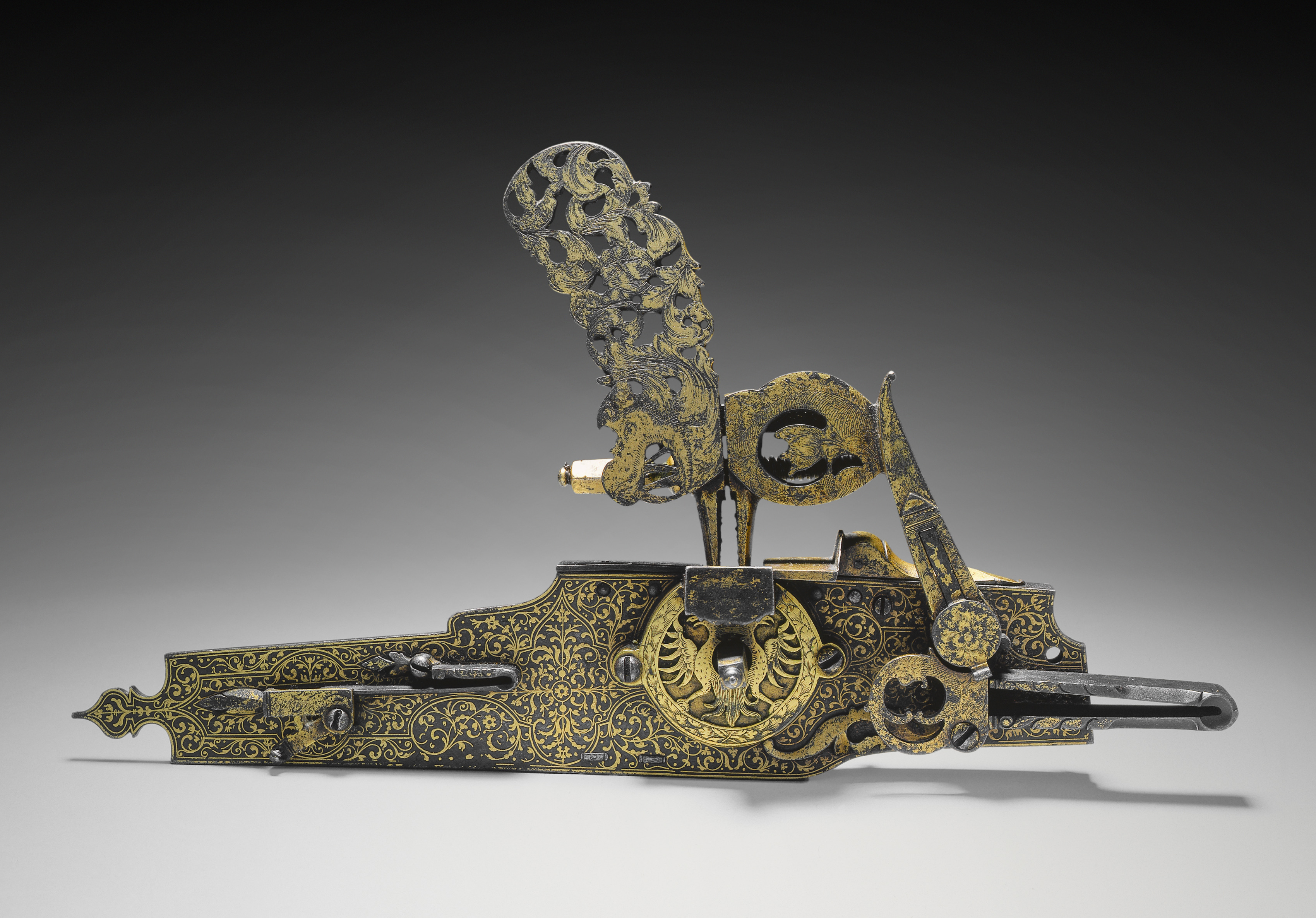
At Zoey Fashion Lab, the role of the Chief Fabric Deconstructionist is to transcend traditional material boundaries, extracting narrative, structural, and aesthetic essences from historical artifacts to forge new fashion languages. The subject of this analysis—a wheel-lock mechanism from an Austrian hunting rifle, circa late 16th to early 17th century—presents a profound opportunity. Crafted from steel, inlaid with a gold Habsburg eagle, and featuring pierced and chiseled detailing, this object is not merely a weapon but a microcosm of power, precision, and decorative excess. When viewed through the lens of avant-garde fashion, it becomes a "New DNA Strand"—a genetic blueprint for garments that challenge form, function, and symbolism. This report dissects the wheel-lock’s technical, ornamental, and historical components, translating them into actionable design principles for Zoey Fashion Lab’s next collection.
Technical Architecture: The Steel Skeleton and Mechanical Logic
The wheel-lock’s core is a marvel of mechanical engineering. Its steel body, forged for resilience, houses a rotating wheel, a serpentine (cock), and a spring-loaded mechanism that creates friction to ignite the powder. In fashion, this translates to a structural skeleton—a rigid, exoskeletal framework that supports and articulates movement. For Zoey Fashion Lab, this suggests garments built on articulated metal or polymer boning, not as hidden support but as exposed architectural elements. Think of a bodice with segmented steel plates that pivot at the shoulders and hips, mimicking the wheel-lock’s rotating action. The steel’s dark, oxidized patina offers a base palette: gunmetal grays, charcoal blacks, and weathered silvers. These materials could be layered with translucent fabrics—organza or technical mesh—to reveal the inner mechanics, creating a dialogue between concealment and revelation. The key is to treat the garment as a machine: every seam, zipper, and fastening should serve a kinetic purpose, echoing the wheel-lock’s functional precision.
Ornamental Code: The Gold Habsburg Eagle as Emblematic Inlay
The gold inlay of the Habsburg eagle on the steel surface is a masterclass in contrast and symbolism. The double-headed eagle, a heraldic emblem of imperial authority, is rendered in precious metal, elevating a tool of violence into an object of courtly art. In avant-garde fashion, this becomes a technique of embedded storytelling. Zoey Fashion Lab can adopt gold-thread embroidery, metallic appliqué, or laser-cut brass emblems that are literally "inlaid" into fabric—not sewn on top, but fused or bonded into the textile’s surface. For instance, a black wool coat could feature a gold foil eagle motif that is heat-pressed into the fibers, creating a subtle relief. Alternatively, the eagle’s double-headed form can be abstracted into a repeating pattern—mirrored profiles that suggest duality, power, and surveillance. This motif could appear on cuffs, collars, or as a central chest piece, referencing the rifle’s placement of the emblem. The gold should not dominate but rather punctuate, like a glint of light in a shadowy composition.
Pierced and Chiseled Detailing: Negative Space and Surface Texture
The pierced and chiseled work on the wheel-lock introduces a third dimension: negative space and tactile depth. Piercing involves cutting away metal to create openwork patterns, while chiseling carves relief textures. Together, they produce a surface that is both fragile and formidable. For fashion, this translates to cutwork, laser-perforated leathers, and embossed textures. Imagine a jacket where the shoulder panels are laser-cut with intricate, geometric openwork—inspired by the wheel-lock’s floral or scroll motifs—revealing a contrasting lining beneath. The chiseled effect can be achieved through embossing or pleating, creating ridges and valleys that catch light and shadow. This technique invites touch and visual exploration, turning the garment into a tactile landscape. The pierced areas also allow for ventilation and movement, merging aesthetic with function. Zoey Fashion Lab could experiment with multi-layered fabrics: a top layer of perforated leather over a second layer of sheer silk, creating an interplay of opacity and transparency.
Historical Context: The Hunting Rifle as Avant-Garde Provocation
The wheel-lock’s origin as a hunting rifle for the Austrian nobility imbues it with themes of privilege, violence, and ritual. In avant-garde fashion, these themes are not shied away from but deconstructed and recontextualized. The rifle was a tool of leisure for the elite, yet it also represented control over nature and life. Zoey Fashion Lab can channel this tension through designs that juxtapose luxury with menace. For example, a gown might feature a corset shaped like a rifle stock, with a skirt that cascades like a hunter’s cape, but constructed from deconstructed camouflage netting and gold-threaded organza. The Habsburg eagle becomes a symbol of old-world power, now reimagined as a critique of contemporary hierarchies. Accessories could include belt buckles shaped like wheel-lock wheels, or gloves with metal-tipped fingers that mimic the serpentine’s curve. The collection should challenge the wearer to consider the cost of beauty and the mechanics of control.
New DNA Strand: Translating Mechanism into Movement
The phrase "New DNA Strand" implies a fundamental restructuring of fashion’s genetic code. The wheel-lock’s mechanism—its cock, wheel, and spring—can be abstracted into kinetic garment systems. For instance, a dress might incorporate a rotating wheel at the hip, operated by a pull-cord, that changes the silhouette from narrow to flared. The spring-loaded action could inspire pop-up collars or expandable sleeves. These are not gimmicks but integrated responses to the object’s logic. The steel’s coldness can be balanced with warm, organic textures—wool, felt, or raw silk—creating a hybrid of industrial and natural. The gold inlay suggests a future where precious metals are woven into smart textiles, perhaps using conductive threads that light up when the wearer moves. The pierced and chiseled detailing becomes a code for surface manipulation: 3D-printed lace, molded silicone, or heat-shrunk fabrics that mimic carved metal.
Conclusion: A Blueprint for the Avant-Garde
The Austrian wheel-lock is not a relic but a catalyst. Its steel skeleton offers structural rigor; its gold eagle provides symbolic depth; its pierced and chiseled surface invites textural innovation. For Zoey Fashion Lab, this analysis yields a collection that is both armor and art, machine and myth. The garments will be heavy with history yet light with possibility—each piece a wearable mechanism that tells a story of power, precision, and transformation. By treating this artifact as a New DNA Strand, we do not replicate its form but re-engineer its essence, forging a fashion that is as intellectually rigorous as it is visually arresting. The wheel-lock’s legacy is now encoded in fabric, metal, and movement, ready to fire the imagination of the avant-garde.