Deconstructing the Officer's Plug Bayonette: An Avant-Garde Analysis for Zoey Fashion Lab
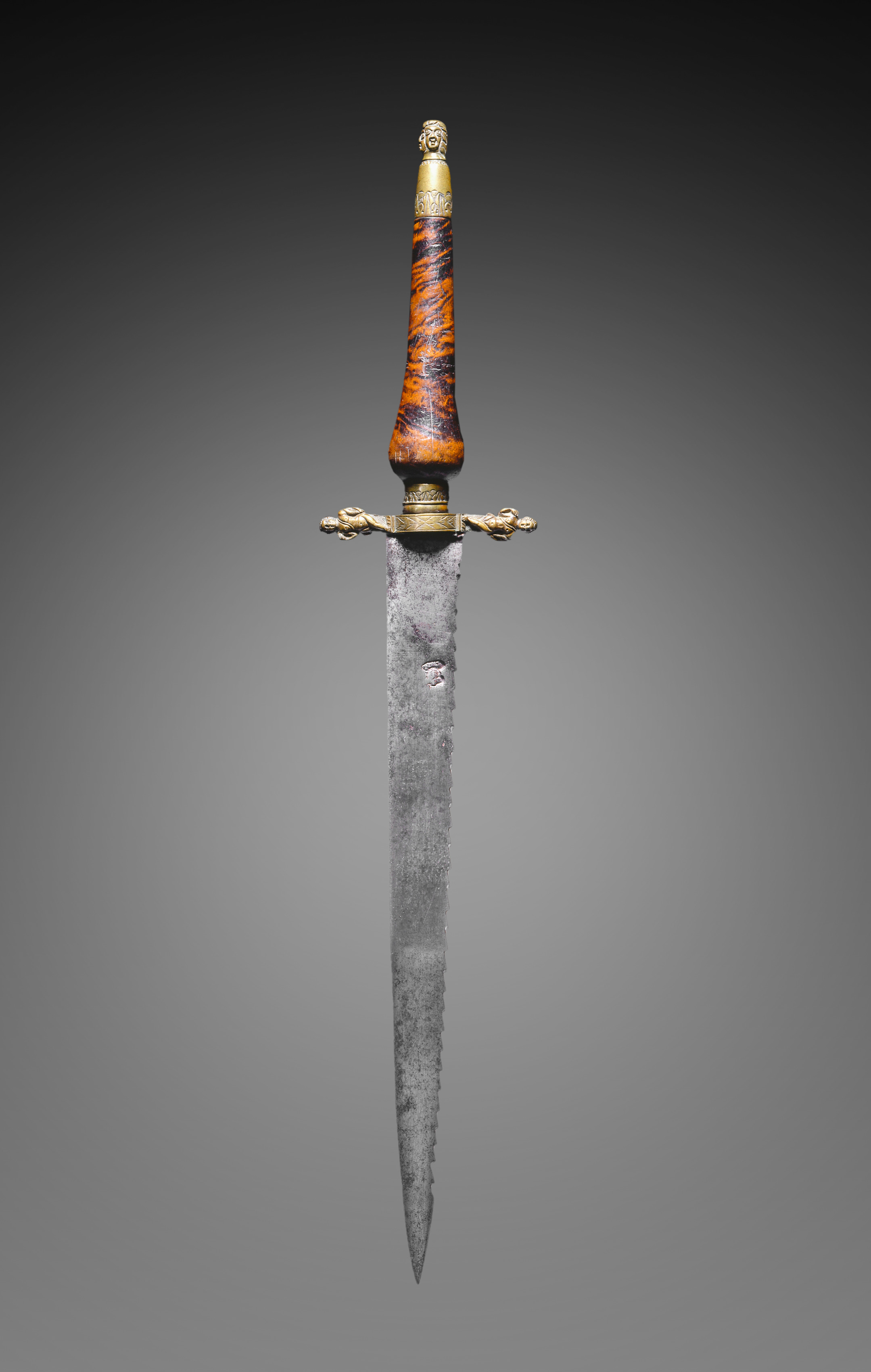
At Zoey Fashion Lab, we do not merely study historical artifacts; we disassemble them to extract their latent narratives, structural secrets, and emotional frequencies. The subject of this analysis—an English Officer's Plug Bayonette from the 17th century—presents a uniquely fertile ground for avant-garde deconstruction. Composed of a steel serrated blade, brass fittings, and a wooden handle, this object is not a weapon; it is a New DNA Strand—a genetic code for a future garment that exists at the intersection of violence, ceremony, and organic decay. Our task is to translate its physical and symbolic architecture into a wearable, living statement that challenges the very definition of fashion.
I. Materiality as a Lexicon: Steel, Brass, Wood
The bayonette's composite materials form a trinity of tension. The steel serrated blade is not a smooth, polished surface of classical weaponry. Its serrations are deliberate, aggressive, and rhythmic—a pattern of controlled chaos. In our avant-garde translation, this becomes a textile of laser-cut, rigid leather panels with jagged, interlocking edges. These panels would be arranged in a modular system, allowing the wearer to reconfigure the garment's silhouette from a sharp, defensive shoulder piece to a cascading, blade-like skirt. The serrations are not decorative; they are functional seams that can be disassembled, echoing the bayonette's original purpose of attachment and detachment.
The brass fittings—the crossguard, the pommel, the rivets—represent a moment of metallic, almost architectural, precision. Brass is a material of permanence, of polished command. For Zoey Fashion Lab, these elements are reimagined as 3D-printed, oxidized bronze joints that connect the leather panels. They are not hidden; they are exposed, exaggerated, and allowed to patina naturally over time. This patina is a record of the garment's life—a living archive of touch, air, and moisture. The brass also introduces a sonic dimension: a subtle, metallic chime when the wearer moves, a ghost of the bayonette's clatter in a 17th-century officer's belt.
The wooden handle is the most organic component, a material of grip, warmth, and eventual decay. It is the point of human contact, the interface between the officer's hand and the weapon's intent. In our design, wood is translated into biodegradable, mycelium-based composites that form the garment's core structure—a corset-like chassis that breathes and grows. This chassis is not rigid; it is flexible, responsive to body heat, and designed to crack and split over time, revealing an inner layer of raw silk and oxidized silver thread. The wood's grain becomes a printed pattern on the silk, a map of the original artifact's life.
II. The Serrated Edge: Rhythm and Rupture
The serrated blade is not merely a cutting tool; it is a rhythmic pattern of rupture. Each tooth is a point of potential violence, but also a point of connection. In the 17th century, this bayonette was plugged into a musket barrel, transforming a firearm into a spear. This act of transformation through insertion is a core conceptual driver for our avant-garde piece.
We propose a garment that features reversible, serrated edges along its hem, cuffs, and collar. These edges are constructed from thermoplastic polyurethane (TPU) that can be heated and molded into new shapes, allowing the wearer to "plug" the garment into itself or into other accessories. The serrations become a system of attachment—a modular, living architecture. A sleeve can be detached and worn as a neckpiece; a skirt panel can be folded and locked into a structural bustier. The garment is never complete; it is always in a state of becoming, a reflection of the bayonette's dual identity as both a separate tool and an integrated component.
III. The Officer's Plug: Ceremony and Violence
The term "Officer's Plug Bayonette" carries a heavy symbolic weight. It is an object of ceremony—a sign of rank, of command, of the structured violence of 17th-century warfare. The officer did not merely carry a weapon; he carried a symbol of his authority to order death. This duality—the elegant brass and wood housing a serrated blade—is the core tension we seek to embody.
In our avant-garde interpretation, the garment is a ceremonial uniform for a post-human officer. It is not a uniform of war, but of deconstruction. The brass fittings are replaced with hollow, resin-cast structures that contain small vials of synthetic blood and rust. These vials are visible through the translucent resin, a constant reminder of the bayonette's violent history. The wooden handle is reimagined as a carved, ebony collar that rises from the shoulders, its grain inlaid with gold leaf that catches the light, creating a halo of authority and decay.
The serrated blade becomes a train of leather and steel mesh that trails behind the wearer, its edges deliberately catching on surfaces, leaving a trail of scratched paint and frayed fabric. This is not a garment for preservation; it is a garment for active destruction. The wearer is both officer and casualty, the one who commands and the one who is torn.
IV. New DNA Strand: The Living Garment
The central reference—New DNA Strand—is the key to our design philosophy. We are not copying the bayonette; we are extracting its genetic code and splicing it into a new, living organism. The garment must be responsive, adaptive, and mortal.
We propose a smart textile layer embedded with shape-memory alloys that contract and expand in response to the wearer's body temperature and ambient humidity. When the wearer is still, the garment relaxes into a soft, almost organic state. When the wearer moves with intention—a sharp turn, a raised arm—the alloys stiffen, creating temporary, serrated edges that mimic the blade's aggressive stance. This is a garment that remembers its source but is not bound by it.
The brass and wood are not replicated; they are transubstantiated. The brass becomes a conductive thread woven into the fabric, capable of transmitting low-voltage electrical signals that power small, embedded LEDs. These LEDs pulse in a pattern derived from the bayonette's serration rhythm—a visual heartbeat. The wood is replaced by cellulose-based, 3D-printed lattice that forms the garment's skeleton, a structure that is both rigid and porous, allowing the skin to breathe and the fabric to move.
Finally, the garment is designed to decay gracefully. The mycelium components will break down after a set number of wear cycles, revealing a second, inner garment made of recycled silver and raw silk. This inner layer is the "DNA" of the original bayonette—the essential, unadorned truth of steel and wood, stripped of ceremony. The wearer is invited to witness the garment's transformation, to participate in its death and rebirth.
V. Conclusion: The Bayonette as a Living System
The English Officer's Plug Bayonette is not a relic; it is a blueprint for a new kind of fashion. At Zoey Fashion Lab, we have deconstructed its steel, brass, and wood into a living system of modularity, ritual, and decay. The serrated blade becomes a rhythmic edge of connection; the brass becomes a conductor of memory; the wood becomes a breathing skeleton. The garment is not a costume; it is a New DNA Strand—a code that writes itself anew with every wear, every movement, every tear. This is fashion as archaeology, as violence, as ceremony, and as a living, dying, and regenerating organism.