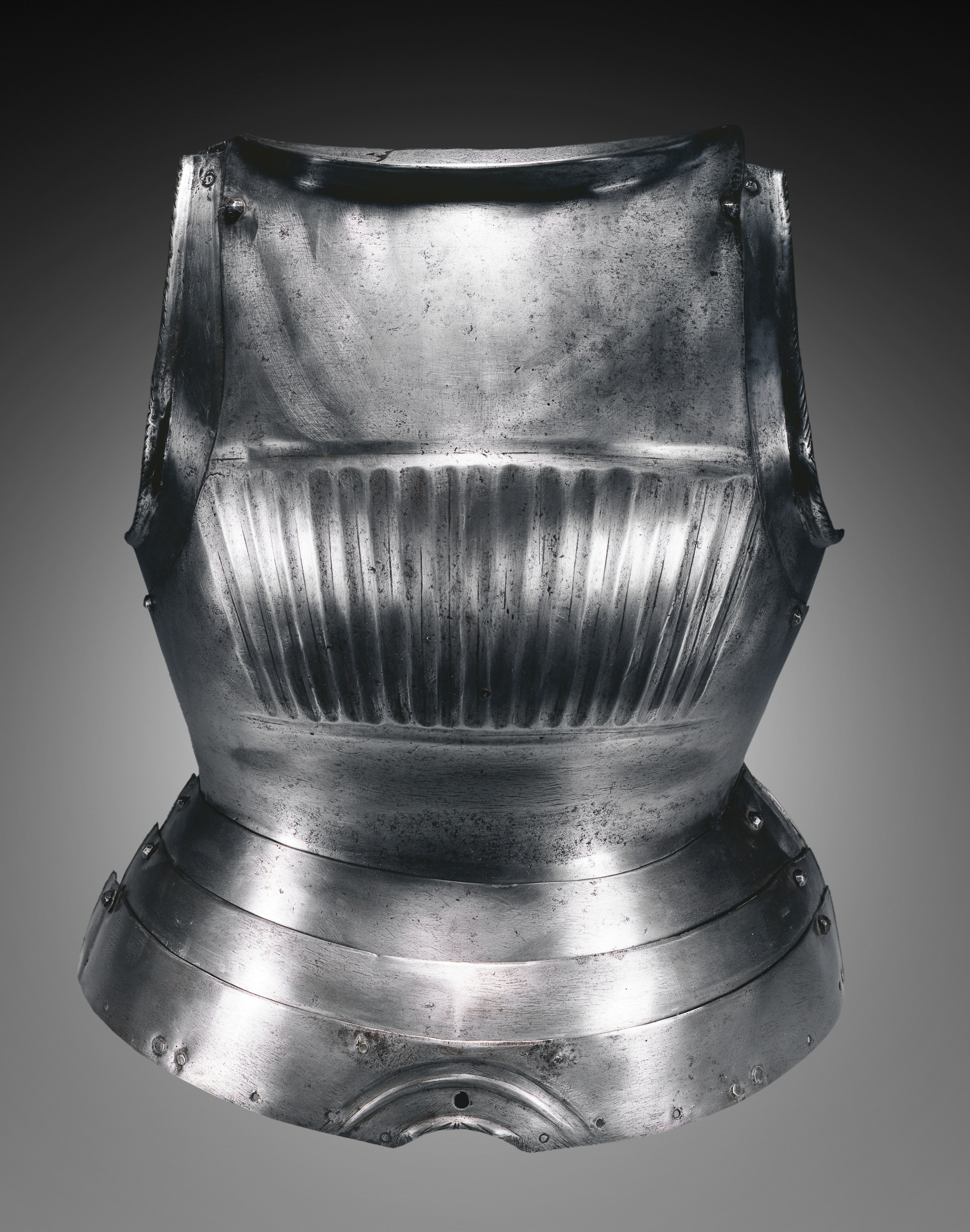
Deconstructing the Maximilian Breastplate: An Avant-Garde Analysis for Zoey Fashion Lab
In the annals of historical armor, few pieces command the visual and structural respect of the Maximilian-style breastplate. Originating from the early 16th century, likely in the metallurgical heart of Nuremberg, Germany, this artifact represents a zenith of both defensive technology and aesthetic ambition. For Zoey Fashion Lab, the task is not merely to catalog this object as a relic, but to deconstruct its DNA—to isolate the tensile strength of its steel, the rhythmic punctuation of its brass rivets, and the ergonomic logic of its form—and re-synthesize them into a new, avant-garde fashion language. This analysis treats the breastplate not as armor, but as a wearable architectural statement, a precursor to modern structural silhouettes, and a blueprint for a new strand of design DNA that challenges the boundaries between protection, ornament, and identity.
I. The Armor as a Structural Sculpture: From Fortress to Fashion
The Maximilian breastplate is distinguished by its characteristic fluting—parallel, radiating channels that traverse the surface from the neckline to the waist. Historically, these flutes served a dual purpose: they deflected blade strikes and increased the plate's rigidity without adding weight. For Zoey Fashion Lab, this fluting is not a decorative afterthought but a primary structural motif. In our avant-garde interpretation, we translate these channels into a series of rigid, yet flexible, pleats constructed from high-tensile synthetic polymers or layered, heat-pressed textiles. The breastplate’s form—a convex, anatomically contoured shell that simultaneously conceals and accentuates the torso—becomes a template for a new kind of garment: one that sculpts the body into a living, kinetic monument.
The brass rivets, originally used to secure leather straps and articulate the plates, are reimagined as functional jewelry. They become connective nodes in a modular system, allowing for interchangeable panels of fabric, metal mesh, or transparent acrylic. This transforms the breastplate from a static object into a dynamic, customizable garment. The rivet’s role as a fastener is elevated to a decorative and structural pivot point, echoing the avant-garde fascination with exposed construction and mechanical aesthetics.
II. The New DNA Strand: Materiality and Deconstruction
The reference to a “New DNA Strand” is critical. This breastplate, forged in the crucible of Nuremberg’s blacksmith guilds, represents a specific genetic code: the marriage of ferrous strength with human anatomy. For Zoey, we extract this genetic material and splice it with contemporary technologies. The steel is replaced by carbon-fiber-infused leather or laser-sintered metal alloys that mimic the weightlessness of fabric while retaining the armor’s protective silhouette. The brass rivets become 3D-printed titanium nodes, their surfaces etched with micro-patterns that refract light, creating a shimmering, almost digital effect.
Deconstruction, a hallmark of avant-garde fashion, is applied to the breastplate’s integrity. We do not preserve it as a whole; we fragment it. A single fluted panel becomes a shoulder yoke. The central ridge, or “tapul,” is extracted and reimagined as a spine-like corset busk. The lower fauld (the overlapping plates protecting the hips) is detached and reinterpreted as a series of articulated, asymmetrical skirt panels that move with the wearer, clattering like a metallic cascade. This process of disassembly and reassembly is the core of the new DNA strand: it honors the original structure while breaking its functional constraints, turning protection into performance.
III. Avant-Garde Silhouette: The Body as a Fortress of Identity
The Maximilian breastplate’s silhouette is inherently confrontational. It broadens the shoulders, narrows the waist, and creates a powerful, almost superhuman torso. In an avant-garde context, this is not about physical defense but about psychological armor. The garment becomes a statement of invulnerability, a shell that projects authority and mystery. Zoey Fashion Lab’s design language amplifies this by exaggerating the breastplate’s proportions: the shoulders are extended into sharp, wing-like epaulettes; the waist is cinched with a rigid, metal-boned corset that mimics the armor’s internal structure; the neckline is raised into a high, fluted collar that frames the face like a modern gorget.
The avant-garde twist lies in the juxtaposition of materials. We pair the cold, reflective steel with sheer, translucent organza that reveals the body beneath, creating a tension between concealment and exposure. The brass rivets are echoed in gold-leafed leather appliqués that trace the line of the original fluting, but are now rendered in a fluid, almost liquid form. The result is a garment that is simultaneously armored and vulnerable, historical and futuristic, rigid and flowing. This duality is the essence of the new DNA strand: it is a garment that does not merely clothe the body but redefines its spatial and psychological boundaries.
IV. Cultural and Symbolic Recontextualization
The Maximilian breastplate was a symbol of knighthood, wealth, and martial prowess in a hierarchical, war-torn society. In the avant-garde fashion of Zoey Fashion Lab, this symbolism is subverted and democratized. The armor is no longer a marker of nobility or violence but a canvas for individual expression and resistance. The fluting, once a functional element for deflecting swords, now becomes a visual rhythm that echoes the pulse of the wearer’s heartbeat, captured in the garment’s structure. The brass rivets, originally utilitarian, become cyborg-like interfaces, suggesting a fusion of human and machine, of flesh and metal.
This recontextualization aligns with avant-garde fashion’s tendency to critique and challenge societal norms. The breastplate, when worn in a contemporary setting, becomes a statement against vulnerability in a modern world—a declaration of strength in the face of digital surveillance, social pressure, or personal trauma. It is a wearable manifesto that says: “I am my own fortress.”
V. Conclusion: Forging the Future from the Past
The Maximilian breastplate from early 16th-century Nuremberg is far more than a historical artifact. It is a blueprint for structural innovation, a testament to the human desire to merge form with function, and a rich source of design DNA for Zoey Fashion Lab. By deconstructing its steel, its rivets, its fluting, and its silhouette, we extract a new genetic code—one that is avant-garde in spirit, architectural in form, and deeply human in its intent. The resulting garments are not replicas but mutations: they honor the past while propelling fashion into a future where armor is not worn for war, but for the battle of identity itself. This is the new strand of DNA—a fusion of history, technology, and art, forged in the fires of deconstruction and reborn on the runway as a living, breathing sculpture.