Deconstructing the Head: A Structuralist Manifesto for SS26
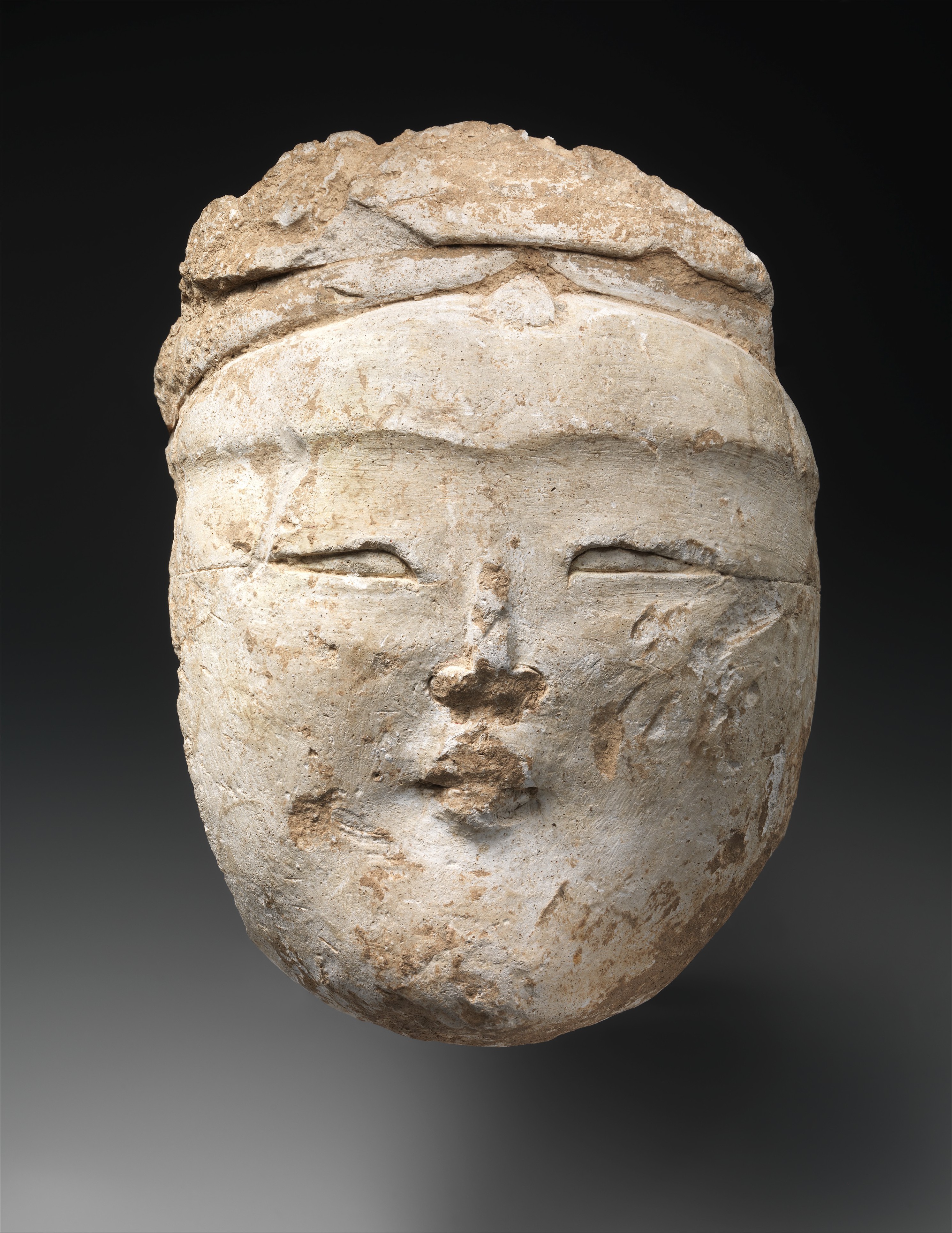
The intersection of archaeological artifact and futuristic garment architecture forms the core thesis of this SS26 analysis. We examine a singular object—the Head of a Central Asian Figure, rendered in gypsum plaster through modeled and carved techniques—not as a relic, but as a generative blueprint for deconstructive couture. This piece, originating from the nebulous “Global Frontier,” challenges the Western canon of portraiture and offers a radical reimagining of the human silhouette. For the avant-garde studio, this is not a study of the past; it is a materialist prophecy for the future of structural innovation.
The gypsum plaster head, with its raw, unglazed surface and deliberate asymmetry, embodies a post-industrial aesthetic that rejects polish in favor of process. The artist’s hand is visible in every carved incision, every modeled contour that suggests a face emerging from geological strata. This is not a representation of a specific individual but an archetype of cultural hybridity, a face that belongs to no single nation yet resonates with the tectonic shifts of global identity. For the SS26 collection, this object becomes a silhouette generator—a starting point for garments that do not merely drape the body but reconstruct it as a sculptural volume.
The Silhouette as Tectonic Plate
The first structural innovation derived from this head is the fractured silhouette. The gypsum’s carved lines—deep grooves that suggest cheekbones, brow ridges, and jawlines—are translated into garment architecture as negative-space panels. Imagine a coat whose shoulders are not padded but carved away, leaving a void that mirrors the excavated eye sockets of the head. The back of a jacket becomes a topographic map of the cranium, with raised ridges of bias-cut organza mimicking the carved gypsum. This is not a literal reproduction but a formal abstraction: the silhouette is destabilized, broken into geometric fragments that float away from the body, creating a silhouette that is simultaneously ancient and futuristic.
The materiality of gypsum—its chalky, porous texture—dictates a palette of matte, absorbent fabrics. We propose a revolutionary use of unbleached linen, raw silk noil, and recycled cotton canvas, all treated with a mineral wash to simulate the patina of age. Yet, the avant-garde imperative demands a counterpoint: iridescent metallic threads woven into the seams, catching light like traces of gold leaf on a plaster surface. The silhouette is not soft; it is armored, but with a fragile, geological beauty. The shoulders are broadened into trapezoidal planes, the waist cinched not by a belt but by a carved wooden corset that echoes the head’s carved details.
Volume and Void: The Negative Space of Identity
The head’s most provocative feature is its hollow interior—the gypsum is not solid but a shell, a vessel for absence. This concept of the void becomes the central structural device for SS26. Garments are designed with internal armatures that create negative volumes, spaces where the body does not touch the fabric. A dress for a runway presentation might feature a floating collar that rises six inches above the collarbone, supported by a hidden carbon-fiber frame, creating a halo of negative space around the neck. Sleeves are detached, hovering around the arm via magnetic fasteners, suggesting a disembodied presence that mirrors the head’s existential status.
The structural innovation extends to the modular construction of the garments. Inspired by the carved nature of the head, each piece is designed as a collection of removable, interchangeable components. A skirt is composed of overlapping gypsum-like panels of stiffened silk, each one carved with a distinct pattern—a cheekbone curve, a brow ridge line. These panels can be rearranged by the wearer, allowing for an infinite reconfiguration of silhouette. This is a direct response to the head’s origin as a “Global Frontier” artifact—identity is not fixed but fluid, assembled from fragments of different cultures and times.
Structural Innovation: The Carved Seam and the Plaster Stitch
Traditional garment construction relies on seams that join fabric. This collection proposes the carved seam, a technique borrowed from the gypsum’s incision. Seams are not hidden but exaggerated, left raw and then coated with a plaster-like resin that hardens into a three-dimensional ridge. This creates a structural topography on the garment’s surface, where every seam becomes a sculptural element. The effect is akin to a plaster cast of the body, but reversed—the garment becomes a negative mold of the wearer’s form.
Further, we introduce the plaster stitch: a hand-woven technique using threads of unbleached cotton and metallic fiber, mimicking the cracks and fissures of aged gypsum. These stitches are not functional but decorative, applied in patterns that echo the head’s carved lines. They serve as a cartography of time, mapping the passage of wear and tear onto the garment’s surface. For the avant-garde client, this is a luxury of process—the garment is not finished but perpetually evolving, much like the archaeological artifact that continues to be unearthed.
The Global Frontier as Couture Context
The head’s origin as a “Global Frontier” artifact is the most potent conceptual driver. This is not a piece from a single civilization but a hybrid object, born from the collision of trade routes, migrations, and cultural exchanges. For SS26, the collection is a nomadic wardrobe—garments that can be folded, packed, and transformed. A cape becomes a hood, a skirt becomes a shawl, all through a system of magnetic closures and adjustable straps. The silhouette is not static but adaptive, capable of shifting from a structured, monumental form to a fluid, draped one. This is a direct response to the fluidity of identity in a globalized world.
The futuristic silhouette emerges from this context: a garment that is both a sculpture and a tool for self-definition. The head’s carved features—the almond-shaped eyes, the high cheekbones—are translated into architectural cutouts on bodices and sleeves. A jacket might have a single, oversized cutout over the chest, shaped like the head’s left eye, revealing a flash of skin or a metallic underlayer. The shoulder line is exaggerated into a sweeping curve that mimics the head’s brow ridge, creating a silhouette that is both protective and aggressive.
Conclusion: The Head as Generative Matrix
The Head of a Central Asian Figure is not a passive artifact but an active agent in the creation of SS26’s avant-garde language. Its gypsum plaster materiality, its carved and modeled surfaces, and its rootless origin as a “Global Frontier” object all conspire to produce a collection that is radically deconstructive yet deeply reverent of craft. The silhouette is no longer a simple outline of the body; it is a tectonic landscape, a terrain of volume and void, of negative space and carved form. This is couture as archaeology, fashion as a future excavation of our own humanity. The head has spoken—now, the garment must listen.