Deconstructing the Vanity Case: A Study in Avant-Garde Contradiction
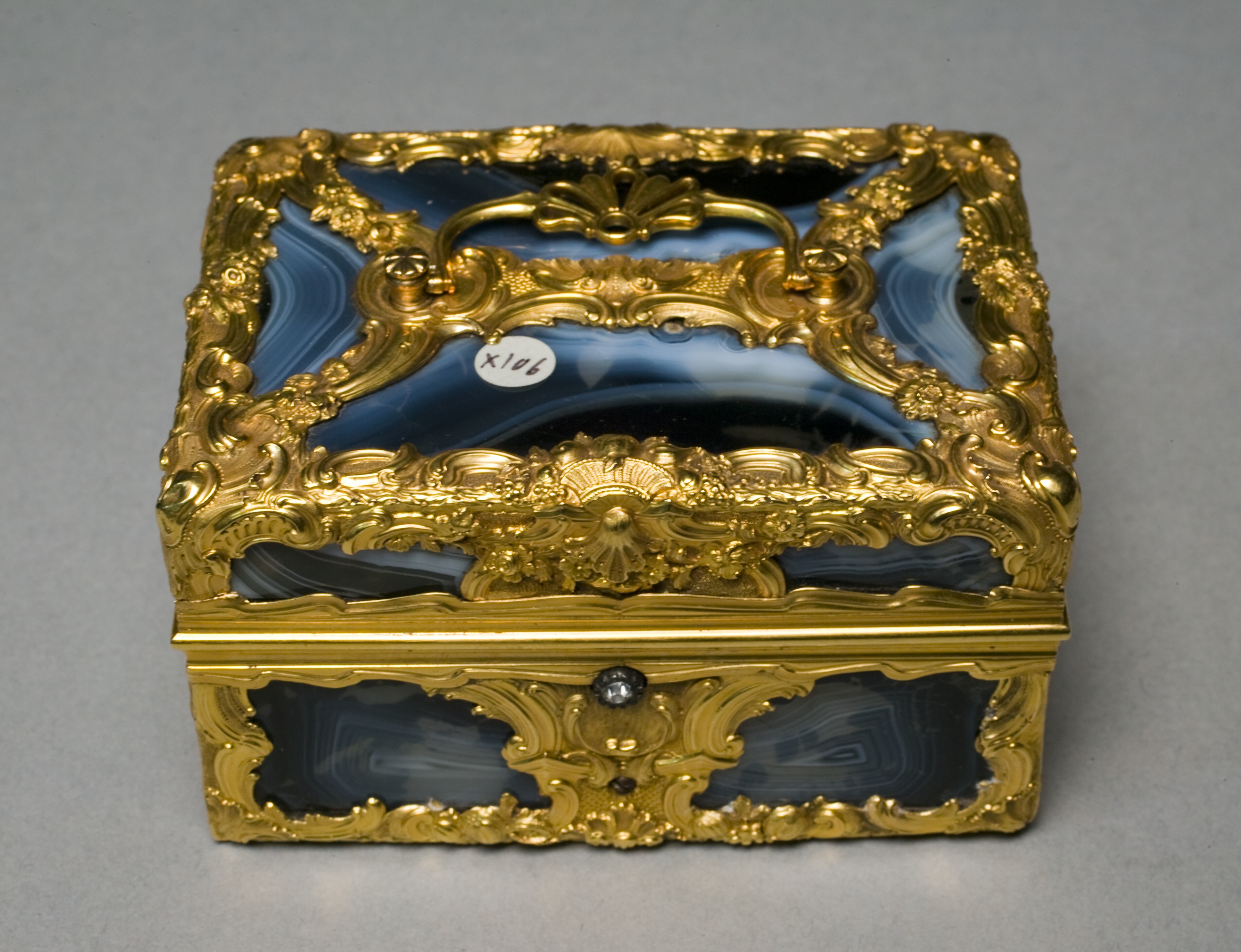
At Zoey Fashion Lab, we do not merely study historical artifacts; we dissect them. We seek the tension between their original purpose and their latent, disruptive potential. The subject of this analysis—a mid-18th century English Vanity Case, or Nécessaire—presents a particularly rich paradox. Crafted from gold and agate, its interior fitted with a mirror and gold-mounted implements, it is a masterpiece of rococo refinement. Yet, its very essence is one of concealment, performance, and the commodification of personal ritual. Our deconstruction, informed by the Archive Resonance of a fragmented mirror description—*一面是光洁银镜上以黄金镶嵌的纷繁棕叶纹,另一面是冰冷石棺板上以浮雕诉说的生命叙事* (one side a smooth silver mirror inlaid with intricate golden palm leaf patterns, the other a cold sarcophagus slab narrating life in relief)—reveals a blueprint for an avant-garde intervention that challenges the very nature of beauty, mortality, and the feminine gaze.
I. The Object as a Microcosm of Control
The 18th-century Nécessaire was not a tool of liberation but of regimented presentation. Its compact form—a portable theater of cosmetics, powders, and implements—was designed to facilitate the meticulous construction of a social self. The gold speaks of wealth and permanence, a material that resists decay. The agate, a banded chalcedony, introduces a geological time scale, a cold, stone-like permanence that contrasts sharply with the ephemeral nature of the powders and rouge it once housed. The mirror, the case’s functional heart, is the instrument of self-surveillance. It is the surface upon which the wearer’s identity is constantly adjusted, checked, and approved for public consumption.
Our Archive Resonance reframes this. The “smooth silver mirror inlaid with intricate golden palm leaf patterns” is the object’s public face—a celebration of life, ornament, and the natural world rendered in precious metal. But the other side, the “cold sarcophagus slab,” is the hidden truth. The vanity case, in its pristine, functional state, is a denial of mortality. It is a tool to arrest time, to preserve a fleeting ideal of youth and beauty. The avant-garde designer must recognize this: the case is a mausoleum for the living, a beautiful coffin for the rituals of the self.
II. Material Dissonance: Gold and Agate as Avant-Garde Signifiers
To approach this object from an avant-garde perspective, we must first dismantle its material hierarchy. Gold, in traditional luxury, signifies value, light, and divinity. Agate, with its layered bands, suggests depth, time, and the earth. In a deconstructionist reading, these materials become antagonistic. The gold’s reflective warmth is a lie; the agate’s cold, striated surface is the truth of the body’s eventual return to the mineral world.
Our proposed intervention would subvert the function of the gold. Instead of framing the mirror as a window to a perfected self, it becomes a cage. Imagine the gold-mounted implements—the tweezers, the spatulas, the tiny brushes—not as tools of enhancement, but as surgical instruments for excising the unwanted. The agate, traditionally the passive, supportive material, becomes the active, dominant surface. We would etch the palm leaf patterns not into the gold, but into the agate itself, using a technique of acid erosion that mimics decay. The “intricate golden palm leaf patterns” become ghostly traces, a memory of ornament slowly being consumed by the stone.
The mirror, the central element, is the most potent site for deconstruction. The Archive Resonance’s “smooth silver mirror” is a surface of pure, unblemished reflection. But an avant-garde reading demands we break this surface. We propose a fractured mirror, not shattered in a random accident, but precisely segmented into a grid of geometric shards, each one framed by a thin, blackened gold. This creates a fragmented, cubist self-portrait. The user cannot see a unified face; they see a mosaic of their own features, a visual reminder that identity is not singular but constructed from disparate, often contradictory, parts. The “cold sarcophagus slab” is no longer a metaphor; it is the literal surface of the mirror, reflecting a self that is already in pieces.
III. The Implements: From Ritual to Relic
The interior of the Nécessaire is a miniature armory of beauty. The gold-mounted implements—a powder puff, a lip brush, a comb, a small knife for cutting patches—are tools of transformation. In an avant-garde recontextualization, these become relics of a lost, violent ritual. The powder puff, once soft and downy, is replaced by a disc of polished, black obsidian, cold and unyielding. The lip brush is transformed into a tiny, gold-plated scalpel. The comb, once for arranging hair, becomes a comb of sharpened, surgical steel.
These are not tools for beautification; they are tools for excavation. They are designed to scrape away the superficial, to reveal the bone and the structure beneath. The case itself, when opened, should not present a neat, orderly array. Instead, the implements are arranged in a chaotic, almost anatomical display, as if they were the contents of a medical kit for performing an autopsy on the self. The velvet lining, traditionally a soft, protective bed, is replaced with a rigid, blackened steel grid, each implement held in place by a magnetic clasp. The act of opening the case becomes a confrontation, not a comfort.
IV. The Avant-Garde Manifesto: Beauty as a Mortal Condition
Zoey Fashion Lab’s analysis concludes that the mid-18th century Vanity Case is not an artifact of vanity, but of existential terror. Its beauty is a defense mechanism, a gilded shell against the knowledge of decay. The avant-garde designer must strip away this shell. The new Vanity Case—the Nécessaire de la Mort—is not for the living, but for the aware. It is a tool for those who refuse the consoling lie of eternal beauty.
The design language is one of controlled decay. The gold is not polished but oxidized to a deep, matte black, with only the faintest traces of its original luster. The agate is cracked and veined with gold leaf, a deliberate kintsugi that celebrates breakage rather than hiding it. The mirror is not a window, but a slab of polished, black hematite, reflecting only a distorted, shadowed silhouette. The implements are not tools of enhancement, but of revelation: a tiny hammer for cracking the shell of pretense, a set of fine needles for pricking the balloon of self-importance, a small, gold-plated chisel for carving away the false.
This is not a product for the market. It is a provocation, a wearable philosophical statement. It asks the wearer: Are you ready to see yourself as you truly are—a temporary arrangement of bone, flesh, and desire, housed in a beautiful, fragile case? The Vanity Case, deconstructed, becomes a memento mori for the modern age, a tool not for constructing a self, but for dismantling it. In the hands of Zoey Fashion Lab, the object of vanity is reborn as an instrument of brutal, beautiful truth. The Archive Resonance’s final whisper—the “life narrative told in relief on a cold sarcophagus slab”—is no longer a hidden side. It is the only side that matters.