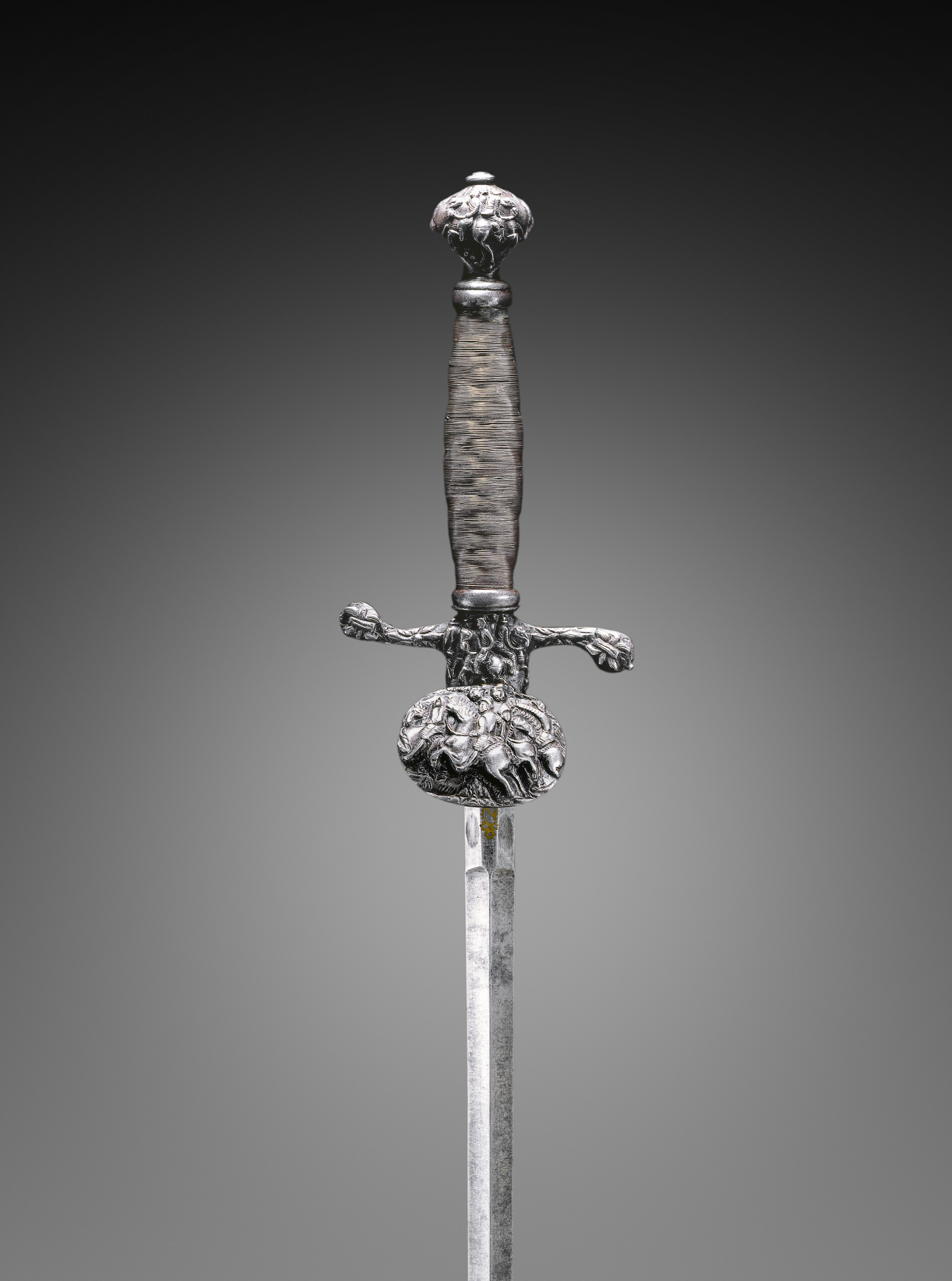
Deconstructing the Small Sword: An Avant-Garde Analysis for Zoey Fashion Lab
The Small Sword, a quintessential accessory of the 18th-century French aristocracy, is far more than a weapon. It is a statement of power, precision, and aesthetic refinement. For Zoey Fashion Lab, this artifact presents a profound opportunity for deconstruction and reinterpretation. As Chief Fabric Deconstructionist, I have analyzed the Small Sword not as a historical relic, but as a DNA strand of design—a genetic code of form, material, and social function that can be extracted, mutated, and woven into avant-garde fashion. This analysis will dissect the sword’s technical components, its cultural resonance, and the radical potential for its re-embodiment in a contemporary, forward-thinking collection.
I. The Technical Blueprint: Steel, Copper, and Wood
The Small Sword’s construction is a masterclass in contrasting materials, each with a specific role that speaks to both utility and ornament. The primary material, steel, is forged into the blade. In the 18th century, this steel was often high-carbon, capable of holding a razor-sharp edge while maintaining flexibility. For Zoey Fashion Lab, steel is not merely a metal; it is a metaphor for structure, tension, and the skeleton of a garment. Imagine a corset or a bodice where the steel is not hidden but exposed, forming a lattice that both supports and constrains the body. The blade’s shape—long, slender, and tapering to a needle point—suggests a line of infinite extension, a silhouette that could be translated into a dramatic, elongated sleeve or a train that trails the floor like a metallic whisper.
The copper alloy inlays on the hilt and guard are a critical element of visual and tactile contrast. Copper, with its warm, reddish-gold hue, stands against the cold, grey-blue of the steel. In the original sword, these inlays often took the form of intricate scrollwork or geometric patterns, showcasing the artisan’s skill. For our avant-garde reinterpretation, copper can be used as a conductive, almost organic element. Consider a jacket where copper wire is embroidered into the fabric, forming circuits that pulse with light or heat. Alternatively, copper alloy could be cast into small, modular tiles that are sewn onto a base garment, creating a surface that shifts and reflects light like a living mosaic. The inlays are not just decoration; they represent the intersection of rigidity and fluidity, a duality central to our design philosophy.
The wood grip with steel wire is perhaps the most tactile and human element of the sword. The wood, likely ebony or rosewood, offers a warm, organic contrast to the cold metal. The steel wire, tightly wound around the grip, provides texture and a secure hold. In fashion, this combination speaks to the relationship between the hand and the object, the body and the garment. We can deconstruct this by using wooden beads or carved wood panels as structural elements in a harness or a belt, while steel wire can be used to create a net-like overlay for a skirt or a top. The wire’s tension and the wood’s solidity create a dialogue between the natural and the manufactured, the soft and the hard. This is the essence of avant-garde design: to take a functional, historical object and extract its core principles—tension, contrast, and tactile engagement—and then rebuild them into something entirely new.
II. The Cultural DNA: Power, Precision, and Performance
The Small Sword was not worn in battle; it was worn at court, in salons, and in the streets of Paris. It was a symbol of social standing, a marker of the gentleman who could afford both a master smith and the finest tailoring. The sword was an extension of the body, a tool for dueling that required grace, speed, and precision. For Zoey Fashion Lab, this cultural resonance is a rich vein of inspiration. The sword’s DNA is encoded with ideas of controlled aggression, refined violence, and performative identity. An avant-garde collection can channel these themes not through literal weaponry, but through silhouettes that suggest tension and release, fabrics that mimic the gleam of steel, and structures that impose a deliberate posture on the wearer.
Consider the “New DNA Strand” referenced in the brief. This is not a biological term, but a design principle: we are extracting the genetic information of the Small Sword—its shape, its materials, its cultural meaning—and splicing it with modern, often contradictory elements. For example, the sword’s rigid, straight line can be broken and recombined with the fluidity of silk or the transparency of organza. The copper inlays can become digital circuits, connecting the wearer to a network of light and sound. The wood grip can be replaced with 3D-printed bioplastics, echoing the original’s organic feel while embracing a futuristic, sustainable ethos. This is the process of genetic mutation in design: we take the original code and introduce errors, rearrangements, and new sequences to create a form that is both familiar and alien.
III. Avant-Garde Reinterpretation: From Object to Garment
How does this analysis translate into a concrete fashion collection? We begin with the silhouette. The Small Sword’s blade suggests a line that is both vertical and forward-reaching. This can be expressed in a series of garments that emphasize elongation: a coat with a single, asymmetrical lapel that extends into a sharp point; a dress with a train that tapers to a needle-like finish; or a pair of trousers with seams that converge at the ankle, mimicking the blade’s taper. The steel wire on the grip inspires a technique of wrapping and tension. Imagine a top where strips of leather or metal are wound around the torso, not unlike the wire on the sword’s handle, creating a structural exoskeleton that both reveals and conceals the body.
The copper alloy inlays are perhaps the most fertile ground for innovation. We can use copper as a conductive thread in smart textiles, allowing garments to change color or emit light in response to movement or touch. Alternatively, copper can be used as a print motif, with digital patterns that mimic the organic, flowing shapes of 18th-century ornamentation. These patterns can be applied to high-tech fabrics like neoprene or recycled polyester, creating a dialogue between historical craftsmanship and contemporary production. The wood grip can be reinterpreted as structural padding—for example, a shoulder pad carved from lightweight balsa wood, or a hip piece made from laminated wood veneers that follow the body’s curves. This brings the warmth and tactility of the original material into a new, wearable context.
Finally, the Small Sword’s overall aesthetic is one of restrained elegance with a sharp edge. For the avant-garde, this means rejecting the purely decorative in favor of the functional and the provocative. Each garment should contain a hidden tension—a zipper that pulls tight like a blade’s edge, a clasp that requires a specific gesture to open, or a fabric that stiffens when exposed to air. The collection should feel like a duel between the wearer and the garment, where the body is both constrained and empowered. The Small Sword is not a weapon of war; it is a weapon of style. Our reinterpretation must carry that same weight: it must be a tool for self-definition, a statement of precision, and a testament to the power of deconstruction.
In conclusion, the 18th-century French Small Sword is a rich, multi-layered design artifact. For Zoey Fashion Lab, it is not a costume piece but a blueprint for innovation. By deconstructing its technical components—steel, copper, wood, wire—and its cultural DNA of power and performance, we can create an avant-garde collection that is both a homage to history and a leap into the future. The result will be garments that are sharp, structural, and deeply resonant, proving that the most radical fashion often begins with a careful look at the past.