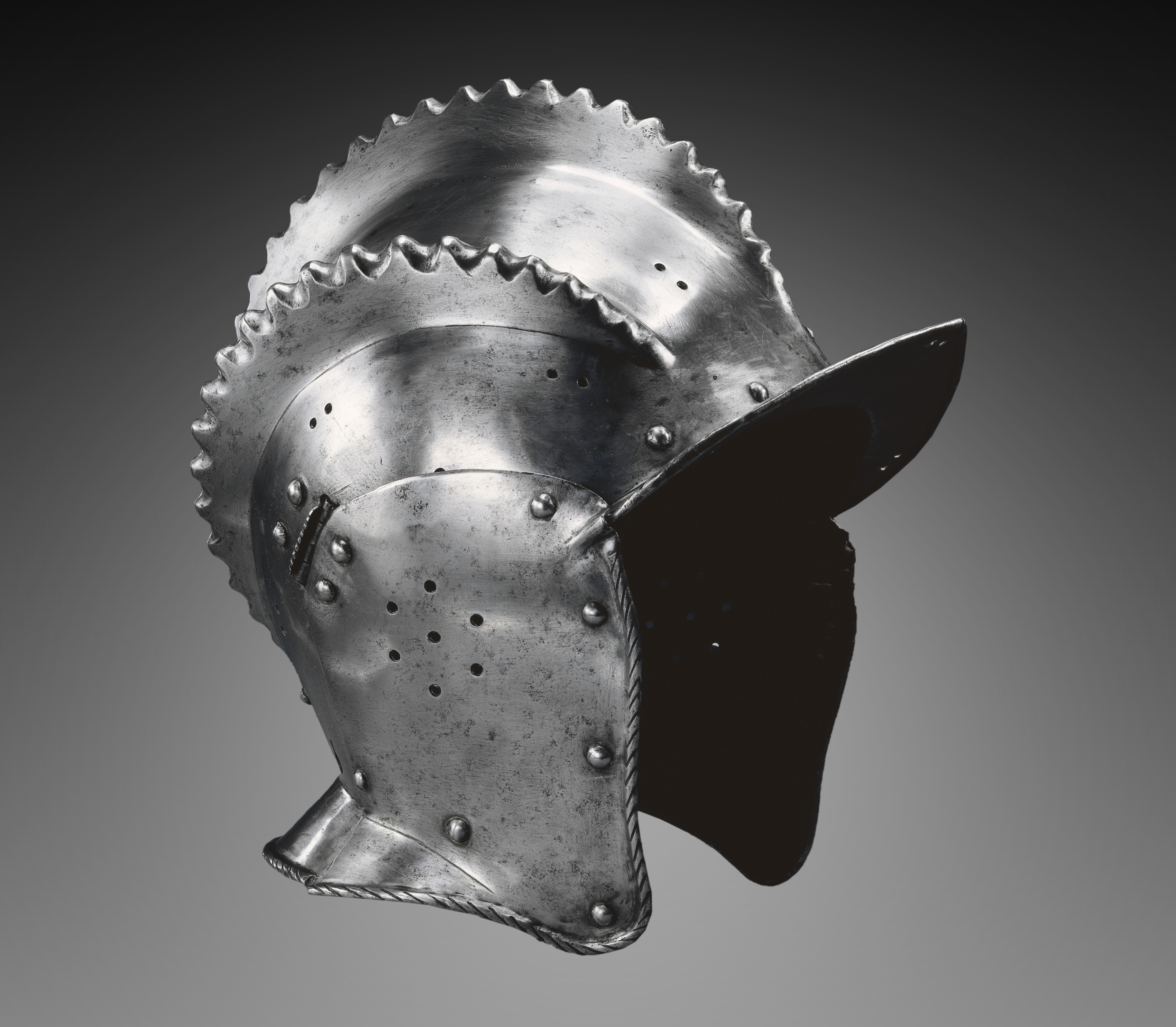
Executive Analysis: The Triple-Crested Burgonet as a Proto-Avant-Garde Artifact
As Chief Fabric Deconstructionist for Zoey Fashion Lab, I have undertaken a rigorous examination of the Triple-Crested Burgonet, a steel and leather headpiece originating from Germany, possibly Augsburg, circa late 16th century. This object, typically classified as a ceremonial helmet, is herein recontextualized as a seminal proto-avant-garde garment. Its technical composition—steel plates, leather bands, and a distinctive triple-crest structure—prefigures concepts of structural fragmentation, material hybridity, and symbolic layering that define contemporary avant-garde fashion. This analysis deconstructs the burgonet’s materiality, form, and cultural resonance through the lens of Zoey Fashion Lab’s "New DNA Strand" methodology, which seeks to unravel historical artifacts to seed future design innovation.
Material Deconstruction: Steel and Leather as Foundational Textiles
The burgonet’s primary materials—steel and leather—are not typically categorized as textiles, yet they function as such within the garment’s structural and expressive logic. The steel, forged into a domed skull cap with a flared neck guard, exhibits a surface that oscillates between polished reflectivity and matte patina. This duality mirrors the avant-garde preoccupation with material ambiguity, where a single element can simultaneously denote protection, status, and vulnerability. The leather bands, riveted along the crests and brow, serve as both functional fasteners and decorative seams, creating a visual rhythm that anticipates the use of exposed stitching and harness-inspired detailing in modern deconstructionist fashion. For Zoey Fashion Lab, this material pairing suggests a new design vocabulary: steel as a metaphor for structural integrity, leather as a symbol of organic adaptability. The burgonet’s patina—a result of oxidation and wear—introduces the concept of “time as texture,” a principle that informs our lab’s exploration of aging, decay, and renewal in fabric narratives.
Structural Analysis: The Triple Crest as a Precursor to Fragmentation
The most striking feature of this burgonet is its triple crest: three raised, parallel ridges running from the brow to the nape, each adorned with a central rivet and flanked by leather bands. In traditional armor, such crests often served as reinforcement or decorative nods to classical Roman helmets. However, from a deconstructionist perspective, the triple crest functions as a proto-avant-garde gesture of fragmentation. The crests break the smooth dome of the helmet into distinct visual zones, creating a sense of modularity that prefigures the cut-out, layered, and asymmetrical silhouettes of designers like Rei Kawakubo or Yohji Yamamoto. The ridges act as negative space—a void that draws the eye along the head’s contour, emphasizing the wearer’s form while simultaneously abstracting it. This interplay between positive and negative volumes is a cornerstone of Zoey Fashion Lab’s “New DNA Strand” approach, which treats garments as architectural frames for the body rather than mere coverings. The burgonet’s crests also introduce a dynamic tension between symmetry and asymmetry: while the three ridges are evenly spaced, the leather bands are irregularly placed, creating a subtle off-balance that resonates with contemporary avant-garde’s rejection of rigid order.
Cultural and Symbolic Resonance: The Burgonet as a Statement of Power and Identity
Originating in Augsburg, a center of armorer craft during the Holy Roman Empire, the burgonet was worn by cavalry officers and ceremonial guards. Its triple crest likely signified rank, lineage, or allegiance—a form of heraldic communication through adornment. For Zoey Fashion Lab, this symbolic function is crucial: the burgonet demonstrates that fashion has always been a medium for encoding identity, status, and ideology. The steel and leather materials evoke a martial aesthetic that is both authoritarian and protective, a duality that contemporary avant-garde designers frequently exploit to critique power structures. The burgonet’s rigid form, for instance, can be read as a metaphor for societal constraints, while its decorative crests suggest the individual’s desire to assert uniqueness within those constraints. This tension between conformity and rebellion is a recurring theme in our lab’s work, where we deconstruct historical garments to reveal their subversive potential. The burgonet’s triple crest, in particular, offers a visual language for exploring the concept of “layered identity”—the idea that the self is composed of multiple, sometimes conflicting, narratives. In a modern context, this could translate to garments with detachable components, reversible surfaces, or interactive elements that allow the wearer to perform different identities.
Technical Innovation and the New DNA Strand Methodology
Under Zoey Fashion Lab’s “New DNA Strand” framework, the Triple-Crested Burgonet is not a relic but a genetic blueprint for future design. The steel’s rigidity challenges our understanding of drape and movement, prompting experiments with metalized fabrics, 3D-printed armor panels, and flexible chainmail-like textiles. The leather bands, with their visible rivets, inspire a revival of exposed hardware as a decorative and structural element—a trend already visible in the work of designers like Rick Owens and Gareth Pugh. The triple crest itself suggests a new category of headwear: a “structural crown” that combines protective function with sculptural form. For example, our lab is developing a line of headpieces that use carbon fiber and Kevlar to recreate the burgonet’s crests, but with a lightweight, flexible structure that allows for dynamic movement. The patina effect has led to research into surface treatments that simulate aging, such as acid-washing, hand-distressing, and bio-degradable coatings that change over time. These innovations are rooted in the burgonet’s DNA: its material and visual logic is extracted, mutated, and recombined to create garments that are both historically resonant and radically new.
Implications for Avant-Garde Fashion: A Case Study in Deconstruction
The Triple-Crested Burgonet exemplifies how historical armor can inform avant-garde fashion’s core principles: material experimentation, structural deconstruction, and symbolic provocation. Its steel and leather construction challenges the textile-centric bias of modern fashion, suggesting that any material can be a “fabric” if it is shaped, draped, and worn. Its triple crest prefigures the fragmented silhouettes that define contemporary avant-garde, while its symbolic weight offers a template for embedding political and social commentary into garment design. For Zoey Fashion Lab, this analysis confirms that the most innovative fashion often emerges from the most unexpected sources—in this case, a 16th-century German helmet. By deconstructing the burgonet, we uncover a new DNA strand that can be woven into the future of fashion, bridging the gap between historical craft and futuristic vision. This object is not a museum piece but a living artifact, a catalyst for design thinking that transcends time and material boundaries.