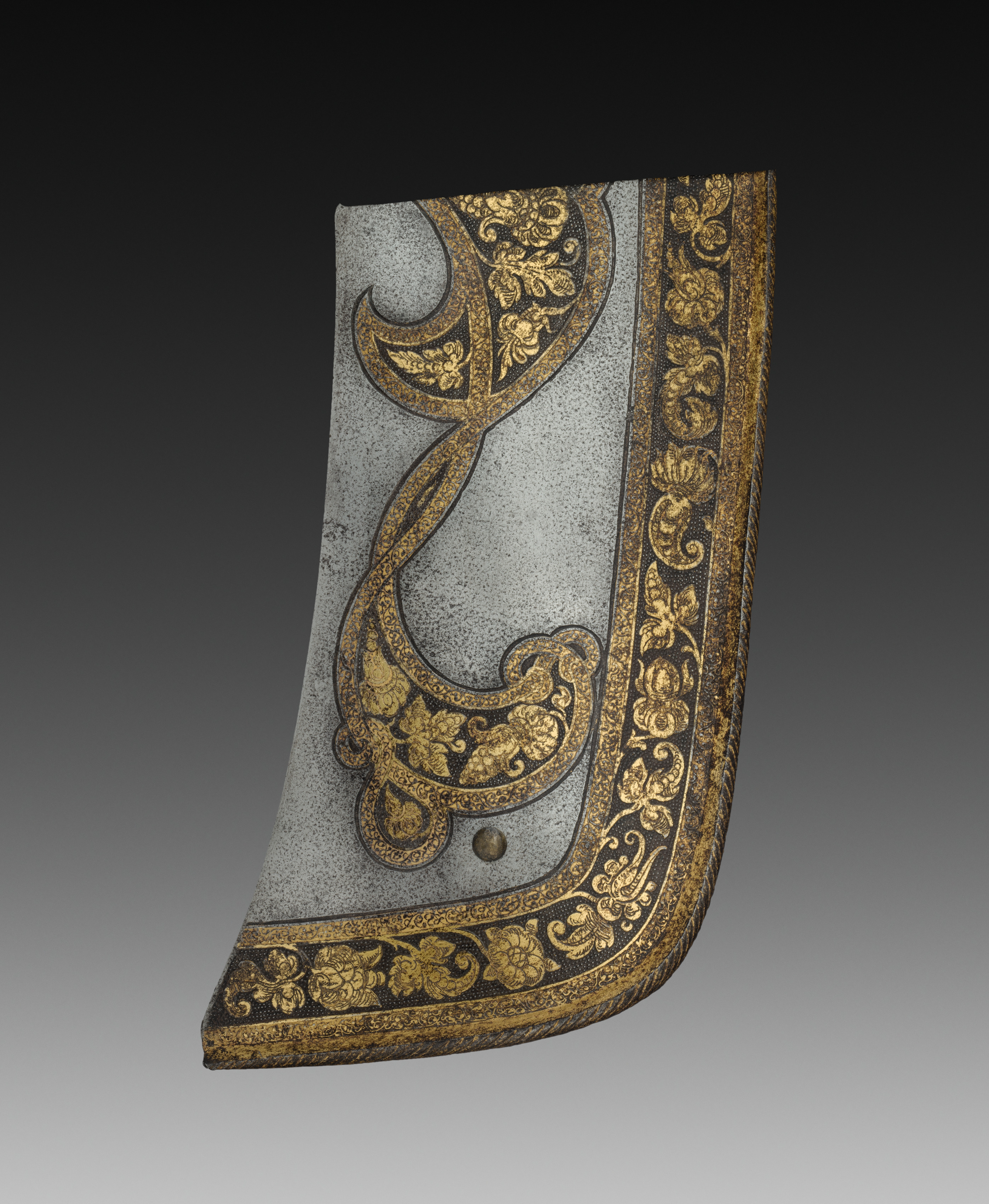
Deconstructing the Pommel Plate: An Avant-Garde Analysis of the Garniture of Rudolf II
As Chief Fabric Deconstructionist at Zoey Fashion Lab, my role is to dissect historical artifacts not as static relics, but as living blueprints for avant-garde design. The pommel plate from the Garniture of Rudolf II—a masterpiece of blued, etched, and gilded steel from Augsburg, Germany—offers a profound case study. This object is not merely armor; it is a New DNA Strand that, when decoded, reveals a radical language of power, materiality, and spatial tension. For Zoey Fashion Lab, this analysis will extract three core principles: chromatic alchemy, etched narrative architecture, and structural deconstruction.
Chromatic Alchemy: The Blued and Gilded Surface as a Living Skin
The pommel plate’s surface is a study in controlled chaos. The bluing—a chemical process that oxidizes steel to a deep, almost black indigo—is not a uniform coat. It is a volatile canvas, where variations in temperature and application create a mottled, organic depth. This is not a passive color; it is a dynamic skin that shifts under light, from midnight blue to charcoal, to a whisper of violet. For Zoey, this is a direct challenge to the static, dyed fabrics of conventional fashion. We must replicate this chromatic alchemy through reactive textiles—perhaps using thermochromic threads or layered, oxidized metallic organza that changes hue with body heat and movement.
The gilding, applied in intricate patterns, is not merely decorative. It is a counterpoint to the darkness. The gold leaf, burnished to a high sheen, creates a visual tension—a battle between light and shadow. In avant-garde design, this translates to asymmetric gilding on a garment: a single sleeve or a shoulder panel treated with liquid metal, while the rest remains a deep, matte black. This is not ornamentation; it is a narrative of power. The gold catches the eye, drawing attention to the wearer’s movement, while the blued steel grounds the piece in a sense of weight and history. The pommel plate teaches us that color is not a flat surface but a layered, reactive event.
Etched Narrative Architecture: The Surface as a Storytelling Engine
The etching on the pommel plate is not mere decoration; it is a micro-architecture of meaning. The intricate patterns—scrolls, hunting scenes, and allegorical figures—are not randomly placed. They are deliberate interruptions in the metal’s surface, creating a texture that is both visual and tactile. For Zoey, this is a new language of fabric. We must think of etching not as a removal of material, but as a positive addition of narrative. Consider a garment where the fabric is laser-cut or chemically etched to reveal a hidden layer beneath—a second skin of contrasting texture or color. The pommel plate’s scenes are not flat; they are reliefs that catch light and shadow, creating a dynamic reading of the surface.
This narrative architecture can be translated into sculptural seams or draped panels that tell a story through their arrangement. For example, a jacket could have a series of etched leather panels that, when the wearer moves, reveal a hidden pattern—a kinetic narrative. The pommel plate’s etching is also asymmetric—the left and right sides are not mirror images. This is a radical departure from traditional symmetry in armor. In fashion, this translates to asymmetric etching on a bodice or a skirt, where one side is heavily patterned and the other is bare, creating a visual imbalance that forces the eye to move and engage. The surface is not a backdrop; it is a storytelling engine that demands interaction.
Structural Deconstruction: The Pommel Plate as a Fragment of a Larger Body
The pommel plate is not a complete object; it is a fragment from a garniture—a set of armor that once covered a horse and rider. This incompleteness is its most avant-garde quality. It is a New DNA Strand because it contains the genetic code of a larger system, yet it stands alone as a powerful artifact. For Zoey, this is a direct call to deconstruct the garment into its component parts. Imagine a coat that is not a single piece but a series of detachable plates—a shoulder piece, a chest plate, a hip guard—each with its own surface treatment, each capable of being worn alone or combined. This is modular armor for the contemporary body.
The pommel plate’s curvature is also critical. It is not flat; it is sculpted to the horse’s anatomy. This biomorphic form challenges the rectilinear geometry of most fashion. For Zoey, we must design garments that follow the natural curves of the human body but also exaggerate them through structural inserts. The plate’s concave shape can be translated into molded leather or resin panels that create a second skeleton over the wearer’s torso. This is not about comfort; it is about transformation. The pommel plate teaches us that structure is not hidden but celebrated. The seams, the joints, the points of articulation—these are not flaws but features that define the garment’s character.
Conclusion: The Pommel Plate as a Blueprint for the Future
The pommel plate from the Garniture of Rudolf II is not a historical artifact; it is a prophetic document for avant-garde fashion. Its chromatic alchemy demands reactive surfaces that shift with light and movement. Its etched narrative architecture calls for garments that tell stories through texture and asymmetry. Its structural deconstruction inspires modular, biomorphic forms that celebrate the fragment. For Zoey Fashion Lab, this analysis is not an exercise in nostalgia but a deconstruction of the past to build the future. The pommel plate is a New DNA Strand—a genetic code for a fashion that is powerful, reactive, and unapologetically avant-garde. We will not replicate it; we will reanimate it.