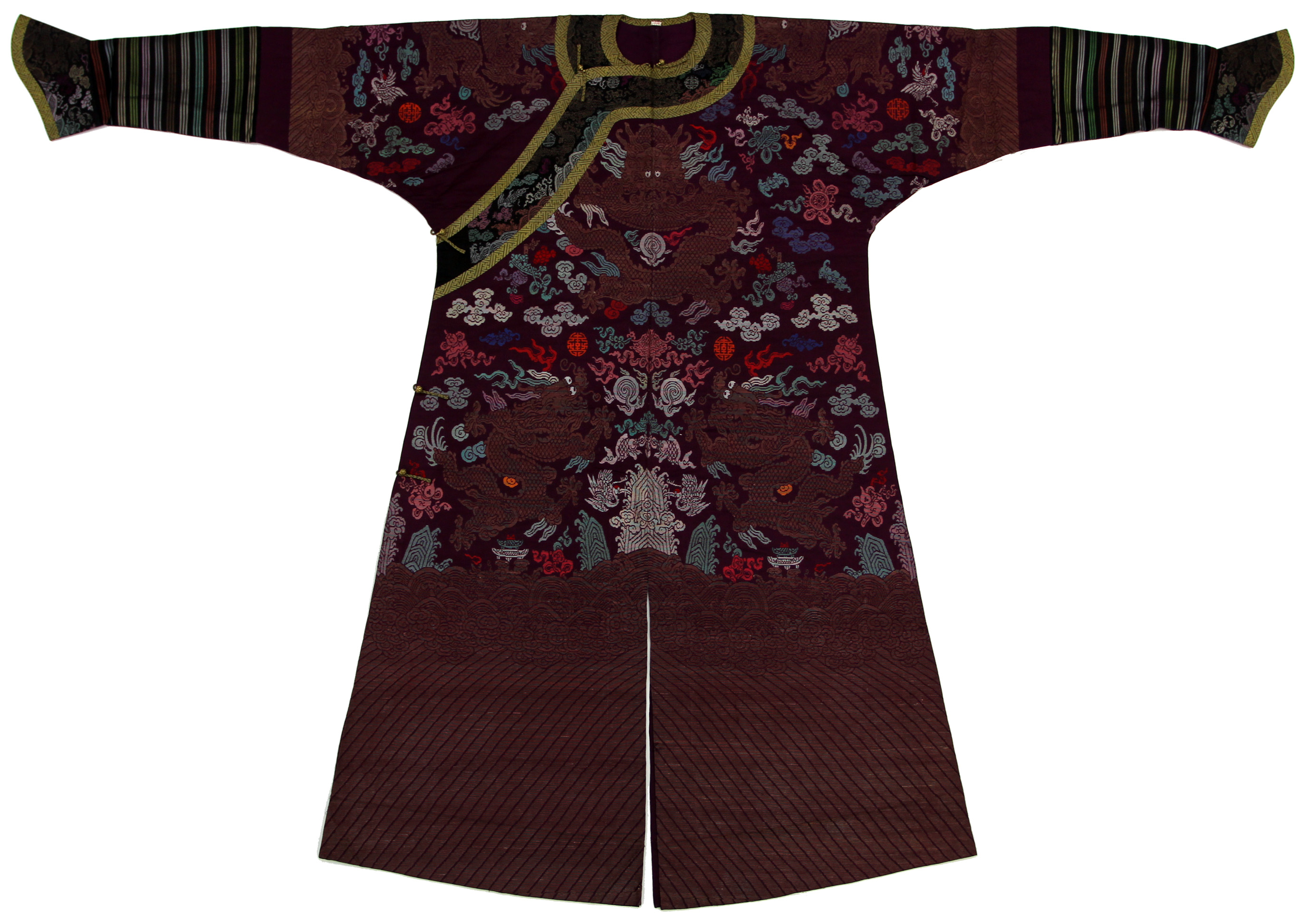
Deconstructing the Dragon’s Spine: An Avant-Garde Reimagining of the Imperial Court Robe for SS26
The imperial court robe, a vessel of dynastic power and cosmological order, traditionally embodies rigid hierarchy through its voluminous silhouette, intricate embroidery, and symbolic color codes. For Zoey Fashion Laboratory’s SS26 avant-garde study, we dismantle this artifact not as a relic but as a generative matrix for futuristic garment architecture. The robe’s inherent tension—between opulent surface and restrictive form—becomes the catalyst for structural innovation. By isolating its core components (silk, metallic thread, and the iconic dragon motif), we engineer a silhouette that defies historical gravity, propelling it into a speculative future where garment and body form a symbiotic, kinetic organism.
Silk as Liquid Armor: From Draped Opulence to Structural Membrane
Traditionally, silk in the imperial robe signified wealth and fluidity, its weight dictating the wearer’s stately movement. Our SS26 deconstruction redefines silk as a dynamic structural membrane. We employ a proprietary technique of thermal-bonded silk laminates, where multiple layers of raw silk are fused with a micro-thin, biodegradable thermoplastic grid. This creates a material that retains silk’s lustrous drape yet possesses the tensile strength of a carbon-fiber weave. The result is a silhouette that can self-support without internal boning or padding. Imagine a robe that, when at rest, appears as a cascading waterfall of liquid gold. When the wearer moves, the fabric snaps into predefined architectural folds, echoing the pleated fan of a celestial fan. This is not passive draping; it is programmable volume. The robe’s hem, traditionally weighted to the floor, is now a series of floating, cantilevered panels that hover two inches above the ground, creating a negative space that suggests levitation—a futuristic coronation of weightlessness.
Metallic Thread as Circuitry: The Dragon as Data Stream
The metallic thread in the original robe was a symbol of imperial radiance, painstakingly embroidered into static, mythological dragons. Our avant-garde intervention transforms this thread into conductive, interactive pathways. We integrate micro-encapsulated copper filaments within the silk laminate, woven not as decorative motifs but as functional circuitry. The dragon, traditionally a guardian of cosmic balance, becomes a dynamic data stream. Using a custom-developed biometric sensor array embedded at the collar and cuffs, the robe’s metallic threads respond to the wearer’s pulse and respiration. As the wearer’s heart rate rises, the dragon’s scales—rendered as kinetic, hinged metallic plates—begin to undulate in a wave-like pattern, mimicking the creature’s breath. The robe’s surface no longer tells a story; it performs one. This is not decoration; it is responsive architecture. The metallic thread becomes a living lattice, pulsing with a soft, ambient luminescence that shifts from imperial gold to a glacial, futuristic silver-blue as the wearer’s emotional state changes. The robe is no longer a costume; it is a second nervous system.
Silhouette as Deconstruction: The Robe as a Modular Exoskeleton
The imperial robe’s traditional silhouette—a rigidly vertical, A-line shape—is a cage of tradition. Our SS26 study shatters this geometry into a modular exoskeleton. We deconstruct the robe into five independent, reconfigurable zones: the yoke (collar and shoulder), the dorsal panel (back), the ventral panel (front), the sleeve wings, and the train. Each zone is connected via magnetic snap-links and tension cables of silk-wrapped Kevlar. The wearer, or a digital assistant, can reprogram the silhouette in real-time. For a runway moment, the robe can be configured as a high-neck, cape-like cocoon with a dramatic, asymmetrical train that sweeps the floor like a comet’s tail. For a more aggressive, avant-garde stance, the dorsal panel can be detached and worn as a freestanding, back-mounted structure—a sculptural wing that extends three feet beyond the body, supported by a lightweight, 3D-printed titanium frame that mimics the dragon’s ribcage. The sleeve wings, traditionally draped and voluminous, are now articulated, accordion-folded panels that can be locked into a sharp, geometric peak or collapsed into a sleek, aerodynamic sheath. This is silhouette as a verb—a constant state of becoming, not being.
Color as Temporal Distortion: From Imperial Gold to Speculative Silver
The original robe’s color palette—cinnabar red, imperial yellow, and deep indigo—was a static code of rank and season. Our SS26 study treats color as a temporal distortion. We employ thermochromic and photochromic dyes infused into the silk laminate. Under natural light, the robe appears as a ghostly, oxidized silver—a futuristic patina that evokes a relic from a forgotten future. Under UV light or when exposed to the wearer’s body heat, the metallic threads activate a spectrum of imperial hues: a deep, pulsating indigo along the spine, a molten gold at the collar, and a crimson that bleeds from the hem upward, as if the robe is remembering its own history. This is not color as decoration; it is chromatic memory. The robe’s surface becomes a living archive, where the past and future coexist in a single, shifting garment.
Structural Innovation: The Robe as a Biomorphic Architecture
The ultimate innovation lies in the robe’s biomorphic skeleton. We replace the traditional internal lining with a 3D-printed, lattice structure made from recycled silk fibroin and biodegradable polymers. This lattice acts as a flexible, shock-absorbing exoskeleton that distributes the robe’s weight across the wearer’s shoulders and hips, eliminating the need for restrictive undergarments. The lattice’s geometry is inspired by the dragon’s scale pattern, but rendered in a hyperbolic, non-Euclidean topology that allows the robe to compress and expand like a living organism. When the wearer sits, the lattice collapses into a compact, origami-like form. When they stand, it unfolds into a majestic, billowing silhouette that defies the limits of traditional textile construction. This is not a garment; it is a wearable habitat—a portable, responsive environment that adapts to the body’s every gesture.
Conclusion: The Robe as a Manifesto for SS26
This deconstruction of the imperial court robe is not an exercise in nostalgia. It is a manifesto for SS26, where fashion becomes a cybernetic dialogue between tradition and speculation. By reimagining silk as liquid armor, metallic thread as responsive circuitry, and silhouette as a modular exoskeleton, we transform a static symbol of imperial power into a dynamic instrument of personal agency. The robe no longer confines the body; it augments it. It is a garment that thinks, remembers, and transforms—a testament to the future of couture as a living, breathing architecture. At Zoey Fashion Laboratory, the dragon’s spine is not a relic to be preserved; it is a blueprint for a new species of garment.