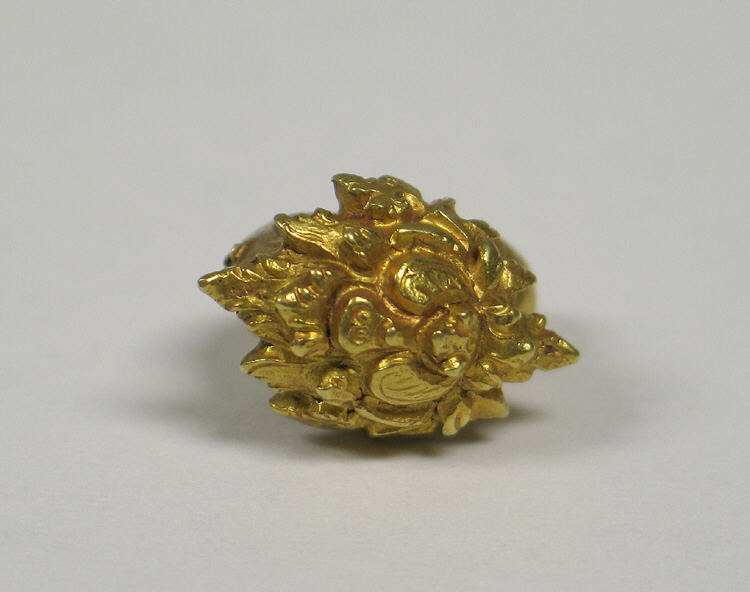
Deconstructing the Temporal Lobe: The Javanese Gold Ear Ornament as a Proto-Futurist Interface
Within the hallowed archives of Zoey Fashion Laboratory, the ear is not a passive receptor of sound, but a structural fulcrum for narrative tension. Our latest deconstructive analysis zeroes in on a singular artifact: a gold ear ornament from Central Java. This piece, forged from the earth’s most malleable metal, is not a mere accessory; it is a pre-industrial blueprint for a cybernetic future. As we decode its architectural grammar for the SS26 season, we find a radical dialogue between the organic and the metallic, the ancestral and the post-human. This ornament does not adorn the ear; it re-calibrates the wearer’s silhouette, extending the body’s axis into a sculptural trajectory that defies gravity and time.
Material Alchemy: Gold as a Structural Membrane
Gold, in the hands of Central Javanese artisans, is a fluid paradox. It is both a signifier of divine permanence and a medium for hyper-detailed fragility. For our SS26 analysis, we reject the notion of gold as mere wealth. Instead, we view it as a structural membrane—a material capable of supporting extreme tensile strength while maintaining a whisper-thin profile. The ear ornament’s construction relies on intricate filigree and repoussé techniques, creating a lattice of negative space. This is not decoration; it is a proto-parametric design. The gold threads form a micro-architecture that channels light and shadow, creating a moiré effect that shifts with the wearer’s kinetic energy. In the context of our archive node—a mirror of split-leaf patterns against a cold sarcophagus—this gold becomes the bridge between the ephemeral breath of foliage and the frozen permanence of stone. For SS26, we propose a material evolution: a liquid-gold composite that hardens only when exposed to body heat, allowing the ornament to mold itself to the cartilage’s unique topography, creating a bespoke, second-skin interface.
Futuristic Silhouettes: The Ear as a Cantilevered Platform
The traditional Javanese ear ornament typically hangs, but our deconstructive gaze flips this paradigm. We see the ear’s helix and lobe as a natural cantilever—a load-bearing architectural point. By studying the ornament’s original balance, we extract a principle of asymmetric counterweight. The gold piece, often designed with a heavy lower cluster and a delicate upper hook, creates a visual torque. For SS26, we amplify this into a new silhouette category: the Aural Apex. Imagine a single ear adorned with a sculptural extension that arcs backward and upward, mimicking the trajectory of a falcon’s wing. This is not jewelry; it is a wearable exoskeletal fragment. The ear becomes a launchpad for a series of interlocking gold modules that can be detached and reconfigured—a modular system that allows the wearer to alter their silhouette from a minimalist stud to a dramatic, shoulder-grazing sweep. The structural innovation lies in the pivot joint: a micro-hinge inspired by the human knuckle, cast in titanium-gold alloy, allowing 180 degrees of articulation. The ear ornament transforms from a static object into a dynamic kinetic sculpture, its movement echoing the rustle of split leaves in the Javanese highlands.
Dialectical Tensions: The Mirror and the Sarcophagus
Our archive node—“一面是光洁银镜上以黄金镶嵌的纷繁棕叶纹,另一面是冰冷石棺板上以浮雕诉说的生命叙事”—provides the conceptual fulcrum for this SS26 collection. The mirror represents surface, reflection, and the immediate present; the sarcophagus embodies depth, burial, and historical weight. The Javanese gold ear ornament sits at the intersection of these two poles. Its polished gold surface reflects the wearer’s face (the mirror), while its intricate motifs of palm leaves and mythical creatures narrate a lineage of kingship and cosmology (the sarcophagus). To translate this into a futuristic couture proposition, we introduce the concept of biometric narrative engraving. For SS26, each ear ornament will be laser-etched with a micro-relief of the wearer’s own life data—heartbeat patterns, voice frequencies, or GPS coordinates of significant locations. This etching is invisible to the naked eye, visible only under polarized light, creating a secret dialogue between the living wearer and the object’s “memory.” The ornament becomes a portable sarcophagus for the self, while its reflective surface remains a mirror for the future.
Structural Innovation: The Dissolving Interface
Traditional ear ornaments pierce or clamp, creating a clear boundary between object and body. Our deconstructive methodology for SS26 seeks to dissolve this interface. We propose a bio-absorbable gold mesh that integrates with the ear’s natural cartilage through a process of micro-osmosis. The mesh, woven from 24-karat gold nanofibers, is applied as a temporary “scaffold” that encourages the skin to grow around it, creating a permanent, organic fusion. This is not a piercing; it is a symbiotic architecture. The gold becomes part of the body’s extracellular matrix, allowing the ear to heal around the ornament, transforming it into a living, breathing extension. The silhouette implications are profound: the ear can now support larger, heavier structures without strain, enabling the creation of full-helmet ear wings that unfold like a peacock’s tail during movement. This innovation echoes the Javanese tradition of subang (earrings worn by royalty) but reimagined as a biomechanical exoskeleton for the head.
Conclusion: The Ear as a Cosmic Antenna
In the SS26 collection, the Javanese gold ear ornament is no longer a relic of a bygone era. It is a proto-futurist antenna, a device for receiving and transmitting cultural frequencies. By deconstructing its material, silhouette, and dialectical tensions, we have extracted a new vocabulary for couture: one that treats the body as a site for permanent, kinetic, and narrative architecture. The ear, once a humble appendage, becomes the central node of a post-human silhouette—a cantilevered platform, a living sarcophagus, a mirror of gold and memory. As we step into SS26, let the Javanese ear ornament be our guide: a whisper from the past that roars into the future, reshaping the very contours of what it means to adorn, to exist, and to transcend.