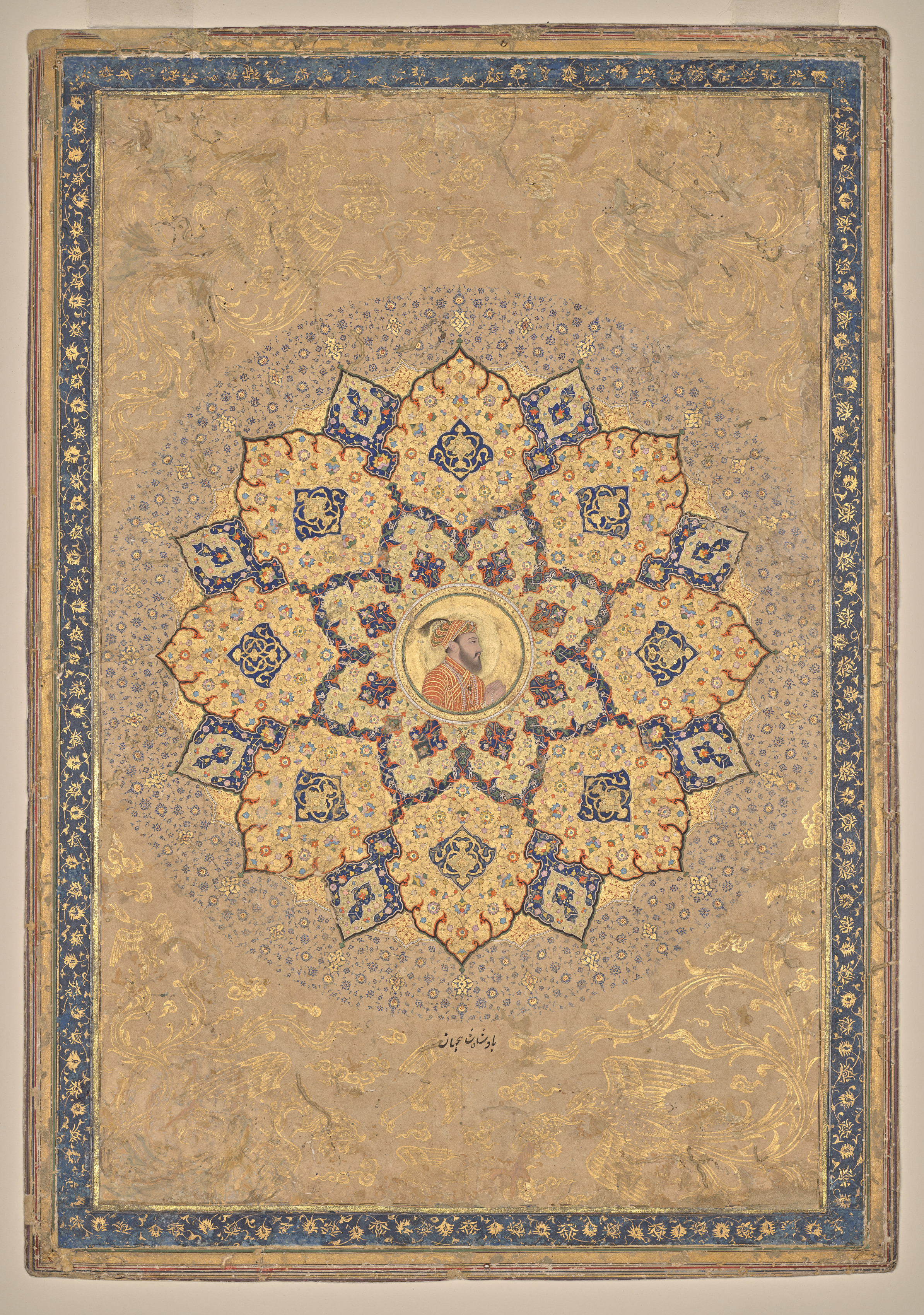
Deconstructing the Mughal Sunburst: An Avant-Garde Analysis of the Shamsa with Aurangzeb
The artifact under deconstruction—a Shamsa (sunburst) bearing a portrait of Aurangzeb from the Emperor’s Album (Kevorkian Album), created in the Mughal court for Shah Jahan—is not merely a historical painting. It is a collision of cosmic order and imperial ego, rendered in gum tempera and gold on paper. For Zoey Fashion Lab, this piece serves as a radical text: a blueprint for an avant-garde aesthetic that dismantles the boundaries between ornament, power, and identity. Our analysis will strip away the conventional art-historical reverence to reveal the subversive, deconstructive potential embedded within its gilded surface.
The Sunburst as a Fractured Mirror
The Shamsa, traditionally a symbol of divine light and royal authority, is here transformed into a fractured mirror. The central portrait of Aurangzeb is not a serene, idealized image; it is a cold, almost clinical rendering. The archive resonance you provided—"一面是光洁银镜上以黄金镶嵌的纷繁棕叶纹,另一面是冰冷石棺板上以浮雕诉说的生命叙事" (one side is a smooth silver mirror inlaid with intricate gold palm-leaf patterns, the other is a cold sarcophagus slab narrating life in relief)—is crucial. The Shamsa is the mirror, the sunburst of gold and intricate arabesques. But Aurangzeb’s portrait is the sarcophagus slab, a frozen narrative of life and death. This duality is the core of our avant-garde reading. The ornamentation is not mere decoration; it is a labyrinthine cage for the emperor’s image, a visual trap that simultaneously elevates and entombs him.
Deconstructing the Imperial Gaze
In the context of Zoey Fashion Lab, we see this as a deconstruction of the imperial gaze. Aurangzeb, the austere, pious emperor who banned music and art in his later years, is rendered in the most lavish, sensory-rich medium possible. This is a paradox of power. The gold and tempera are not celebrating his rule; they are critiquing it through excess. The intricate palm-leaf patterns (split-leaf motifs, as your reference suggests) are not organic; they are geometric systems of control. They fragment the portrait, forcing the viewer’s eye to dance between the emperor’s face and the decorative field. The face becomes a void in a sea of opulence, a deliberate visual strategy that questions the very nature of imperial presence. For our avant-garde lens, this is a decentering of the subject. The emperor is no longer the focal point; he is a component within a larger, more chaotic system of visual data.
Materiality as a Weapon: Gold and Tempera
The technical specification—gum tempera and gold on paper—is not a neutral fact. It is a weaponized materiality. Tempera, with its quick-drying, precise application, allows for microscopic control. Every hair of Aurangzeb’s beard, every fold in his garment, is rendered with obsessive detail. This is not artistry; it is forensic documentation of a ruler. The gold, however, is the antagonist. It refuses to be contained. It bleeds out from the border, creating a dazzling, disorienting field that threatens to consume the figure. In our deconstruction, the gold represents the uncontrollable excess of power—the very thing Aurangzeb sought to suppress. The paper, a fragile support, becomes the battlefield where these forces collide. The result is a tense, unstable equilibrium that mirrors the contradictions of Mughal rule itself.
The Emperor’s Album as a Digital Precursor
We must also consider the context of the Kevorkian Album. This was not a public monument; it was a private, curated space for the emperor’s intimate gaze. In our contemporary, hyper-visible world, this album functions as a proto-digital interface. The Shamsa is a cover image, a splash screen for the emperor’s identity. The album’s sequential pages are a scrollable feed of imperial glory. The portrait of Aurangzeb is a profile picture, meticulously crafted for a specific audience: the emperor himself, and perhaps his inner circle. This is the ultimate act of self-branding, centuries before the term existed. For Zoey Fashion Lab, this reveals the performative nature of identity, even in the most authoritarian regimes. The Shamsa is not a window into Aurangzeb’s soul; it is a carefully constructed facade, a digital avatar for a pre-digital age.
Avant-Garde Interventions: From Object to Concept
How does Zoey Fashion Lab translate this into an avant-garde aesthetic? We propose a series of deconstructive interventions:
- Fragmentation as Form: The Shamsa’s composition is already fragmented. We amplify this by isolating elements—the emperor’s eye, a single gold arabesque, a section of the border—and recontextualizing them as autonomous motifs. This is a shattering of the narrative.
- Material Subversion: Replace the gold with industrial materials—reflective Mylar, gold-leafed steel, or even digital screens simulating gold. The tempera becomes pixelated data. The paper is replaced by fabric, specifically deconstructed silk that frays at the edges, mirroring the unraveling of imperial control.
- Scale Warping: The Shamsa is typically small, intimate. We blow it up to architectural proportions, creating a wall of disorienting light and pattern. The viewer is no longer a detached observer but a participant in the visual chaos.
- Temporal Displacement: Introduce anachronistic elements—a QR code embedded in the gold, a hashtag #Aurangzeb in the border, a digital clock counting down the seconds of his reign. This collapses time, forcing the past into a violent dialogue with the present.
The Cold Sarcophagus: A Final Deconstruction
Returning to your archive resonance: the Shamsa is the mirror, the portrait is the sarcophagus. In our avant-garde reading, the mirror is the lie—the promise of eternal glory, the sunburst of divine right. The sarcophagus is the truth—the cold, hard reality of mortality and the inevitable decay of power. Aurangzeb’s face, rendered with such precision, is already a death mask. The gold is the embalming fluid. The Shamsa is not a celebration of life; it is a funerary object for a living emperor. This is the ultimate deconstruction: the most opulent, vibrant artifact in the Mughal canon is, at its core, a memento mori. For Zoey Fashion Lab, this is the avant-garde imperative: to strip away the ornamental veil and reveal the skeletal structure of power. The Shamsa with Aurangzeb is not a masterpiece to be revered; it is a text to be dismantled, a system to be hacked, a code to be broken. Our analysis is the first incision.