Technical Deconstruction: The Anatomy of a Renaissance Marvel
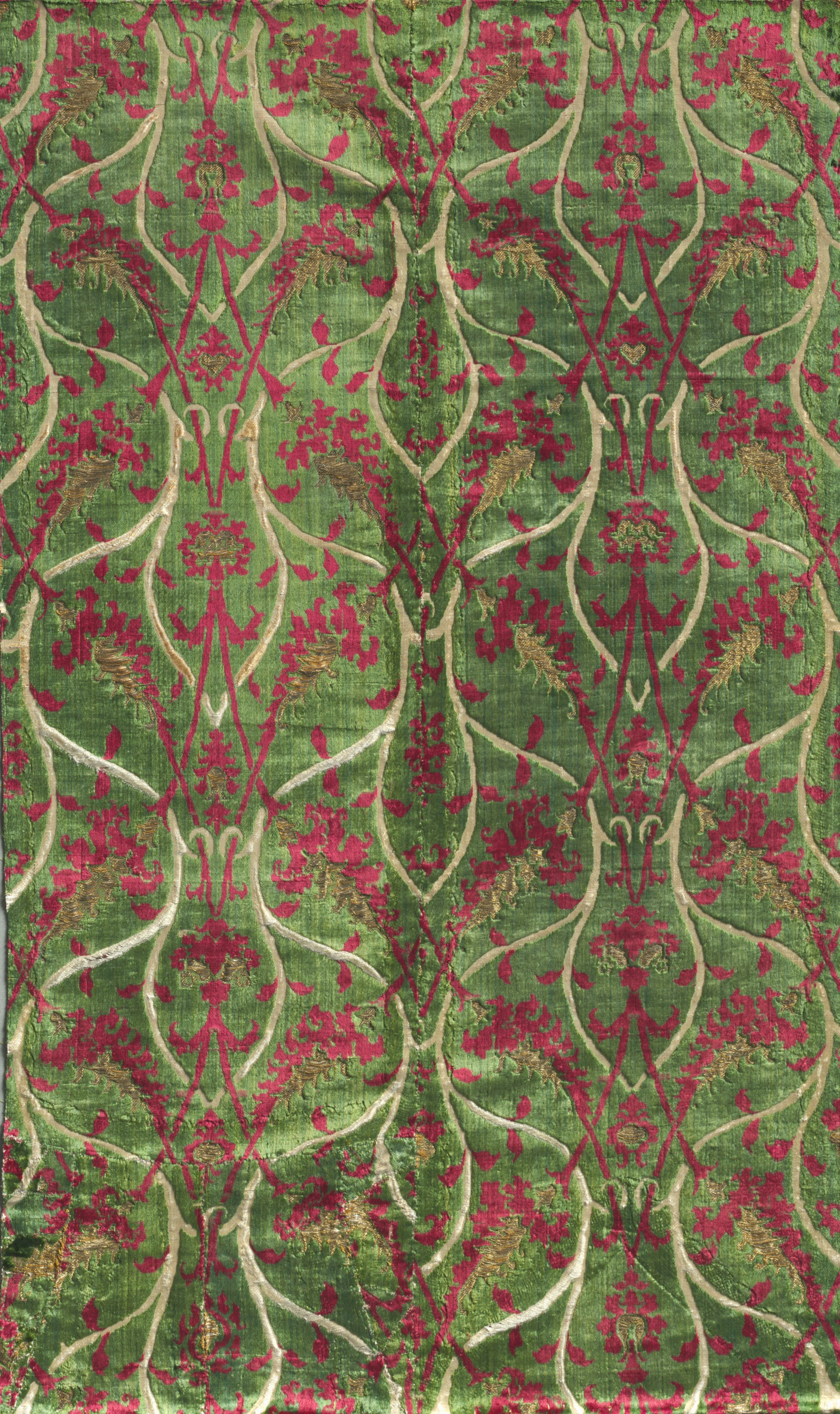
The fabric in question is not merely a textile; it is a masterclass in late 15th-century Italian textile engineering, representing the zenith of pre-industrial loom technology. Our analysis must begin at the molecular level of its construction. The foundation is pure silk, a substrate chosen for its inherent strength, luminous sheen, and capacity to hold dense, precise pile. Upon this, the velvet is created—a cut pile structure where supplementary warp threads are raised over rods and later cut, creating that quintessential plush, light-absorbing surface. This is the first color field.
The complexity escalates with the introduction of the second color and the metallic element. This is a polychrome voided velvet, meaning the two distinct pile colors (e.g., crimson and deep sapphire) are not printed or applied but are integral, woven into the ground, with areas of the silk foundation left bare (voided) to form part of the pattern. Simultaneously, it is brocaded with gold thread. This "thread" was likely filé—a thin strip of gold wound around a silk core. This brocading was a separate, painstaking hand-operation, inserting the gold into the weave to highlight specific motifs, making those elements literally and figuratively radiant against the matte, shadowed velvet pile.
Pattern Analysis: The Double Curved Lattice as Philosophical Framework
The described double curved lattice is the architectural heart of the design. Unlike a rigid, geometric grid, this lattice is organic, fluid, and interlocking. Imagine the sinuous, rhythmic stems of an acanthus vine, twisting and crossing over itself to form irregular, eye-shaped apertures. Within these apertures, one would likely find secondary motifs—pomegranates (symbolizing fertility and resurrection), pinecones (persistence), or hybrid floral forms. This lattice is not a boundary but a growing, living framework.
This is where the provided Archive Resonance becomes critically illuminating. The reference to "a mirror with split-leaf..." and the duality of "a polished silver mirror inlaid with gold for intricate arabesques" versus "a cold stone sarcophagus panel narrating life in relief" decodes the pattern's essence. The velvet performs this same duality. The gold-brocaded elements act as the mirror: they are reflective, immediate, glorious, capturing the light and the eye with their worldly splendor. The voided and cut-pile velvet, with its deep shadows and tactile depth, is the stone sarcophagus relief: it is narrative, somber, requiring contemplation to read its story, speaking of mortality, depth, and complexity. The pattern is a memento mori and a celebration of life, woven into one inseparable fabric.
Avant-Garde Translation: From Medici Palace to Zoey Lab Runway
The directive is Avant-garde. This forbids literal historical reproduction. Our task is not to replicate but to resonate with the core principles of the original: duality, material contrast, organic structure, and philosophical narrative. The Renaissance marvel becomes our conceptual feedstock for deconstruction.
Material Re-interpretation
We replace and subvert the original materials while honoring their textural dialogue. The silk velvet can be translated into a technically advanced recycled polyester micro-velvet, engineered to have a higher, more directional pile, achieving deeper voids. The gold thread is reimagined as laser-etched, foil-laminated strips on a transparent thermoplastic substrate, or as conductive metallic yarns woven to interface with embedded lighting. The "voided" ground shifts from exposed silk to a sheer, fused mesh or a second skin of liquid silicone coating, creating a play of opacity and revelation.
Pattern and Structural Re-coding
The double curved lattice is digitally dissected. We might explode the lattice, isolating its sinuous lines as raised, silicone-printed seams on a garment's shell. The "apertures" become actual physical voids in the garment—laser-cut openings framed by the metallic brocading, revealing the skin or an underlayer. The pattern is no longer a flat, woven decoration but a three-dimensional, architectural blueprint for the garment's construction. A sleeve could be the lattice itself, wrapping the arm in a sculptural, open cage of velvet and metal.
Narrative Duality in Contemporary Context
The mirror/sarcophagus duality translates to a modern tension: the digital self versus the corporeal self. The reflective, gold elements represent the curated, polished, luminous online avatar. The deep, shadowed, tactile velvet represents the physical, mortal, complex human body. A single garment can embody this schism: one side, a sleek exoskeleton of laminated gold patterns and harsh light; the other, a cascading, disordered drapery of crushed, voided velvet, swallowing light. The wearer becomes the narrative, a walking dialogue between surface and depth, appearance and substance.
Conclusion: The Resonance Collection
For Zoey Fashion Lab, this analysis yields not a costume, but a conceptual framework for a capsule collection—"Resonance: The Florentine Code". Each piece is a study in controlled contradiction: heavy velvet against featherweight mesh, hand-pleated organic forms against laser-precise metallic appliqués, motifs that are both embroidered and eroded. The 15th-century Italian weavers sought to capture the divine paradox of life and death in silk and gold. Our avant-garde mission is to capture the contemporary paradox of identity and existence in engineered textiles and sculptural form. The original fabric's genius lies in its layered complexity; our reinterpretation's success will lie in making that complexity physically and intellectually wearable for the 21st-century psyche.