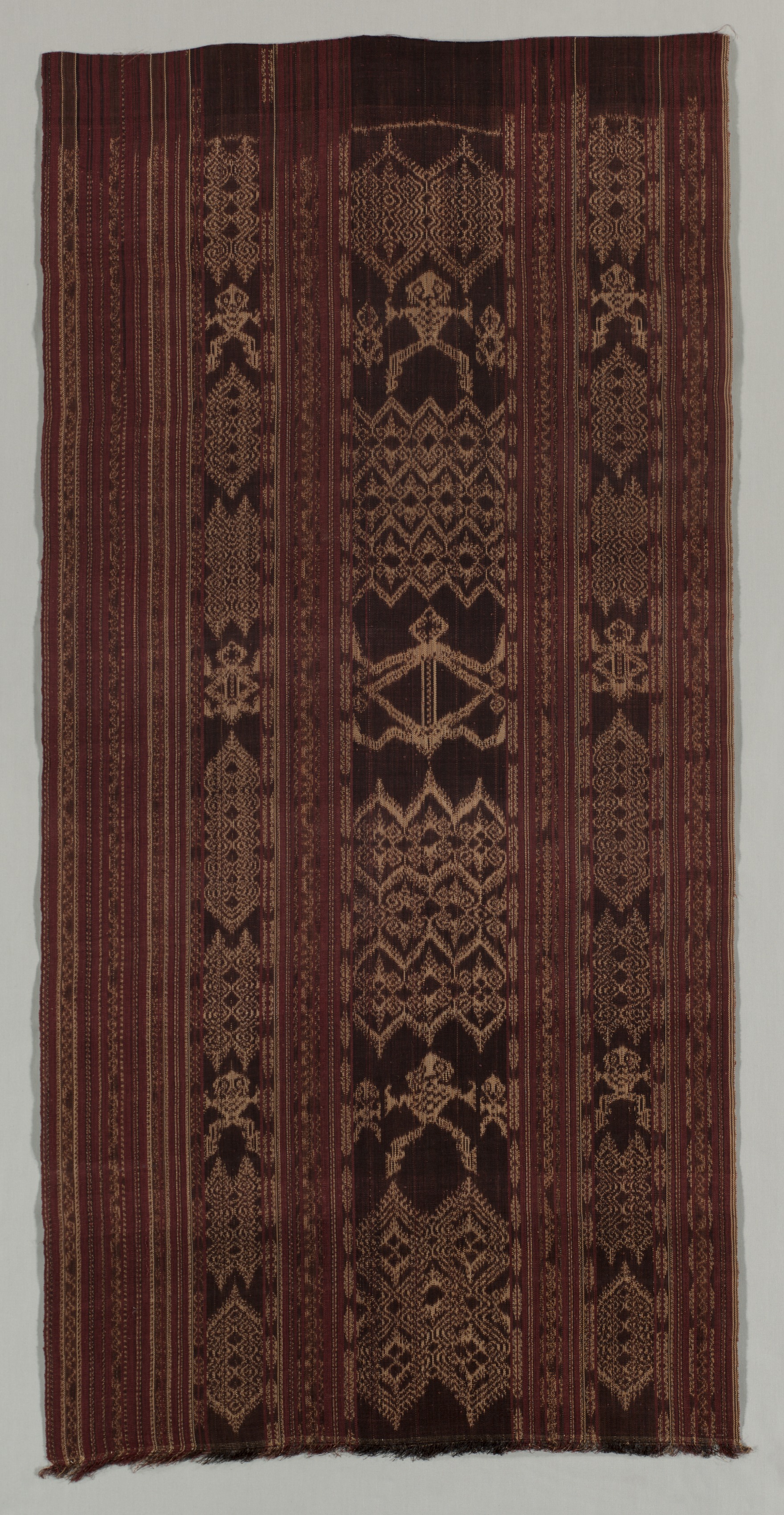
Deconstructing the Dagmay: An Avant-Garde Analysis of the Mandaya Ikat Textile
At Zoey Fashion Lab, our mission is to dismantle the conventional boundaries of textile understanding, treating each fabric not as a finished product but as a living archive of cultural and technical knowledge. The Mandaya dagmay, a plain-weave hemp ikat from Mindanao, Philippines, presents a profound case study. To the untrained eye, it is a rustic, hand-dyed cloth. To the Chief Fabric Deconstructionist, it is a complex system of coded information, a precursor to modern pixelation, and a testament to the alchemy of natural materials. This analysis will dissect the dagmay through an avant-garde lens, stripping away romanticism to reveal its radical technical and aesthetic DNA.
Technical Autopsy: The Plain-Weave Hemp Matrix
The foundation of the dagmay is its plain weave structure—the simplest, most fundamental interlacing of warp and weft. Yet, within this apparent simplicity lies a radical constraint. Hemp fiber, derived from the abaca plant or similar bast fibers, is inherently stiff, coarse, and resistant. Unlike the pliant, forgiving nature of cotton or silk, hemp demands a rigorous, almost architectural approach. The weaver does not drape; they construct. The plain weave creates a grid, a Cartesian plane upon which the ikat pattern is imposed. This grid is not a canvas; it is a structural framework that dictates the rhythm of the design.
In an avant-garde context, we can view this as a form of materialist minimalism. The dagmary’s technical limitations—its low thread count, its rigid hand, its resistance to complex weaves—become its greatest assets. The fiber’s natural luster, when dyed, produces a matte, almost chalky finish. This is not a fabric that reflects light; it absorbs and diffuses it, creating a depth that is internal rather than superficial. The deconstructionist sees this as a deliberate rejection of surface glamour, a focus on the substance of the thread itself. The hemp matrix is a statement: the fabric is not a screen for a pattern; the pattern is an intrinsic property of the fiber’s arrangement.
The Ikat Paradox: Dyed Resistance and the Pixelated Archive
The defining technical feature of the dagmay is its ikat dyeing process—specifically, warp ikat, where the vertical threads are resist-dyed before weaving. This is a process of immense precision and risk. The dyer must bind bundles of warp threads with meticulous knots, then dye them in successive baths of natural pigments (indigo for blues, tungog bark for reds, and luyang dilaw for yellows). The unbound areas absorb color; the bound areas remain white or take on a lighter shade. When the bindings are removed and the warp is mounted on the loom, the pattern exists only as a series of interrupted, fragmented marks.
This is where the dagmay becomes a direct ancestor of digital imaging. The ikat pattern is, in effect, a low-resolution bitmap. Each bound and unbound section of warp thread represents a pixel—a binary state of “dyed” or “undyed.” The weaver, by inserting the weft threads through this pre-determined grid, must align the horizontal lines with the vertical pixels. The result is a pattern that is inherently blurred, soft-edged, and vibrating. This is not a flaw; it is a feature of the technique. The avant-garde eye recognizes this as a deliberate aesthetic of imperfection and entropy. The dagmay does not reproduce a perfect, static image; it generates a shimmering, unstable field of color that shifts with the angle of light and the tension of the weave.
Archive Resonance: Echoes of 16th-17th Century Global Exchange
To fully deconstruct the dagmay, we must place it within the broader context of global textile history. The reference to “Archive Resonance” and the 16th-17th centuries is crucial. This period marks the height of the Manila Galleon Trade, which connected Asia, the Americas, and Europe. Mindanao was a node in this network. The dagmay, while deeply indigenous, was not isolated. The hemp fiber itself was a commodity; the natural dyes—particularly indigo—were part of a global color palette. The geometric patterns of the dagmay—zigzags, diamonds, human figures, and crocodile motifs—resonate with the abstract, symbolic languages found in pre-colonial Southeast Asian textiles, but they also echo the geometric abstractions of Islamic art, which entered the Philippines through trade routes.
From an avant-garde perspective, this is a hybridized, creolized archive. The dagmay is not a pure, untouched artifact; it is a product of cultural friction. The weaver’s hand is not isolated; it is in dialogue with a global system of material and visual exchange. The “resonance” lies in the way the dagmay’s abstract geometry anticipates the non-representational art of the 20th century—the grids of Mondrian, the color fields of Rothko, the pixelated experiments of early computer art. The dagmay is a pre-industrial data visualization, encoding social status, spiritual beliefs, and clan identity into a repeatable, wearable pattern. The deconstructionist reads this not as folklore, but as a sophisticated system of visual cryptography.
Avant-Garde Application: Reclaiming the Dagmay as Radical Material
How does Zoey Fashion Lab apply this analysis? We reject the notion of the dagmay as a “traditional” or “ethnic” fabric to be preserved in a museum. Instead, we see it as a radical material toolkit for contemporary design. The dagmay’s key avant-garde attributes are:
- Structural Pixelation: The inherent blur of the ikat pattern can be amplified, not corrected. We can design garments that celebrate the moiré effect—the visual interference patterns created when the warp and weft are slightly misaligned. This is a deliberate distortion, a rejection of crisp, digital perfection.
- Material Honesty: The hemp’s stiffness is not a limitation; it is a sculptural property. Garments can be designed with sharp, architectural folds and geometric silhouettes that mimic the fabric’s own construction. The fabric becomes the structure, rather than being draped over a structure.
- Chromatic Depth: The natural dyes produce colors that are unstable, variable, and alive. They fade and shift over time. This is a rejection of fast-fashion’s colorfastness. The garment ages with the wearer, its color becoming a record of exposure to sun, water, and air.
- Cultural Code as Design Language: The geometric motifs are not decorative; they are semiotic units. We can extract these motifs—the crocodile, the diamond, the human figure—and recontextualize them as abstract, contemporary prints, or even as woven data representing modern narratives (e.g., climate data, migration patterns).
In conclusion, the Mandaya dagmay is not a relic. It is a living, breathing system of material intelligence. Its plain weave hemp matrix, its pixelated ikat dyeing, and its resonance with global trade histories make it a perfect subject for avant-garde deconstruction. At Zoey Fashion Lab, we do not simply analyze; we reconstruct. We take the dagmay’s radical principles—its structural honesty, its embrace of imperfection, its coded visual language—and translate them into garments that challenge the very definition of fashion. The dagmay is not a fabric; it is a manifesto.