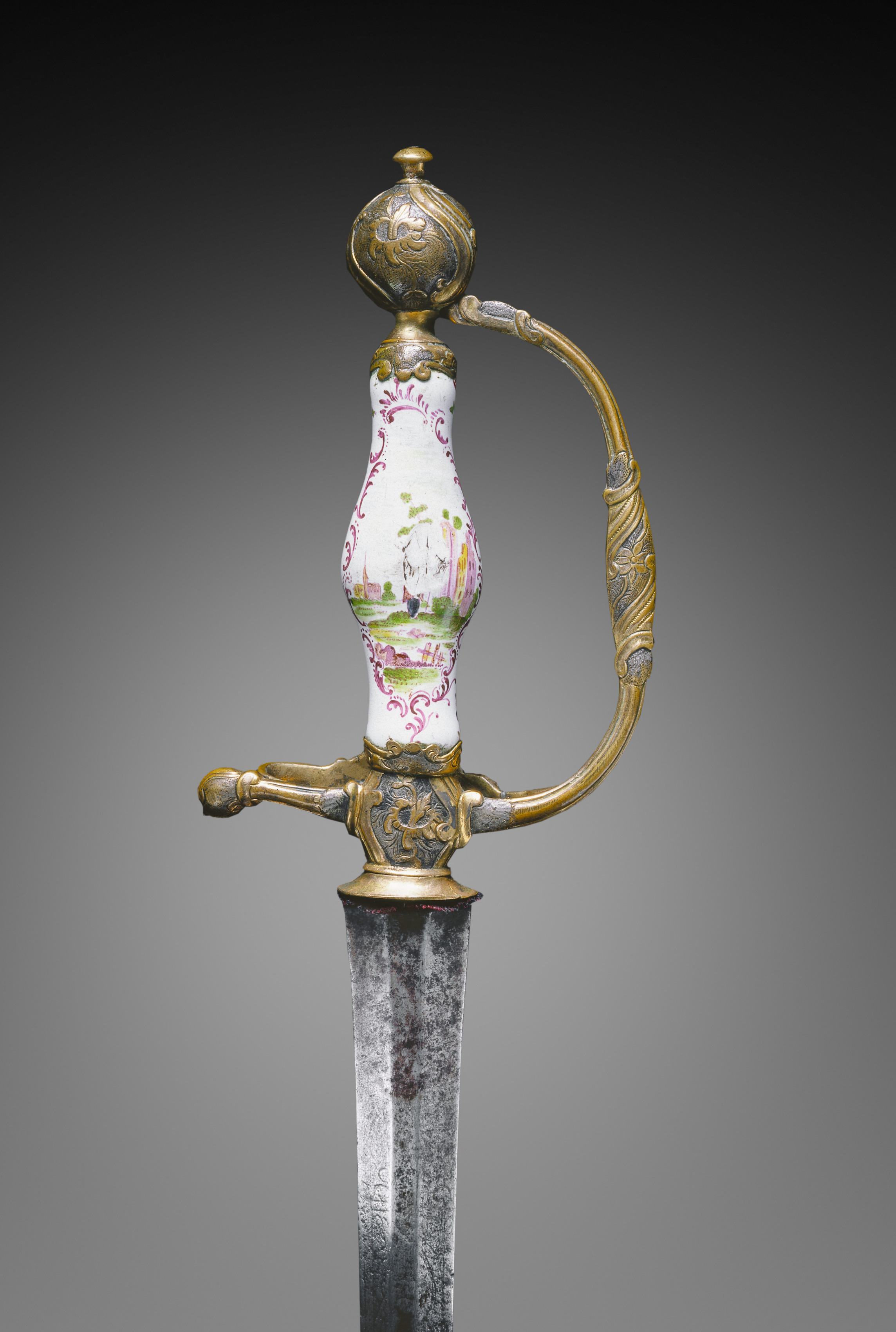
Deconstructing the Small Sword: An Avant-Garde Reinterpretation for Zoey Fashion Lab
At Zoey Fashion Lab, our mission is to unravel the historical fabric of garments and accessories, extracting their core DNA to forge new, avant-garde expressions. Today, we turn our analytical lens to an object of refined lethality: the 18th-century German Small Sword. This is not merely a weapon; it is a statement of status, a ballet of geometry, and a repository of materials that, when deconstructed, reveal a startlingly modern narrative. The Small Sword—with its steel blade, gilt-brass hilt, and porcelain grip—becomes a new DNA strand for our forthcoming collection, a genetic code for a fashion that is both sharp and sculptural.
Material Memory: Steel, Gilt-Brass, and Porcelain
The Small Sword’s technical composition is a trilogy of contrasting elements, each carrying a distinct memory. The steel blade is a study in linear tension. Forged and polished to a mirror finish, it represents the apex of functional minimalism. In our avant-garde context, steel is not cold or aggressive; it is the backbone of structure. We extract its essence as a rigid, reflective line that can be translated into structural seams, metallic threading, or even laser-cut, flexible mesh panels that mimic the blade’s shimmer. The steel’s DNA speaks of precision, of a sharp edge that defines space. In our collection, this becomes a silhouette that is unyielding, with razor-sharp lapels, angular hemlines, and architectural shoulders that cut through the air with the same finality as the sword’s point.
The gilt-brass of the hilt and guard introduces a different narrative: opulence and decay. Gilding—the application of gold leaf or gold paint over brass—is a technique of surface deception. It suggests wealth but also the potential for tarnish, for the passage of time. In our deconstruction, gilt-brass is not a precious metal but a material of contrast. We imagine it as a high-shine, almost liquid metallic finish on synthetic fabrics, or as a patinated, oxidized overlay on leather and vinyl. The brass guard, with its intricate, sweeping curves (often a figure-eight or shell form), becomes a motif for asymmetrical detailing—a single, oversized, metallic appliqué on a shoulder, or a cascading, twisted metal chain that replaces a traditional belt. The DNA of gilt-brass is about the tension between the precious and the perishable, a theme we explore through layering and distressed finishes.
Perhaps the most surprising element is the porcelain grip. In the 18th century, porcelain was a material of immense value, often imported from Meissen or Sèvres. Its use on a sword hilt is a collision of fragility and violence. The porcelain grip is typically white, blue, or polychrome, painted with delicate floral or chinoiserie motifs. This is the DNA of vulnerability. For Zoey Fashion Lab, porcelain is not a ceramic but a textural and chromatic reference. We translate its smooth, cold, and brittle quality into high-gloss, ceramic-coated fabrics or into structured, molded panels that resemble broken shards. The floral motifs become embroidered or printed patterns that disrupt the severity of the steel-like silhouettes. The porcelain grip teaches us that strength can be housed in a fragile shell—a concept we apply to sheer, translucent layers that reveal and conceal, or to accessories that appear delicate but are structurally reinforced.
The Geometry of the Blade: Line, Point, and Balance
The Small Sword is defined by its geometry. Unlike broader military swords, its blade is a slender, triangular or diamond-shaped cross-section, designed for the thrust, not the slash. This geometry is a blueprint for avant-garde proportion. The line of the blade is a continuous, tapering vector that draws the eye to a single point. In our collection, this translates into extreme elongation—dramatic, floor-sweeping trains, elongated sleeves that end in sharp points, and asymmetrical hemlines that mimic the blade’s taper. The point is a focal point, a moment of tension. We incorporate this through sharp, metallic tips on collars, cuffs, and even footwear, creating a silhouette that is perpetually in motion, always aiming forward.
The balance of the sword—between the heavy hilt and the light blade—is another structural lesson. The hilt acts as a counterweight, allowing the weapon to pivot with precision. This dynamic of weight and counterweight becomes a design principle. We imagine garments where a heavy, embellished shoulder (the hilt) is balanced by a light, flowing panel (the blade) from the waist. Or where a sculptural, metallic belt (the guard) anchors a fluid, silk skirt. The balance is not symmetrical but dynamic and off-kilter, reflecting the sword’s perfect equilibrium in the hand of a fencer.
New DNA Strand: The Avant-Garde Synthesis
By deconstructing the Small Sword, we have isolated its core genetic markers: linear tension, material contrast, and geometric precision. The new DNA strand we create for Zoey Fashion Lab is a hybrid that fuses these elements with contemporary textiles and construction methods. We propose a collection where:
- Silhouettes are razor-sharp, with asymmetrical cuts that mimic the blade’s taper. Think of a jumpsuit with one long, pointed sleeve and one bare arm, or a coat that falls in a single, sweeping line from the shoulder to the floor.
- Materials are a dialogue between the precious and the industrial. We use high-shine, metallic-coated nylon for the “gilt-brass” effect, paired with matte, ceramic-finished cotton for the “porcelain” feel. Steel-like elements are introduced through structural boning and laser-cut metal mesh embedded in fabric.
- Details are extracted from the sword’s ornamentation. The floral motifs of the porcelain grip become 3D-printed, ceramic-like appliqués on collars and cuffs. The brass guard’s curves are reinterpreted as sculptural, oversized zippers or metal hinges that allow for modular garment construction.
- Color palette is restrained and potent: the silver-white of polished steel, the gold of tarnished brass, the stark white and deep blue of Meissen porcelain, and the black of the sword’s scabbard.
The Small Sword is not a relic; it is a code for a new kind of fashion—one that embraces sharpness, fragility, and the tension between them. At Zoey Fashion Lab, we do not replicate the past; we mutate it. This German 18th-century object becomes a living, evolving strand of design, a weapon for the modern wardrobe that cuts through convention with surgical precision. The result is a collection that is not worn but wielded, a statement of avant-garde power that is as delicate as porcelain and as unyielding as steel.