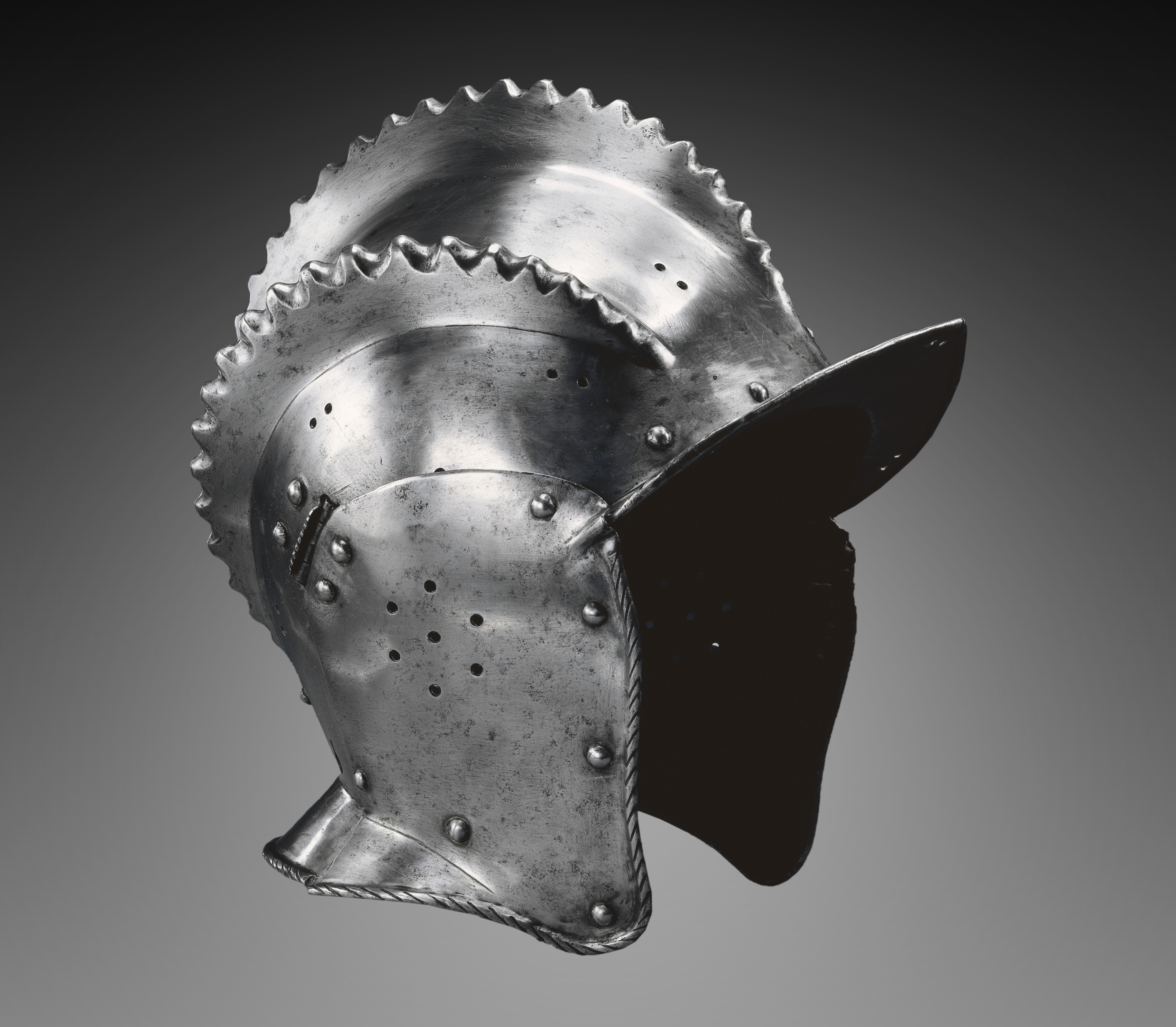
Deconstructing the Triple-Crested Burgonet: An Avant-Garde Analysis for Zoey Fashion Lab
As the Chief Fabric Deconstructionist at Zoey Fashion Lab, my mandate is to dissect historical artifacts not merely as relics of the past, but as living blueprints for future-forward design. The subject of this analysis—a Triple-Crested Burgonet from Germany, possibly Augsburg—presents a formidable challenge and an extraordinary opportunity. Crafted from steel and leather bands, this piece of 16th-century armor is more than a protective helmet; it is a manifesto of power, geometry, and psychological warfare. When viewed through the lens of our New DNA Strand methodology, which seeks to extract the core genetic code of a design and recombine it into avant-garde fashion, the Burgonet reveals a rich vein of inspiration for structural silhouettes, material tension, and spatial defiance.
I. The Original Context: Power Forged in Steel and Leather
The Burgonet, particularly this triple-crested variant, originated in the mid-16th century, a period of intense technological and artistic ferment in German armor-making. Augsburg, a city renowned for its master armorers, produced pieces that were both functional and symbolic. The triple crest—three parallel ridges running from the brow to the back of the skull—was not merely decorative. It served to deflect downward sword blows, channeling them away from the vulnerable crown. The steel provided impenetrable defense, while the leather bands, often used as internal suspension systems or external strapping, introduced a contrasting element of flexibility and organic texture.
For Zoey Fashion Lab, the New DNA Strand approach begins by isolating the core design elements: the aggressive, linear geometry of the crests, the cold hardness of the steel, and the supple, grounding presence of the leather. This is not about replicating armor, but about understanding its physics of protection and its theatrics of intimidation. The Burgonet was designed to make the wearer appear larger, more formidable, and almost superhuman. This psychological dimension is the first thread we pull for our avant-garde translation.
II. Structural DNA: The Triple Crest as a Silhouette Engine
The most immediate and potent element for deconstruction is the triple crest itself. In traditional armor, these ridges are rigid, metallic, and linear. In an avant-garde context, we can re-imagine them as a dynamic structural framework for garments and accessories. The crests are not just lines; they are vectors of energy, directing the eye upward and outward. This suggests a new approach to silhouette construction.
Consider translating the triple crest into a series of exoskeletal spines for a jacket or a dress. Instead of steel, we might use carbon fiber, 3D-printed resin, or even layered, heat-set organza. These spines would run along the spine of a garment, over the shoulders, or down the arms, creating a dramatic, armored silhouette. The key is to maintain the rhythm of the three parallel lines, but to allow them to flex, separate, and interact with the body in motion. The crests become a kinetic sculpture, a visual cadence that breaks the monotony of the human form.
Another translation could involve negative space. The gaps between the crests—the valleys—are equally important. In our deconstruction, we can cut away fabric to reveal skin or an underlying layer, creating a visual echo of the original armor’s functional gaps. This plays with the idea of protection and exposure, a core tension in avant-garde design. The triple crest becomes a window, a frame, or a cage, depending on how we manipulate its geometry.
III. Material Tension: Steel and Leather as a Binary Code
The Burgonet’s material palette—steel and leather—represents a fundamental binary: the rigid versus the flexible, the cold versus the warm, the industrial versus the organic. This material tension is the second strand in our New DNA analysis. For Zoey Fashion Lab, this binary is a rich source of textural and conceptual contrast.
We can deconstruct the steel into laser-cut metal mesh or chainmail, allowing it to drape and flow like fabric while retaining its metallic hardness. This soft armor can be layered over matte leather panels, creating a surface that shifts between hard and soft, reflective and matte. The leather bands, originally functional straps, can be reimagined as structural corsetry or harness-like webbing that cinches and shapes the garment. The interaction between the two materials becomes a dialogue: the steel provides structure, the leather provides grip; the steel reflects light, the leather absorbs it.
In an avant-garde context, we might also invert the roles. What if the steel becomes the base, and the leather becomes the decorative overlay? Or what if both materials are deconstructed into fibers? Steel wool or fine metal threads could be woven with leather strips to create a hybrid textile that is both protective and pliable. This approach aligns with the New DNA Strand philosophy of breaking down a source material to its atomic level and rebuilding it into something unprecedented.
IV. Avant-Garde Manifestations: From Helmet to Haute Couture
Applying these deconstructed elements, we can propose several avant-garde design concepts for Zoey Fashion Lab’s upcoming collection. The first is a crested hood that extends into a full-body cape. The triple crest is rendered in translucent, structural polymer, rising from the hood like a futuristic fin. The cape itself is a hybrid of steel-grey silk and laser-cut leather scales, evoking the overlapping plates of armor while maintaining fluid movement. This piece is a direct descendant of the Burgonet’s silhouette, but it breathes, moves, and interacts with light in ways the original could not.
A second concept is a deconstructed bodice that uses the triple crest as a corset structure. Three articulated metal spines run vertically down the back, connected by leather straps that lace across the front. The bodice is open and airy, exposing the wearer’s back while the crests provide a dramatic, protective frame. This plays with the idea of vulnerability and strength, a hallmark of avant-garde fashion. The leather straps are not merely functional; they are a visual language of binding and release, referencing the original armor’s suspension system.
Finally, we can envision an accessory line inspired by the Burgonet’s visor and crest. A pair of crested shoulder pieces that rise like architectural fins, or a helmet-inspired headpiece that is more sculpture than hat. These pieces would be crafted from a combination of polished steel and aged leather, with the triple crest motif repeated in miniature. They serve as wearable artifacts, bridging the gap between historical armor and contemporary art.
V. Conclusion: The New DNA Strand in Practice
The Triple-Crested Burgonet from Augsburg is a masterclass in the fusion of form, function, and symbolism. Through the New DNA Strand methodology, Zoey Fashion Lab can extract its core genetic code—the aggressive geometry of the crests, the material tension between steel and leather, and the psychological drama of armored protection—and recombine it into avant-garde designs that challenge the boundaries of fashion. This is not about nostalgia; it is about evolution. By deconstructing the past, we forge the future, one crest, one strap, one steel thread at a time.