Deconstructing the Byzantine Pendant Necklace: An Avant-Garde Analysis for Zoey Fashion Lab
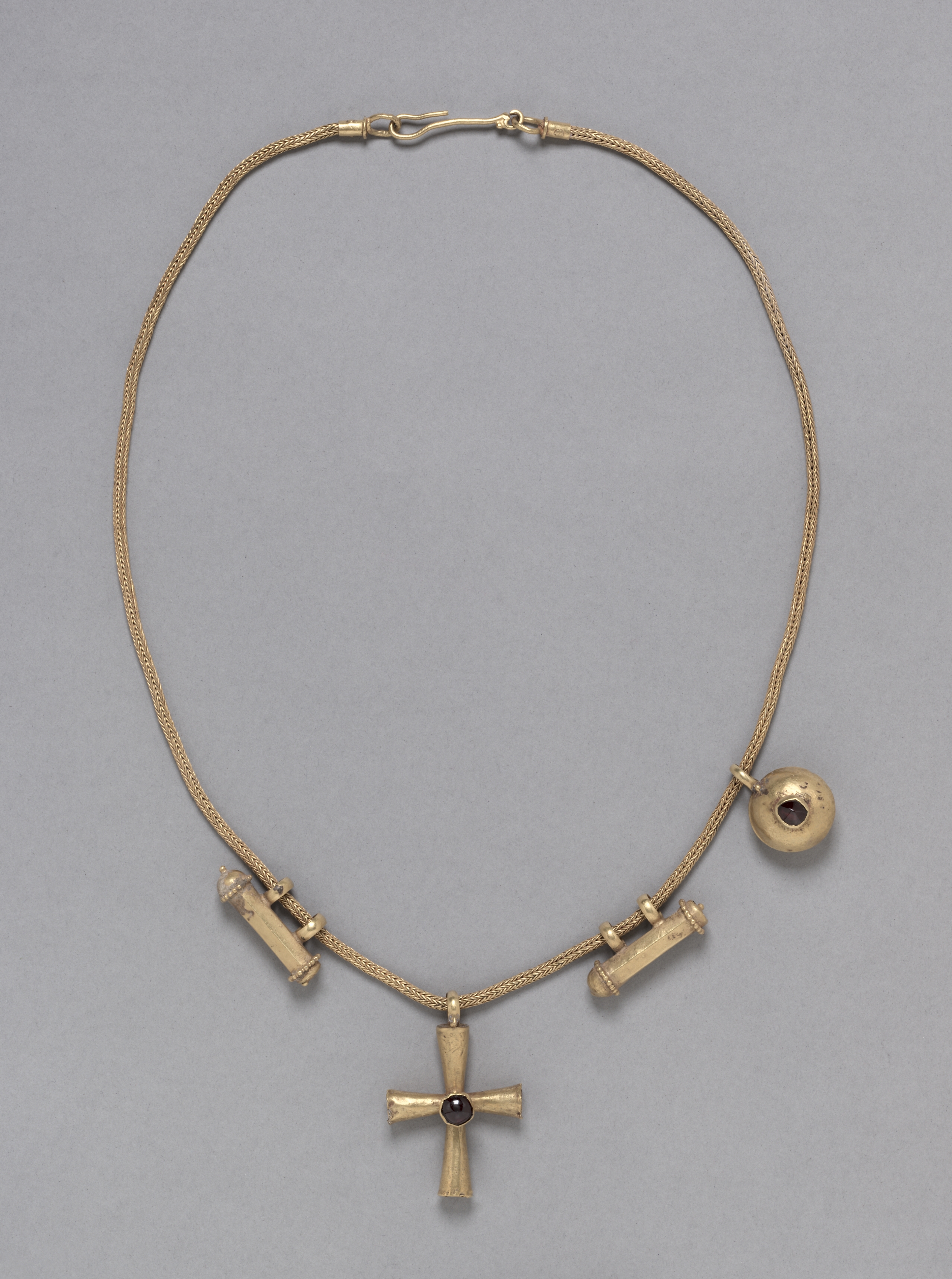
At Zoey Fashion Lab, we do not simply study artifacts; we dissect them. We strip away the patina of history to expose the raw, structural DNA that can be reborn as avant-garde fashion. The object of our current deconstruction is a necklace with pendants, attributed to early Byzantine Constantinople, circa the 6th century. Crafted from gold and garnets, this piece is far more than a relic of imperial piety or aristocratic adornment. It is a frozen conflict—a dialogue between weight and light, between the rigid geometry of faith and the organic pulse of life. Our analysis, informed by the Archive Resonance of the "Mirror with Split-Leaf" dichotomy—the polished silver mirror versus the stone sarcophagus—will reveal how this necklace is a blueprint for a future where fashion is a wearable paradox.
I. The Material Dialectic: Gold as a Prison, Garnet as a Pulse
The technical specifications of this necklace—gold and garnets—are not merely a list of materials. They are the primary agents of a visual argument. In the context of the “Mirror with Split-Leaf” resonance, the gold represents the polished silver mirror: the surface of power, the immutable, the eternal. Byzantine gold, often hammered and worked with extreme precision, was intended to catch light and project an image of divine, unassailable authority. The gold links and settings are a cage of perfection, a rigid syntax that dictates the necklace’s form.
Conversely, the garnets are the cold stone sarcophagus—the dark, the internal, the narrative of death and rebirth. In the 6th century, garnets were often sourced from distant lands (India, Bohemia), their deep, blood-like red symbolizing Christ’s sacrifice and the promise of resurrection. But from an avant-garde perspective, these garnets are fracture points. They are inclusions of raw, organic energy within the perfect gold lattice. Each garnet is a drop of compressed life, a silent scream of color against the metallic silence. For Zoey Fashion Lab, this is the first layer of deconstruction: the necklace is a wearable tension between the rigid frame (society, history, structure) and the volatile interior (emotion, mortality, the unconscious).
II. The Pendant as a Rupture: Geometry of the Split-Leaf
The pendants themselves are the critical elements. They are not merely decorative; they are disruptions in the linear flow of the chain. In early Byzantine jewelry, pendants often took the form of crosses, coins, or stylized leaves. The “Split-Leaf” motif from our Archive Resonance is particularly instructive. A split leaf is a symbol of duality: it is both whole and broken, a single form that has been cleaved.
Imagine the pendants on this necklace not as perfect, symmetrical drops, but as fragments of a larger, unseen whole. One pendant might be a gold circle enclosing a garnet cabochon—a perfect, closed form. But the next pendant could be a split, open-work design, where the gold has been cut away to reveal negative space. This is the avant-garde gesture: the necklace is not a complete statement; it is a series of incomplete sentences.
This aligns with the “Mirror” half of the resonance—the polished, reflective surface that shows a unified image. But the “Split-Leaf” (the sarcophagus) introduces the cut, the break, the fissure. The wearer of such a necklace in the 6th century was not just displaying wealth; they were displaying a theology of fracture—the understanding that earthly life is a broken reflection of divine perfection. In our avant-garde reinterpretation, this becomes a fashion of fragmentation. The necklace is a map of trauma and beauty, where each pendant is a scar, a memory, a moment of rupture.
III. The Chain as a Spine: Linear Narrative vs. Pendant Interruption
The chain of this necklace is its spine—the linear, continuous thread that connects the pendants. In Byzantine design, chains were often intricate, using techniques like loop-in-loop or braided wires. This represents the linear narrative of history: the unbroken line from past to present. The chain is the “silver mirror” of the resonance—smooth, reflective, and continuous.
However, the pendants are the interruptions. They are the “stone relief” that breaks the surface with a story. Each pendant, hanging at a specific point, creates a new vertical axis that pulls the eye downward, away from the horizontal flow. This creates a rhythm of tension and release. The chain pulls the eye along the neckline, while the pendants pull the eye toward the chest, the heart, the internal.
For Zoey Fashion Lab, this is a critical structural insight. The necklace is not a passive ornament; it is an active spatial composition. It creates a dynamic field of vision on the body. The chain is the public, the external; the pendants are the private, the internal. The wearer becomes a walking contradiction: a linear body with vertical outbursts. This is the essence of avant-garde fashion—the body as a site of conflict, not harmony.
IV. The Avant-Garde Rebirth: From Relic to Relational Object
How do we translate this 6th-century artifact into a Zoey Fashion Lab collection? We do not copy the form; we extract the structural principles. The necklace is a system of oppositions: gold/garnet, chain/pendant, mirror/sarcophagus, surface/depth. Our avant-garde interpretation would amplify these oppositions to the point of absurdity or revelation.
First, material subversion. Replace the gold with a matte, blackened steel or a translucent polymer—materials that reject the imperial shine of the original. The garnets could be replaced with laboratory-grown crystals or shards of obsidian, retaining the blood-red color but losing the historical weight. The “precious” becomes the “industrial.”
Second, scale and placement. The pendants, originally small and delicate, could be exaggerated to massive proportions—large, hollow forms that hang like bells or weights. The chain could be a thick, rigid spine, almost like a collar, that forces the wearer into a specific posture. The necklace would no longer be an accessory; it would be a wearable sculpture that dictates movement.
Third, interactivity. What if the pendants could be rearranged? What if the chain could be shortened or lengthened by the wearer, allowing them to choose which “story” (pendant) is most prominent? This transforms the necklace from a fixed relic into a relational object—a tool for self-expression and deconstruction. The wearer becomes the curator of their own fragmentation.
V. Conclusion: The Necklace as a Fractured Mirror
The Byzantine necklace with pendants is not a finished object. It is a document of a culture in conflict with itself—a culture that worshipped an eternal, perfect God but lived in a world of decay and invasion. The gold and garnets are the physical evidence of this cognitive dissonance. The “Mirror with Split-Leaf” resonance captures this perfectly: the desire for a perfect reflection (the polished mirror) and the acceptance of a broken narrative (the stone relief).
For Zoey Fashion Lab, this necklace is a blueprint for a fashion that does not hide its fractures but displays them as design features. It teaches us that the most powerful adornment is not the one that makes the wearer look whole, but the one that makes them look real—a complex, contradictory, living being. The necklace is a wearable philosophy: beauty is not in the absence of breaks, but in the way the light catches them. This is the avant-garde truth we extract from the dust of Constantinople: the future of fashion is not seamless; it is a constellation of precious shards.