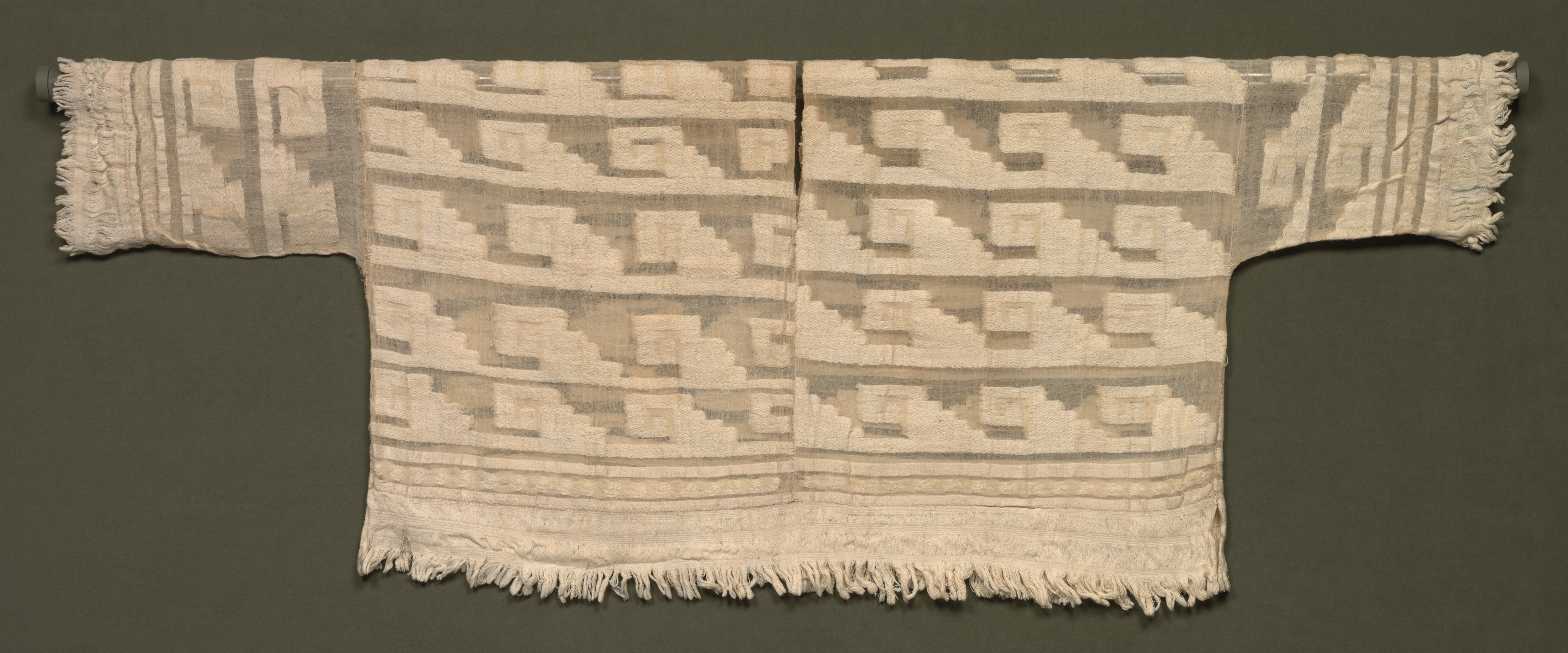
Technical Deconstruction: The Chimú-Inka Tunic as a Textile Artifact
The subject of this analysis is a pre-Columbian tunic from the Chimú or Chimú-Inka period (12th-16th century), originating in present-day Peru. Constructed from white cotton using a plain weave with supplementary weft brocading, this garment represents a pinnacle of Andean textile engineering. For Zoey Fashion Lab, the tunic is not merely an archaeological relic but a living archive of structural intelligence. The plain weave—the most fundamental interlacing of warp and weft—serves as a neutral ground, while the supplementary weft brocading introduces raised, patterned surfaces that disrupt the fabric’s planar uniformity. This technique creates a tactile topography: the brocaded motifs, often geometric or zoomorphic, emerge as dense, embossed islands against the cotton’s soft, absorbent matrix. The choice of white cotton is deliberate, reflecting the Chimú’s mastery of natural fibers and their symbolic association with purity, ritual, and the coastal desert’s stark light.
From a deconstructionist perspective, the tunic’s construction reveals a dialectic between the structural and the ornamental. The warp threads provide vertical stability, while the weft threads—both ground and supplementary—introduce horizontal tension and decorative interruption. The brocading technique, where extra weft threads are inserted only in specific areas, creates a non-uniform density. This selective reinforcement produces zones of stiffness and flexibility, altering the garment’s drape and wear. For the avant-garde designer, this is a lesson in engineered asymmetry: the tunic’s body is not a homogenous field but a choreographed sequence of textured events. The Chimú weaver controlled the interplay of light and shadow, weight and air, by modulating thread tension and pattern repeat. The result is a fabric that breathes with history—each brocaded motif a micro-architecture of rhythm and repetition.
Archive Resonance: Cultural Collision and Aesthetic Witness
The reference to “Archive Resonance” situates this tunic within a broader discourse of cultural exchange and temporal layering. The Chimú civilization, conquered by the Inka around 1470 CE, absorbed and transformed artistic traditions. The tunic’s design may incorporate Inka imperial motifs, such as tocapu (geometric symbols) or stepped diamonds, fused with local Chimú iconography like birds, fish, or stylized waves. This hybrid visual language is a testament to the Chimú-Inka period as a crucible of aesthetic negotiation. The supplementary weft brocading, a technique perfected by the Chimú, was adapted to serve Inka statecraft—textiles became tools of diplomacy and hierarchy. The tunic’s white ground, however, resists complete absorption into Inka chromatic standards (which favored red, yellow, and blue); it asserts a local identity through restrained elegance.
For Zoey Fashion Lab, this archive resonance invites a radical re-reading of colonial and pre-colonial textiles. The tunic is not a static object but a node in a network of influences: the Chimú’s coastal maritime culture, the Inka’s mountainous imperial logic, and the eventual Spanish conquest that would suppress such weaving traditions. The garment’s survival—fragile, faded, yet intact—is a silent testimony to resilience. In the avant-garde context, this resonance translates into design strategies that embrace temporal dissonance. The tunic’s motifs can be deconstructed into abstract fragments, then recombined to create new patterns that reference both the original and its colonial aftermath. The white cotton becomes a canvas for erasure and inscription, where the supplementary weft brocading is reimagined as a code for cultural memory—visible only to those who know how to read its texture.
Avant-Garde Application: Deconstructing the Tunic for Contemporary Fashion
To translate this Chimú-Inka tunic into an avant-garde collection, Zoey Fashion Lab must dismantle its technical and symbolic structures while honoring their integrity. The plain weave with supplementary weft brocading offers a prototype for hybrid construction. Consider a modern iteration where the white cotton base is replaced with a high-tech, breathable mesh, and the brocaded motifs are executed using conductive threads or laser-cut appliqués. This reimagining retains the original’s tactile contrast—soft ground versus raised pattern—while introducing new functionalities: the brocaded areas could house sensors, LED fibers, or pockets for wearable technology. The geometric motifs, once rigid and symmetrical, can be deconstructed into fluid, asymmetric shapes, echoing the Chimú’s mastery of non-uniform density. The tunic’s original silhouette—a rectangular, poncho-like form—can be reassembled into modular garments: a jacket with detachable brocaded panels, a dress with asymmetrical weft inserts, or a cape that maps the tunic’s pattern onto the body’s movement.
The avant-garde approach also demands a recontextualization of the tunic’s ritual function. In Chimú society, such garments were likely worn by elites or used in ceremonial contexts. Zoey Fashion Lab can subvert this by democratizing the brocading technique through digital fabrication. Using 3D weaving or CNC embroidery, the supplementary weft can be automated, allowing for infinite pattern variations. The white cotton, symbolic of purity and hierarchy, can be dyed with natural indigo or cochineal to evoke the Inka palette, creating a dialogue between the two cultures. The resulting garments would be wearable archives: each piece a unique iteration of a historical code, accessible to a global audience. The tunic’s structural intelligence—its selective reinforcement, its modulation of density—becomes a design principle for contemporary fashion that prioritizes adaptive fit and environmental responsiveness. Imagine a dress that stiffens around the shoulders (brocaded zones) while remaining fluid at the hem, or a coat that traps heat in patterned areas while breathing through the plain-weave sections.
Conclusion: The Tunic as a Blueprint for Textile Futurism
In conclusion, the Chimú-Inka tunic is a masterclass in textile deconstruction. Its plain weave with supplementary weft brocading offers a tactile grammar for avant-garde design: the interplay of ground and figure, stability and disruption, tradition and innovation. For Zoey Fashion Lab, this artifact is not a nostalgic relic but a generative matrix—a source of techniques, motifs, and philosophies that can be radically reinterpreted. The archive resonance of cultural collision and aesthetic witness reminds us that fashion is never neutral; it is a field of negotiation between power, identity, and materiality. By deconstructing the tunic’s technical and symbolic layers, we can create garments that are both historically informed and futuristically oriented. The white cotton becomes a blank slate for new narratives; the brocaded patterns become codes for connectivity and memory. This is the essence of Zoey Fashion Lab’s mission: to transform ancient textiles into living, breathing archives that speak to the present and the future. The Chimú-Inka tunic, with its quiet dignity and complex construction, offers a blueprint for a fashion that is rooted in craft, yet unbound by time.