Deconstructing the Maximilian: A Zoey Fashion Lab Analysis of Fluted Steel as Avant-Garde DNA
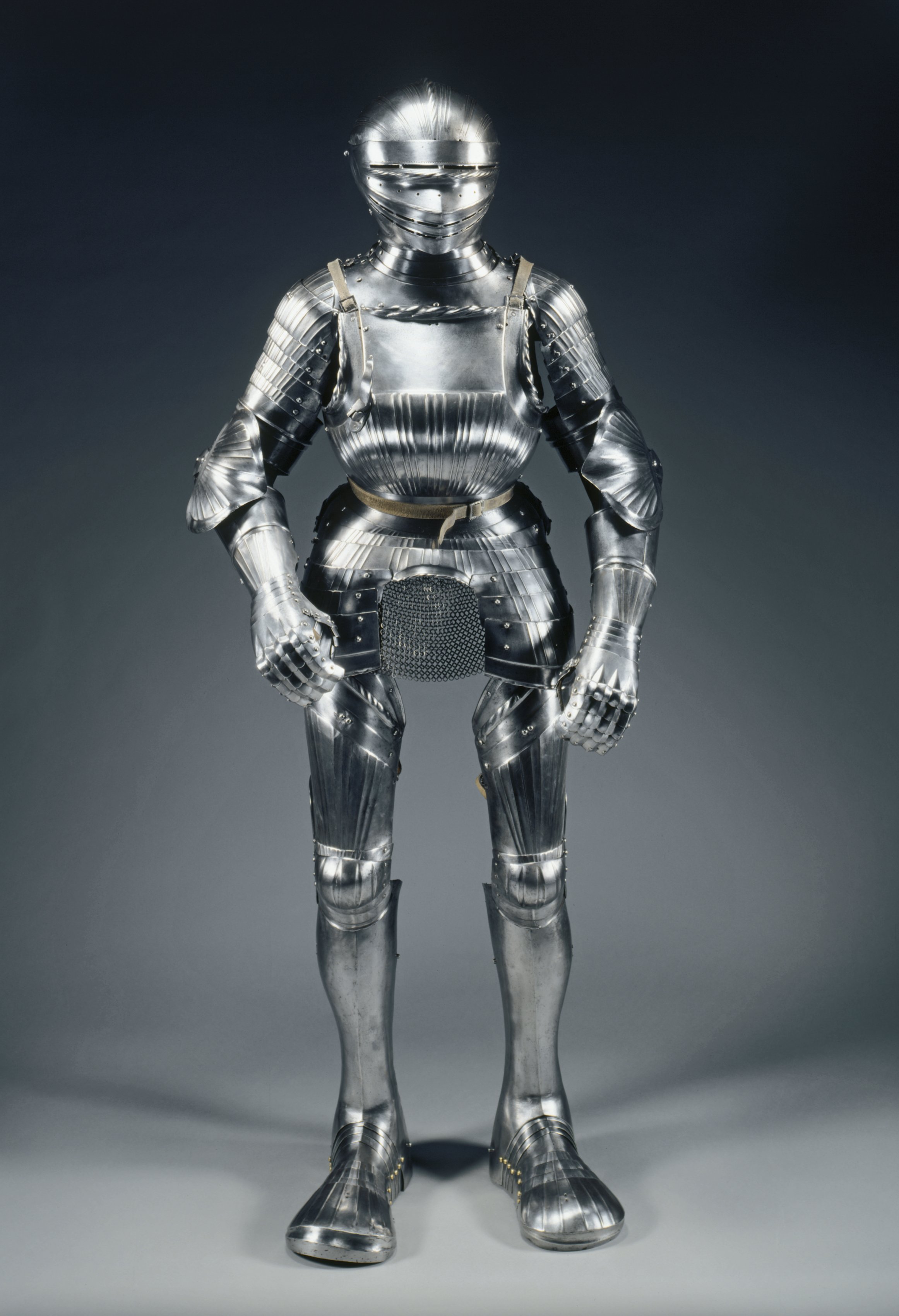
At Zoey Fashion Lab, our mandate is to deconstruct the past to reconstruct the future of fashion. We do not merely observe historical garments; we dissect their structural DNA, their material logic, and their cultural resonance. Today, we turn our analytical lens to a specimen of profound technical and aesthetic sophistication: the Field Armor in the Maximilian style, originating from early 16th-century Germany, likely Augsburg. This object, forged from fluted steel and bound with leather straps, is not a relic of warfare. It is a proto-architectural blueprint for avant-garde design. We identify within its fluted surfaces and articulated joints a New DNA Strand—a genetic code for a future where fashion is not worn, but inhabited as a second skeleton of light and shadow.
I. The Material Lexicon: Steel as Second Skin
The primary material of Maximilian armor—fluted steel—presents a paradox that is central to our deconstruction. Steel is, by nature, rigid, heavy, and unforgiving. Yet the Maximilian style, perfected in the Augsburg workshops of the late 15th and early 16th centuries, transformed this industrial material into a medium of dynamic, almost fluid expression. The deep, parallel fluting that covers the breastplate, tassets, and pauldrons is not merely decorative. It is a structural innovation that increases the armor’s rigidity without adding weight, much like the corrugation in modern cardboard or the ribbing in a whalebone corset. For Zoey Fashion Lab, this fluting represents the first true instance of functional texture in wearable form. It is a surface that actively engages with light, creating a visual rhythm of highlights and shadows that shifts with every movement of the wearer. This is not a passive surface; it is a performative one.
The leather straps, conversely, are the armor’s organic nervous system. They are the points of articulation, the flexible joints that allow the rigid steel plates to move with the human body. In our avant-garde reinterpretation, these straps are not mere fasteners. They are the visible seams of a cyborg exoskeleton, the points where the inorganic meets the organic. They speak to a design philosophy that refuses to hide its construction. The Maximilian armor, like the most radical contemporary fashion, is honest about its assembly. The straps, buckles, and rivets are not concealed; they are celebrated as the architecture of movement.
II. The Structural Logic: Articulation as Avant-Garde Silhouette
The Maximilian style is defined by its articulation. The armor is not a single, monolithic shell but a system of overlapping plates—the cuirass, the gorget, the pauldrons, the gauntlets, the tassets—each moving independently while contributing to a unified whole. This is a modular system centuries ahead of its time. For Zoey Fashion Lab, this articulation is the key to unlocking a new silhouette. The silhouette of Maximilian armor is not the natural shape of the human body; it is an engineered, idealized form—a broad-shouldered, narrow-waisted V-shape that projects power and symmetry. This is the armored silhouette, and it is a direct ancestor of the exaggerated shoulders and cinched waists of contemporary avant-garde designers like Rei Kawakubo or Rick Owens.
However, our analysis goes deeper. The fluting itself creates a secondary silhouette—a surface topography that is independent of the body’s contours. The ridges and valleys of the steel produce a pleated, accordion-like effect that prefigures the structural pleating techniques of Issey Miyake. The armor’s surface is not smooth; it is a landscape of controlled folds. This is a pre-industrial form of 3D printing, where the material is shaped by hammer and heat into a predetermined, repeatable pattern. The result is a garment that is both armor and sculpture, a wearable architecture that defines space around the body.
III. The Cultural Resonance: From Battlefield to Catwalk
The Maximilian armor was designed for the tournament and the battlefield, but its cultural function was equally about spectacle and identity. It was a status symbol, a display of wealth, craftsmanship, and technological prowess. The fluting, in particular, was a stylistic choice that signaled the wearer’s belonging to a specific courtly culture—a visual language of power and refinement. In this sense, the armor is a precursor to the luxury fashion house, where a garment’s value is determined not only by its material but by its ability to communicate a specific aesthetic and social code.
For the avant-garde designer, the Maximilian armor offers a radical proposition: fashion as protective exoskeleton. In an age of digital vulnerability and environmental precarity, the idea of clothing that shields, that projects strength, that redefines the human form as a fortified structure, is deeply resonant. The armor’s fluting becomes a metaphor for resilience—a surface that absorbs and redirects visual and physical impact. The leather straps, worn and patinated, speak to the passage of time, to the wear and tear of existence. This is not a pristine, untouchable object; it is a lived-in, battle-scarred piece of wearable history.
IV. The New DNA Strand: A Blueprint for Deconstruction
At Zoey Fashion Lab, we identify the New DNA Strand within the Maximilian armor as the principle of structured fluidity. This is the ability to create a garment that is simultaneously rigid and flexible, monumental and mobile. The fluting is the key. It is a repetitive, geometric pattern that can be scaled, rotated, and recontextualized. In our avant-garde reconstruction, we would extract this fluting and translate it into new materials: laser-cut leather, molded silicone, 3D-printed polymers, or even woven metallic threads. The fluting becomes a surface algorithm, a repeatable unit of design that can generate infinite variations.
The leather straps become the connective tissue of this new system. They are the points of tension and release, the hinges that allow the rigid plates to articulate. In our design, these straps would be exaggerated, multiplied, and repositioned. They would become the primary visual element—a web of leather that binds the steel components together, creating a harness-like exoskeleton that is both functional and sculptural. The armor’s original function—protection—is retained, but it is transformed. The new garment protects not against swords and lances, but against the invisible violence of the contemporary world: the gaze, the algorithm, the pressure to conform.
Finally, we deconstruct the armor’s silhouette. The exaggerated V-taper, the broad shoulders, the narrow waist—these are proportions that distort the human form in a deliberate, theatrical manner. In our avant-garde interpretation, we would push these proportions to their extreme. The shoulders become wing-like structures, the waist is cinched to an impossible degree, the tassets extend into a sculptural skirt. The result is a garment that is no longer armor in the traditional sense, but a wearable monument—a statement of individuality and defiance. The Maximilian armor, deconstructed and reconstructed, becomes a New DNA Strand for a fashion that is not afraid to be heavy, to be loud, to be unapologetically architectural. It is a reminder that the most radical future is often forged from the most refined past.