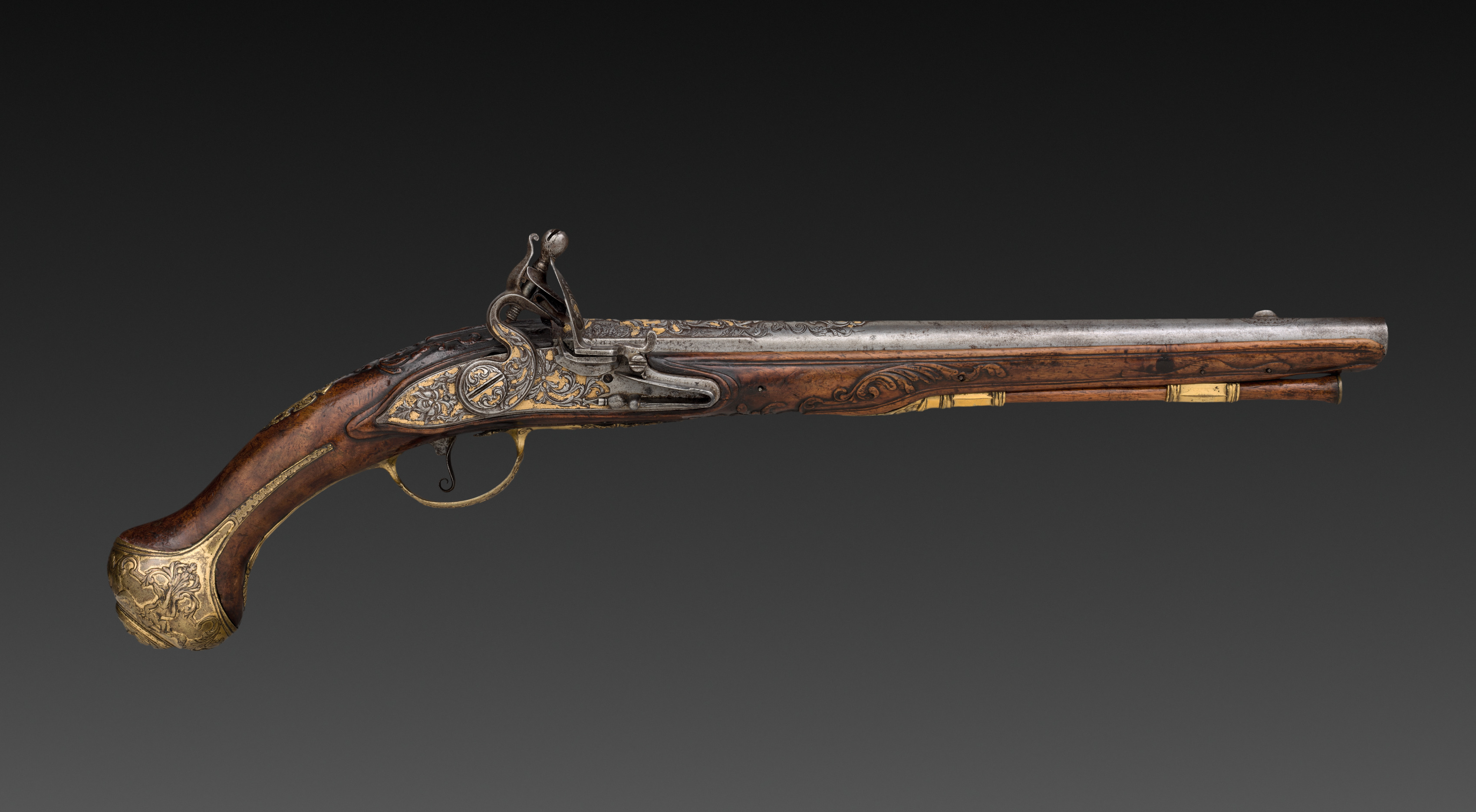
Deconstructing the Flintlock Pistol (2 of 2): A Franco-Flemish Avant-Garde Artifact
At Zoey Fashion Lab, we approach historical artifacts not as static relics but as dynamic blueprints for future design. The Flintlock Pistol (2 of 2), a Franco-Flemish masterpiece from early 18th-century Liège, represents a profound intersection of technical mastery and aesthetic rebellion. This weapon, crafted from steel with gold inlay, gilt-brass mounts, and a walnut burl stock, is more than a firearm—it is a sculptural manifesto. Its chiseled high-relief decoration and intricate goldwork prefigure the avant-garde’s obsession with texture, contrast, and the subversion of function. By analyzing this piece through our proprietary New DNA Strand framework, we uncover a lexicon of design principles that can inform contemporary fashion, from structural silhouettes to material storytelling.
Technical Mastery as Design Language
The pistol’s construction reveals a deliberate tension between utility and ornament. The steel barrel, reinforced with gold inlay, is not merely functional but a canvas for narrative. The gold, applied in flowing arabesques and geometric motifs, creates a visual rhythm that mirrors the weapon’s kinetic potential. This technique—where precious metal is fused with utilitarian steel—echoes modern fashion’s use of hardware as both structure and decoration. Consider how a garment’s zippers or clasps can transform from practical elements into sculptural accents. The walnut burl stock, with its natural swirling grain, adds an organic counterpoint to the metal’s rigidity. This juxtaposition of materials—cold steel against warm wood, precise inlay against organic burl—offers a lesson in contrast. For Zoey Fashion Lab, this inspires collections that pair structured leather with fluid silk, or matte finishes with high-shine accents, creating a dialogue between control and chaos.
The gilt-brass mounts, often overlooked in historical analysis, are critical here. Their polished surfaces catch light in ways that emphasize the pistol’s contours, much like a well-placed seam or panel in a garment. The chiseled high-relief decoration—depicting mythological scenes and floral patterns—adds a third dimension, transforming the flat plane of the metal into a tactile landscape. This three-dimensionality is a direct ancestor of avant-garde fashion’s love for architectural draping, pleating, and fabric manipulation. Techniques like couture-level smocking or laser-cut leather achieve a similar effect, where surface becomes sculpture.
The Avant-Garde Lens: Subverting Function
Historically, the flintlock pistol was a instrument of power and precision. Yet, its ornate decoration suggests a purpose beyond utility. The gold inlay and high-relief carving imply that the owner valued aesthetic impact as much as ballistic performance. This duality—function subverted by form—is a cornerstone of avant-garde design. In fashion, this manifests as garments that prioritize silhouette over practicality, or accessories that challenge traditional ergonomics. For instance, a coat with exaggerated shoulders or a dress with asymmetrical seams can evoke the same tension between purpose and artistry that this pistol embodies.
The New DNA Strand framework identifies five key elements in this artifact: Contrast (steel vs. gold, wood vs. metal), Texture (smooth inlay vs. chiseled relief), Rhythm (repeating arabesques), Scale (intricate details on a compact form), and Narrative (mythological scenes). These elements can be directly translated into fashion design. Contrast inspires fabric pairings like velvet and latex; texture drives surface treatments such as beading or embossing; rhythm guides print placement or seam lines; scale influences proportion, like oversized pockets on a fitted jacket; and narrative creates thematic collections, such as a series inspired by 18th-century weaponry reimagined as wearable art.
Material Storytelling in Contemporary Fashion
The walnut burl stock is particularly instructive. Its organic grain is a natural form of camouflage, not for hiding but for revealing depth. In fashion, this translates to materials like marbled silk or digitally printed textiles that mimic wood grain. The gold inlay, meanwhile, represents a form of luxury that resists mass production. Each piece is hand-applied, making the object unique. This aligns with the current trend toward artisanal fashion, where hand-stitched details or hand-painted fabrics signal exclusivity. For Zoey Fashion Lab, this inspires limited-edition pieces where craftsmanship is the primary value, not just the material cost.
The gilt-brass mounts, often featuring intricate scrollwork, can be reinterpreted as metal hardware in accessories. Think of a belt buckle with chiseled relief or a handbag clasp that doubles as a sculptural element. The high-relief decoration on the barrel, with its mythological figures, suggests a narrative approach to surface design. In fashion, this could manifest as embroidered scenes on a gown or laser-etched patterns on a leather jacket. The key is to integrate storytelling into the construction, making the garment a conversation piece.
Deconstructing the “Weapon” as Fashion Archetype
The flintlock pistol, as an object, carries cultural weight. It is a tool of aggression, yet its beauty invites admiration. This paradox is fertile ground for avant-garde fashion, which often challenges societal norms. A garment inspired by this pistol might use hardware as armor, such as metal shoulder pieces or chainmail accents, but rendered in soft materials like leather or even textile. The silhouette could echo the pistol’s curved grip and straight barrel, creating a visual tension between curved and linear forms. The color palette—steel gray, gold, walnut brown, and brass—offers a restrained yet rich scheme that can be adapted into monochromatic or tonal collections.
Furthermore, the pistol’s compact size belies its complexity. This teaches us that scale does not limit impact. In fashion, this encourages designers to focus on details: a single embroidered motif on a sleeve, a precisely placed seam, or a unique button can elevate an entire garment. The avant-garde thrives on such micro-decisions, where every element is intentional.
Conclusion: A Blueprint for the Future
The Flintlock Pistol (2 of 2) is not a relic of the past but a precursor to modern design thinking. Its fusion of technical precision and artistic expression offers a template for fashion that is both functional and transcendent. By applying the New DNA Strand framework, Zoey Fashion Lab can extract principles of contrast, texture, rhythm, scale, and narrative to create collections that honor historical craftsmanship while pushing the boundaries of contemporary style. This analysis affirms that the most innovative designs often emerge from deconstructing the past, finding new DNA in old forms, and reimagining them for a future where fashion is not just worn but experienced as a living artifact.