Deconstructing the Divine: The Amitabha Triad as Avant-Garde Textile Catalyst
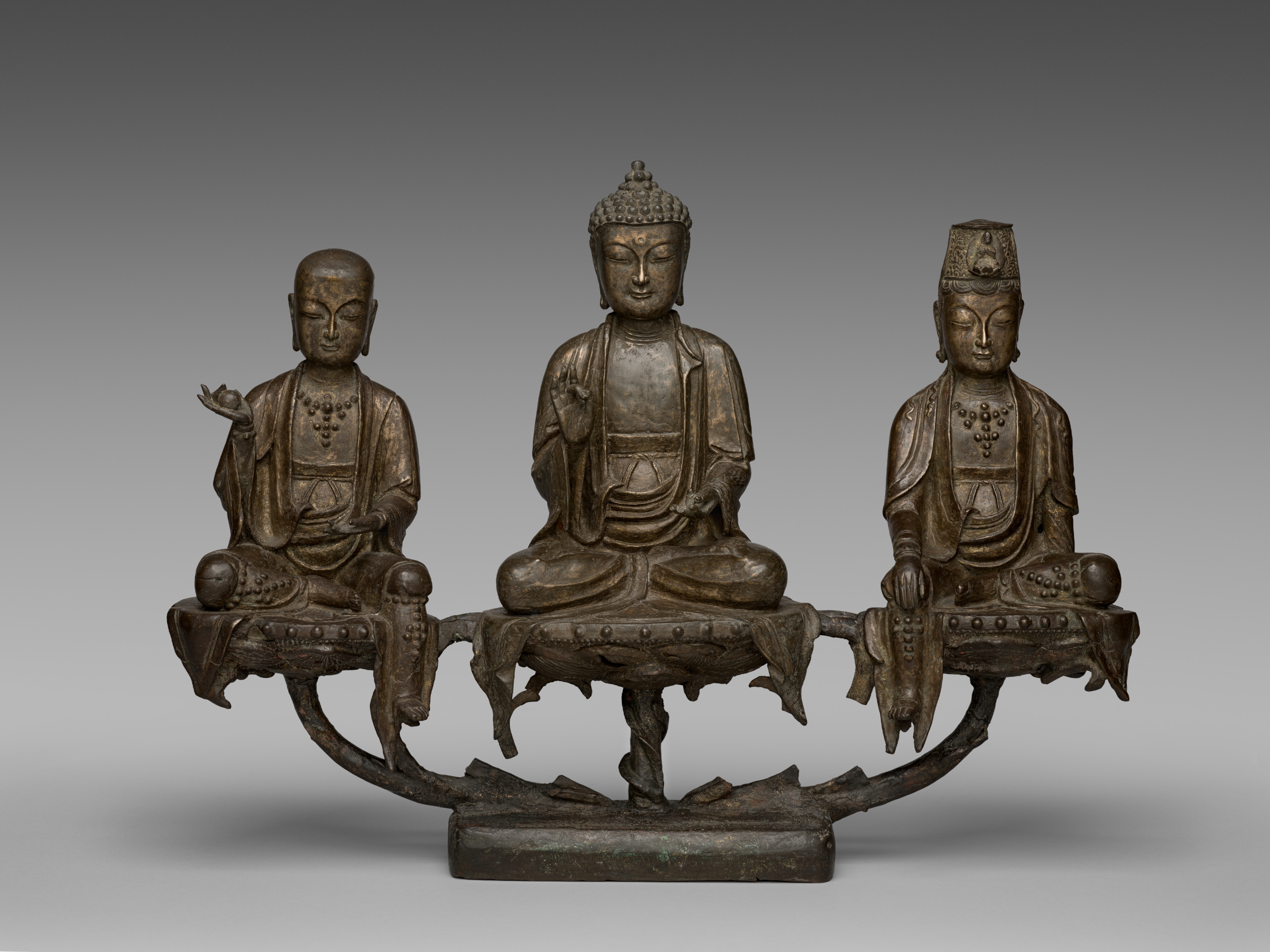
At Zoey Fashion Lab, we approach historical artifacts not as relics to be preserved, but as raw material for narrative deconstruction. The Amitabha Triad—a Korean Joseon dynasty bronze sculpture with traces of gilding—presents a paradox of stillness and movement, of sacred geometry and earthly decay. Its very materiality, the bronze that once shimmered with gold, now speaks of time’s corrosive touch. For our avant-garde sensibility, this triad is not a religious icon but a blueprint for a new kind of fabric: one that weaves together the immaterial aura of enlightenment, the tactile memory of metal, and the radical asymmetry of the human condition.
Material Memory: From Bronze to Bio-Textile
The triad’s bronze, with its patina and residual gilding, becomes our primary text. We deconstruct its surface into a layered textile architecture. Imagine a base fabric woven from oxidized copper threads, their verdigris hue shifting from deep malachite to pale celadon. Upon this, we apply a discontinuous gold foil appliqué—not as a uniform coating, but as fragmented, almost calligraphic traces that mimic the original gilding’s wear. This is not a restoration; it is a deliberate erosion. The gold catches light in unpredictable angles, creating a visual dissonance between the sacred intention of the original and the accidental beauty of its decay.
We then introduce a thermochromic layer—a pigment that shifts from cool silver to warm gold when exposed to body heat. This responds to the wearer’s movement, echoing the triad’s original function as a focus for meditation. The fabric becomes a living relic, its color a barometer of spiritual or kinetic energy. The bronze’s structural rigidity is translated into a 3D-printed lattice of recycled metal dust embedded in a biodegradable polymer, forming a flexible exoskeleton that mimics the triad’s drapery folds. This lattice is not hidden; it is exposed, a visible skeleton that speaks to the tension between the eternal and the ephemeral.
Split-Leaf Mirror: The Triad’s Shadow Self
Our analysis is deepened by the reference to the Mirror with Split-Leaf—a silver mirror with gold palm-leaf inlay on one side, and a stone coffin’s relief narrative on the other. This duality is our second structural principle. The Amitabha Triad, in its serene frontality, becomes the “mirror” side—a polished surface reflecting the ideal. But the avant-garde demands the “stone coffin” side—the hidden, the repressed, the narrative of death and transformation.
We create a double-faced fabric. The outer face, visible to the world, is a high-shine silver lamé with laser-cut palm-leaf motifs, their edges raw and unfinished. This is the “mirror”—cold, reflective, and deceptively perfect. The inner face, against the skin, is a textured, felted wool dyed in the deep umber and charcoal of aged stone. Upon this surface, we embroider a fragmented narrative using black silk thread: the triad’s hands in mudra, the lotus petals, the halo—but all distorted, as if viewed through water or memory. This inner narrative is only revealed when the garment is turned inside out or when the wearer’s movement lifts the outer layer—a secret history against the body.
Avant-Garde Silhouette: The Asymmetric Halo
The triad’s iconic mandorla (halo) is deconstructed into a radically asymmetrical silhouette. We reject the perfect oval. Instead, we create a modular garment: a cape or coat that extends in a sweeping arc from the left shoulder, tapering to a sharp point at the right hip. This asymmetry mirrors the split-leaf motif—a line that is both organic and violent. The fabric’s weight is distributed unevenly, forcing the wearer into a dynamic posture that echoes the triad’s subtle contrapposto, a slight shift in weight that suggests imminent movement.
We introduce deconstructive seams that run diagonally across the torso, mimicking the bronze’s casting lines and the stone coffin’s cracks. These seams are not finished; they are raw, exposing the textile’s inner layers—the felted wool, the copper threads, the thermochromic film. This is a deliberate incompleteness, a rejection of the triad’s serene perfection in favor of a wabi-sabi aesthetic that celebrates the beauty of impermanence. The garment’s hem is laser-burned in irregular patterns, creating a charred edge that references both the gilding’s fire and the coffin’s earthly decay.
Gilding as Code: The Trace of the Sacred
The traces of gilding on the bronze are not merely decorative; they are spiritual code. In Buddhist iconography, gold represents the enlightened mind, the immutable truth. But in our deconstruction, this gilding becomes a fractured algorithm. We translate the gilding’s pattern—its peaks and valleys of wear—into a digital print using a custom algorithm that maps the bronze’s surface topography. This print is applied to the fabric using a discharge technique, where the color is removed rather than added, creating a negative space that echoes the original gilding’s loss.
This printed pattern is then overlaid with hand-stitched gold thread in a random, almost chaotic stitch. The thread is not continuous; it breaks and resumes, mimicking the gilding’s fragmentary survival. This is a meditation on loss—the recognition that the sacred is always partially obscured, always a trace. The wearer becomes a custodian of absence, carrying the memory of a god who is no longer fully present.
Conclusion: The Fabric as Ritual
The Amitabha Triad, deconstructed for the avant-garde, is not a costume but a ritual garment for the post-religious age. It is a fabric that performs its own history: the bronze’s weight, the gilding’s light, the mirror’s reflection, the coffin’s silence. At Zoey Fashion Lab, we do not recreate the past; we reanimate its fragments into a new language of texture, color, and form. This garment is a dialogue between the eternal and the ephemeral, a wearable meditation on what it means to carry the divine in a world of decay. The triad’s serene gaze is now the wearer’s own—a gaze that sees both the mirror’s surface and the stone’s depths, the gold’s gleam and the bronze’s corrosion. In this fabric, the sacred is not a destination but a process of becoming, always trace, always fragment, always alive.