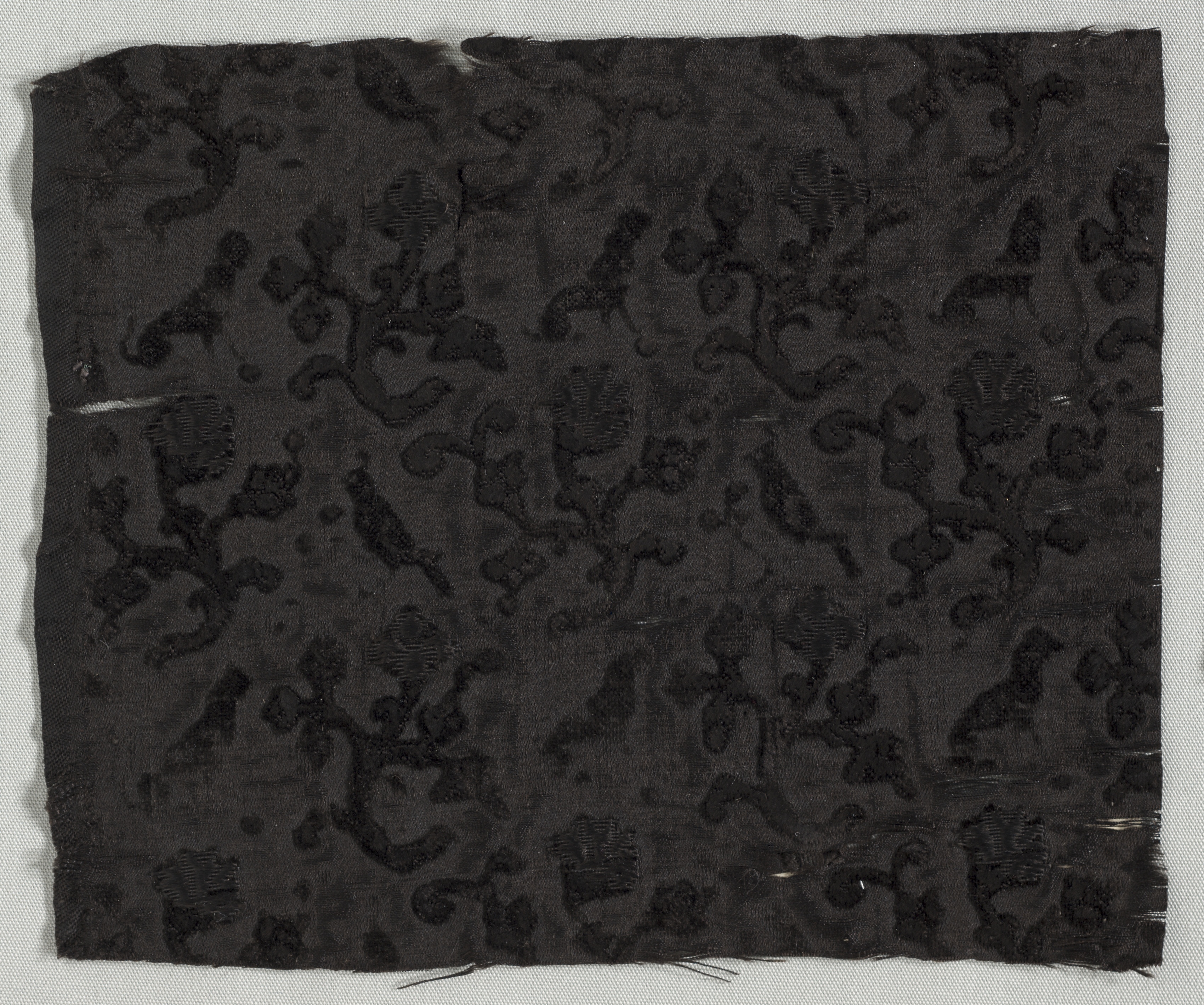
Deconstructing the Velvet Fragment: An Avant-Garde Analysis for Zoey Fashion Lab
At Zoey Fashion Lab, the role of the Chief Fabric Deconstructionist is not merely to dissect textiles but to unearth their latent narratives, structural secrets, and potential for radical reinvention. The subject of this analysis—a velvet fragment originating from early 18th-century Italy—presents a compelling paradox. On one hand, it is a relic of aristocratic opulence, a symbol of courtly power and meticulous craftsmanship. On the other, its materiality, when examined through the lens of avant-garde design, reveals a new DNA strand: a blueprint for subverting tradition, challenging texture, and redefining luxury for the contemporary era. This fragment is not a dead artifact; it is a living, mutable code waiting to be rewritten.
Material Provenance and Historical Context
The fragment’s origin in early 18th-century Italy places it within the zenith of Venetian and Florentine textile production. Velvet, during this period, was a fabric of immense prestige, often woven with silk and metallic threads to create intricate patterns of pomegranates, acanthus leaves, or heraldic motifs. The pile—the dense, cut loops of silk—provided a surface that absorbed and reflected light in a manner that signified wealth and status. For Zoey Fashion Lab, this historical weight is not a constraint but a catalyst. The fragment’s DNA strand is encoded with the labor of anonymous artisans, the chemical aging of natural dyes, and the physical memory of wear. Deconstructing this strand means acknowledging its past while severing its ties to nostalgia. The avant-garde approach demands that we treat this velvet not as a museum piece but as a raw material for a new species of fashion—one that embraces decay, asymmetry, and the unexpected.
Structural Anatomy: Pile, Warp, and Weft
Technically, velvet is a complex weave. The fragment’s structure consists of a ground weave (warp and weft) and a supplementary pile warp that creates the characteristic soft surface. In this Italian example, the pile is likely cut, resulting in a plush, uniform texture. However, centuries of aging have introduced micro-fractures, faded color zones, and areas of pile loss. For the avant-garde deconstructionist, these imperfections are not flaws but new design opportunities. The fragment’s DNA reveals a tension between the original intention (perfect, uniform luxury) and the reality of entropy (uneven wear, discoloration). Zoey Fashion Lab can exploit this tension by isolating the pile structure, selectively shearing it to create topographic relief, or laminating it with transparent polymers to freeze the decay in a state of permanent flux. The warp and weft, often hidden beneath the pile, become exposed narratives—skeletal threads that speak to the fabric’s underlying engineering. By reversing the velvet’s typical hierarchy (pile over ground), we can generate a new textile language: one where the structural bones are celebrated rather than concealed.
Color, Light, and the Avant-Garde Palette
The original dye palette of early 18th-century Italian velvet was derived from natural sources: madder for reds, woad for blues, and kermes for deep crimsons. Over time, these colors have shifted—fading, oxidizing, and interacting with environmental pollutants. The fragment under analysis exhibits a muted, uneven coloration, with areas of deep burgundy transitioning into ochre and grey. This chromatic instability is a goldmine for avant-garde aesthetics. Instead of attempting to restore the original hue, Zoey Fashion Lab can treat the fragment’s color as a living gradient. By applying digital scanning and reactive dye processes, we can amplify the existing patina, creating garments that change color in response to light or humidity. The velvet’s pile, which historically captured light to create a luminous effect, can be manipulated through laser etching or ultrasonic cutting to produce moiré patterns, optical illusions, or even QR-code-like textures that reference digital culture. The fragment’s DNA strand includes a memory of light; we can reprogram it to emit, absorb, or distort light in ways the original weavers could never have imagined.
Deconstruction as Reconstruction: The New DNA Strand
The concept of a new DNA strand is central to Zoey Fashion Lab’s methodology. In biological terms, DNA is a code that can be edited, spliced, and mutated. Similarly, the velvet fragment’s material DNA—its fiber composition, weave structure, and dye chemistry—can be recombined with contemporary materials. Consider merging the velvet’s silk pile with recycled carbon fiber or bio-fabricated cellulose. The result would be a hybrid textile that retains the tactile luxury of velvet while gaining structural rigidity, conductivity, or biodegradability. The fragment’s historical weave pattern (perhaps a Baroque damask) can be digitally reinterpreted as a parametric algorithm, generating infinite variations that are then woven or printed onto new substrates. This is not mere replication; it is genetic modification of a textile’s essence. The avant-garde garment that emerges from this process would be a palimpsest—layered with the ghost of the original yet fully adapted to the demands of a future where fashion is interactive, sustainable, and provocative.
Avant-Garde Applications: From Fragment to Form
How does this analysis translate into tangible design? Zoey Fashion Lab can approach the velvet fragment as a modular unit. The fragment’s dimensions (assuming a roughly 30x40 cm piece) suggest possibilities for deconstructed construction. Instead of cutting the velvet into traditional pattern pieces, we can preserve its irregular edges and incorporate them into a garment’s seams, creating a deliberate asymmetry that honors the fragment’s history. The pile can be selectively burned away using laser technology to reveal the ground weave, forming text or abstract imagery. The fragment can be embedded within a transparent resin shell, creating a wearable artifact that freezes the moment of decay. Alternatively, the velvet can be shredded and re-felted into a new non-woven fabric, its fibers randomized to erase the original pattern while retaining the tactile DNA. Each of these applications treats the fragment not as a sacred relic but as a catalyst for mutation.
Conclusion: The Fragment as a Living Archive
The early 18th-century Italian velvet fragment, when subjected to avant-garde deconstruction, ceases to be a passive object of study. It becomes a living archive—a repository of techniques, materials, and histories that can be activated, disrupted, and reimagined. For Zoey Fashion Lab, this analysis confirms that the most radical designs often emerge from the most traditional sources. By decoding the fragment’s DNA strand—its weave, color, decay, and context—we unlock a vocabulary of subversion. The velvet is no longer a symbol of static luxury; it is a dynamic system, a text to be rewritten, a code to be hacked. In the hands of the Chief Fabric Deconstructionist, this fragment is not the end of a story but the beginning of a new species of fashion—one that honors the past by daring to destroy it, and in doing so, creates something truly unprecedented.