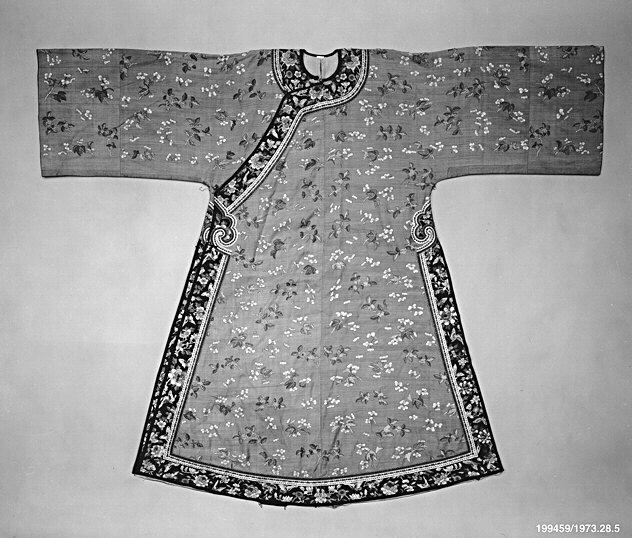
Deconstructing the Silhouette: The Woman’s Informal Robe as a Futuristic Armature
Within the hallowed halls of Zoey Fashion Laboratory, the Woman’s Informal Robe from China emerges not as a relic of domestic leisure, but as a radical prototype for Spring/Summer 2026. This garment, traditionally defined by its loose, enveloping form, undergoes a tectonic shift. The robe is no longer passive; it becomes an active agent of architectural expression. The alloy of silk and metallic thread is not a mere decorative flourish—it is a structural manifesto. The silk provides a liquid, almost sentient base, while the metallic thread acts as a rigid, tensile skeleton, creating a paradoxical fabric that drapes with fluidity yet holds its sculptural edge. This is the foundation of a new silhouette: one that is simultaneously soft and unyielding, organic and industrial.
The Metallic Thread as Structural Exoskeleton
The true innovation lies in the strategic placement of the metallic thread. Rather than a uniform weave, the thread is concentrated in key stress points: the shoulders, the spine, and the hem. This creates a dynamic exoskeleton that redefines the robe’s traditional drape. The shoulders are cantilevered outward, forming sharp, aerodynamic points that evoke futuristic armor. The spine is traced by a continuous metallic line that runs from the nape to the lower back, allowing the robe to arc away from the body in a controlled, parabolic curve. This is not a garment that hangs; it articulates. The hem, weighted with a dense lattice of metallic thread, resists gravity, floating in a constant state of tension. The result is a silhouette that appears to be in mid-transformation—a frozen moment of structural innovation.
Futuristic Silhouettes: The Robe as a Modular System
For SS26, the Woman’s Informal Robe is reimagined as a modular system. The traditional open front is replaced with a series of asymmetrical, laser-cut closures that allow for multiple configurations. The robe can be worn fully closed, creating a sleek, cocoon-like form that narrows at the ankles. Alternatively, one side can be unlatched, revealing a dramatic, diagonal sweep of fabric that cascades like a digital waterfall. This is a transformable architecture that responds to the wearer’s movement. The metallic thread catches light differently in each configuration, creating a shifting, holographic effect that mimics the digital glitches of virtual fashion. The silhouette is no longer fixed; it is a variable, a system of possibilities. This modularity speaks to a future where garments are not static objects but adaptive interfaces.
The Silk as a Living Membrane
The silk itself is treated with a bio-mimetic finish that reacts to ambient temperature and humidity. In cooler environments, the fabric contracts, creating a tighter, more structured silhouette. As the temperature rises, the silk relaxes, allowing the robe to expand and flow. This is not a mere gimmick; it is a functional innovation that redefines the relationship between garment and environment. The metallic thread, woven in a pattern reminiscent of neural networks, amplifies this effect. When the silk expands, the metallic threads create a visible, grid-like pattern on the surface, transforming the robe into a living cartography of the wearer’s immediate surroundings. The silhouette becomes a responsive landscape, shifting from a sharp, architectural form to a more organic, billowing one. This is the avant-garde at its most intellectual: a garment that thinks, adapts, and communicates.
Structural Innovation: The Invisible Infrastructure
Beneath the surface, the robe’s construction is a marvel of engineering. The traditional Chinese robe relies on simple seams and straight cuts. Here, the garment is built on a hidden infrastructure of internal boning and tension cables, all made from the same metallic thread. This infrastructure is invisible from the exterior but dictates the robe’s every curve and angle. The boning runs along the internal seams, creating a rigid armature that allows the silk to maintain its futuristic silhouette without external support. The tension cables, anchored at the shoulders and hem, can be adjusted by the wearer to alter the robe’s volume and shape. This is a dynamic chassis that empowers the wearer to become the architect of their own silhouette. The robe is no longer a garment; it is a wearable machine, a tool for personal expression through structural manipulation.
The Deconstructive Aesthetic: Exposing the Process
The avant-garde ethos demands a deconstructive approach. The robe’s seams are deliberately exposed, revealing the metallic thread’s intricate weave. The raw edges are left unfinished, fraying into delicate tendrils that catch the light. This is not a sign of negligence but a celebration of process. The garment’s construction is laid bare, inviting the viewer to understand the engineering behind the aesthetic. The metallic thread is visible not just in the structure but in the stitching itself, creating a contrast between the fluid silk and the rigid, almost surgical precision of the thread. This deconstructive layer adds a dimension of intellectual rigor, transforming the robe from a simple object into a manifesto of materiality. The wearer becomes a living exhibit of textile science and design philosophy.
Conclusion: The Robe as a Portal to SS26
The Woman’s Informal Robe, reimagined for Zoey Fashion Laboratory, is a definitive statement for SS26. It is a garment that transcends its origins, becoming a platform for futuristic silhouettes and structural innovation. The silk and metallic thread are not materials; they are agents of transformation. The modular closures, the responsive fabric, the hidden infrastructure—all converge to create a silhouette that is both timeless and radically new. This is not a robe for lounging; it is a robe for commanding space, for defining one’s own presence. In the context of the avant-garde, this garment stands as a testament to the power of deconstructive thinking and architectural rigor. It is a portal to a future where fashion is not just worn but inhabited—a living system of structure, light, and movement. For the discerning connoisseur of high-concept couture, this robe is not merely an item of clothing; it is a blueprint for the next decade of design.