Deconstructing the Celestial Vessel: Firdausi’s Parable as a Blueprint for SS26 Structural Innovation
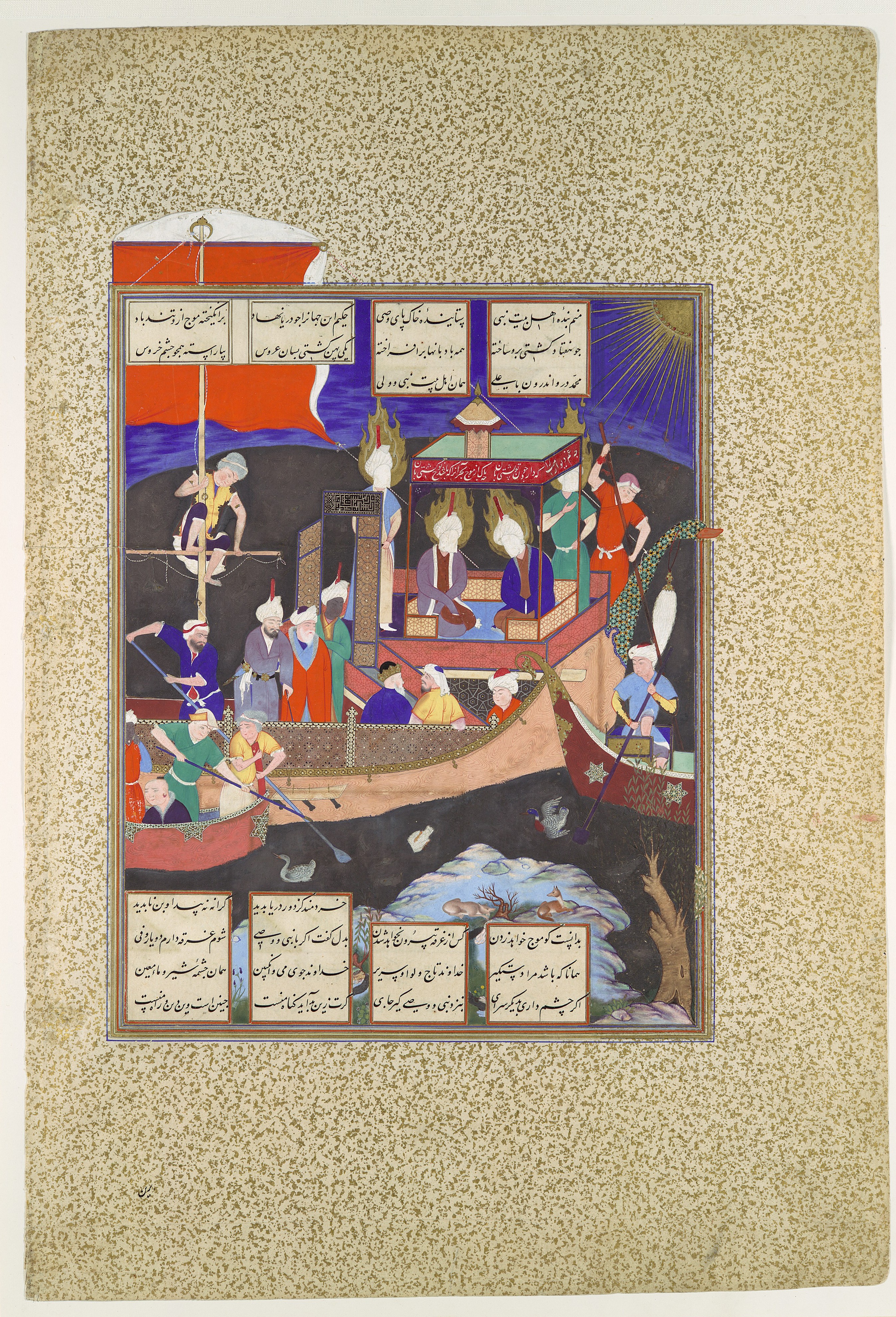
The intersection of myth and materiality has long served as the crucible for avant-garde expression. At Zoey Fashion Laboratory, we do not merely reference history; we dissect its visual lexicon to forge new dimensional realities. Our analysis of Firdausi’s Parable of the Ship of Shi’ism, Folio 18v from the monumental Shahnama of Shah Tahmasp, transcends conventional art-historical interpretation. This is not a study in Persianate miniature painting, but a strategic extraction of structural principles for the SS26 frontier. The work, executed in opaque watercolor, ink, silver, and gold on paper, presents a paradox: a static, two-dimensional iconography that pulses with the kinetic energy of a vessel navigating both spiritual and physical tempests. For the laboratory, this is a masterclass in futuristic silhouettes born from the tension between ornament and void.
The Ship as a Deconstructive Armature
The central metaphor—the ship—is rendered not as a cohesive form, but as a series of intersecting, layered planes. The hull, a patchwork of gold leaf and deep indigo, appears to be assembled from fragmented shards. For SS26, we interpret this as a deconstructive armature: a garment that is built from modular, non-contiguous panels. The silhouette is not draped but assembled, each piece a structural component that can be reconfigured. The use of silver and gold is not mere opulence; it is a material code for reflectivity and light manipulation. Imagine a jacket where the left shoulder is a convex, gilded shell, while the right is a concave, silvered void. The body becomes the vessel, and the garment, the hull that both protects and reveals the tension of its journey.
The ship’s mast, a delicate line of calligraphic ink, bisects the composition. This is a spine-like structural element, a vertical axis from which all other forms radiate. In our SS26 lexicon, this translates to a central, articulated backbone—a metallic or resin-encased spine that runs from nape to coccyx, from which fabric “sails” or “planks” are suspended. The silhouette is not about volume in the traditional sense, but about directional tension. The fabric is pulled taut, creating a series of geometric planes that mimic the ship’s hull. The result is a futuristic, almost architectural silhouette that defies the softness of conventional couture.
Negative Space and the Void of Navigation
Perhaps the most radical element in Folio 18v is the treatment of water. The sea is not a fluid continuum but a series of angular, negative spaces—white and blue voids that swirl around the ship. This is not a depiction of water; it is a depiction of the absence of water, a topological map of movement. For the avant-garde designer, this is a directive to treat negative space as a structural material. In SS26, garments will feature deliberate cuts, slits, and voids that are not merely decorative but functional. A dress might have a large, angular aperture at the hip, creating a visual vortex that draws the eye inward, suggesting a body in motion through a non-physical medium.
The void is also a tool for silhouette modulation. By removing fabric, we create new lines of tension and release. A sleeve might be a single, continuous strip of fabric that wraps around the arm, leaving the majority of the limb exposed, but held in a precise, architectural frame. This is not nudity; it is structural exposure, where the skin becomes a canvas for the garment’s negative space. The gold and silver accents are applied only at the edges of these voids, acting as luminous borders that define the emptiness. The result is a silhouette that is both fragmented and unified, a paradox that mirrors the ship’s journey through the chaotic sea.
Calligraphic Line as Structural Seam
The ink in the Shahnama is not merely descriptive; it is performative. The calligraphic lines that define the ship’s ribs and the waves are gestural, almost violent in their precision. For SS26, we translate this into structural seams that are not hidden but celebrated. These seams are not simple joins; they are lines of force that dictate the garment’s behavior. Imagine a coat where every seam is a raised, ink-black ridge of extruded silicone or resin, creating a topographical map on the fabric’s surface. The garment becomes a text, a narrative of construction and deconstruction.
The most daring application is the asymmetric, calligraphic collar. Inspired by the sweeping lines of the ship’s sail, the collar is a single, continuous piece of rigid material—perhaps carbon fiber or laser-cut leather—that sweeps from the left shoulder, across the nape, and terminates in a sharp point at the right hip. This is not a collar; it is a structural cantilever, a line of flight that redefines the relationship between the garment and the body’s geometry. The silhouette is no longer a soft envelope but a sculptural frame, where the body is the anchor and the garment is the extension.
Futuristic Silhouettes: The Ship as a Wearable Architecture
The ultimate takeaway from Folio 18v is the concept of the garment as a vessel. The ship is not a passive object; it is a machine for navigation, a structure that must withstand external forces. For SS26, we propose a silhouette that is exoskeletal—a second skin that is both protective and expressive. The shoulders are broadened, not with padding, but with articulated, metallic panels that resemble the ship’s hull plates. The waist is cinched, but not with a belt; instead, it is a compression zone where fabric is gathered and locked into place with magnetic or mechanical closures. The hips flare, not in a bell shape, but in a geometric, polygonal expansion that echoes the ship’s stern.
The use of gold and silver is not decorative; it is functional reflectivity. These are not colors; they are light-capture surfaces that alter the garment’s perceived volume. A gold panel on the left shoulder catches light and expands the silhouette; a silver void on the right hip absorbs light and contracts it. The garment is in constant visual flux, a kinetic sculpture that changes with the viewer’s perspective. This is the ultimate expression of the Shahnama’s parable: the ship is never still, even in the static medium of paint.
Conclusion: The Parable as a Manifesto
Firdausi’s parable is not a story of salvation; it is a meditation on the precariousness of form. The ship of Shi’ism is always at risk of capsizing, always navigating between the visible and the invisible. For Zoey Fashion Laboratory, this is the definitive avant-garde position. The SS26 collection will not offer comfort or stability. It will offer structural tension, material paradox, and a new vocabulary of negative space. The garment is not a second skin; it is a vessel for the unknown. The body is the captain, and the silhouette is the voyage. In the gold and silver of a 16th-century folio, we find the blueprint for a future that is already in motion.