The Tsuba as Architectural Blueprint: Deconstructing the Sword Guard for SS26
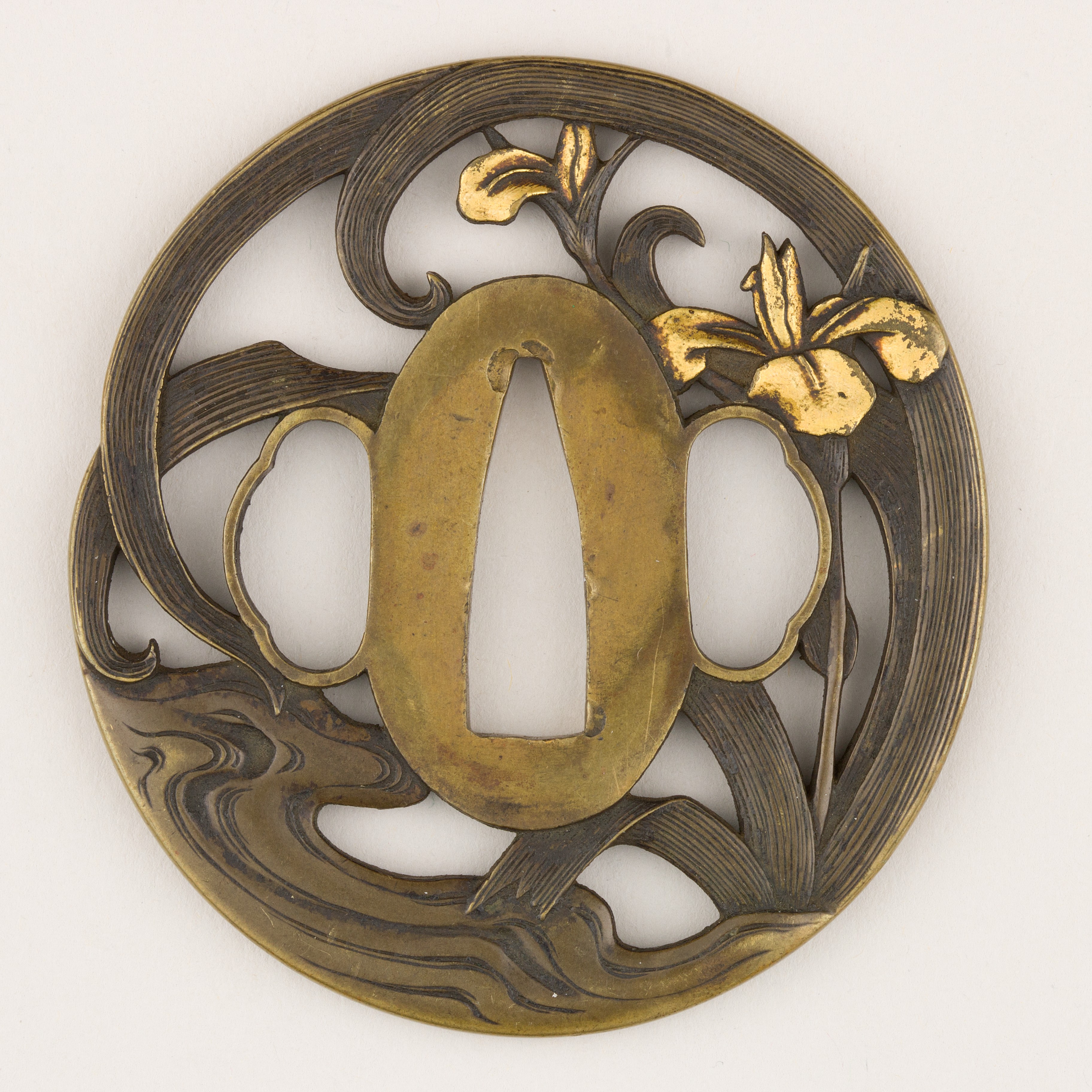
The Sword Guard (Tsuba) Depicting Iris in Running Water, a masterwork of Japanese metalwork in brass and gold, is far more than a historical artifact. It is a manifesto of structural tension, a diagram of fluid dynamics frozen in metal, and a profound source code for the avant-garde. For Zoey Fashion Laboratory’s SS26 collection, this tsuba is not merely a motif to be printed; it is a generative architectural system to be translated into three-dimensional garment construction. The interplay between the rigid, protective form of the guard and the organic, flowing depiction of irises in water creates a dialectic that defines our new silhouette: armored fluidity.
Deconstructing the Form: From Static Guard to Dynamic Silhouette
The tsuba’s function is to protect the hand, a circular shield of controlled space. Its core is a void—the nakago-ana (blade hole)—around which everything revolves. In our SS26 interpretation, this central void becomes the negative-space waist. Imagine a sculpted corset constructed from laser-cut brass-toned polymer panels, each segment mimicking the tsuba’s edge, but instead of a solid circle, the waist is an open, elliptical ring. The garment’s torso is not a tube but a kinetic exoskeleton that hovers around the body, leaving the midsection exposed and framed. This is the void silhouette: a garment that defines the body by what it does not cover, creating a powerful, protective aura of absence.
The Iris in Running Water: Fluid Dynamics as Garment Technology
The tsuba’s surface is a battlefield between order and chaos. The irises (kakitsubata) rise in stylized, geometric stalks, while the water is rendered as a series of flowing, overlapping gold and brass lines. This is not a static image; it is a freeze-frame of motion. For SS26, we translate this into smart textile engineering. Consider a skirt or train constructed from a lattice of shape-memory alloy filaments (Nitinol) woven into a base of liquid-silver organza. These filaments are programmed to shift from a rigid, geometric pattern (the iris stalks) to a fluid, undulating wave (the running water) in response to body heat or ambient temperature. The garment becomes a living surface, a thermochromic and kinetic sculpture that narrates the wearer’s movement. The gold accents of the tsuba are reimagined as micro-LED filaments embedded within the lattice, pulsing with a low, golden light that traces the path of the water, illuminating the silhouette from within.
Material Alchemy: Brass and Gold Reimagined for the Body
The original tsuba uses brass and gold—materials of permanence, value, and defense. Our avant-garde translation rejects literal weight while embracing symbolic density. Brass is replaced by recycled aerospace-grade aluminum that has been anodized to a deep, gunmetal bronze, then laser-etched with the iris pattern. This yields a material that is lighter, stronger, and more sustainable, echoing the tsuba’s protective function without burdening the body. Gold is not applied as plating but as nano-particle pigment suspended in a bio-resin. This resin is used to create translucent, faceted panels that are sewn into the seams of the garment. When light hits these panels, they fracture and scatter, mimicking the effect of gold takazogan (high-relief inlay) but with a futuristic, holographic quality. The result is a surface that is simultaneously armored and ethereal, solid and spectral.
Structural Innovation: The Armored Silhouette of SS26
The true innovation lies in the silhouette’s architecture. The tsuba’s circular form suggests a mandala of protection. We extrapolate this into a series of concentric, overlapping rings that form the shoulders and hips. Imagine a jacket where the shoulders are not padded but are constructed from seven independent, articulating rings of the anodized aluminum, each one slightly offset from the next. These rings pivot and slide, allowing for a range of motion while maintaining a rigid, armored profile. The sleeves are not attached in the traditional sense; they emerge from the void between rings, creating a negative-space armhole that is both dramatic and functional. The back of the garment becomes a kinetic shield, a larger ring that can be raised or lowered via a hidden magnetic clasp, transforming the silhouette from a day-to-night piece with a single gesture. This is not clothing; it is wearable architecture.
Philosophical Underpinnings: The Void as Liberation
Beyond the technical, the tsuba’s core lesson is philosophical. The sword guard exists to protect the hand, the center of action, by creating a barrier. In our SS26 collection, the barrier is not a wall but a dialogue between presence and absence. The void at the garment’s center—the open waist, the negative-space armholes, the gaps between rings—is not a weakness but a strength. It is the space where the wearer’s own kinetic energy becomes the final element of the design. The Iris in Running Water tsuba teaches us that true avant-garde innovation lies not in covering the body, but in framing it within a system of controlled chaos. The water flows; the iris stands firm. The garment protects; the body is liberated. This is the definitive statement for SS26: armor that breathes, structure that flows, and a future forged from the past’s most exquisite contradictions.