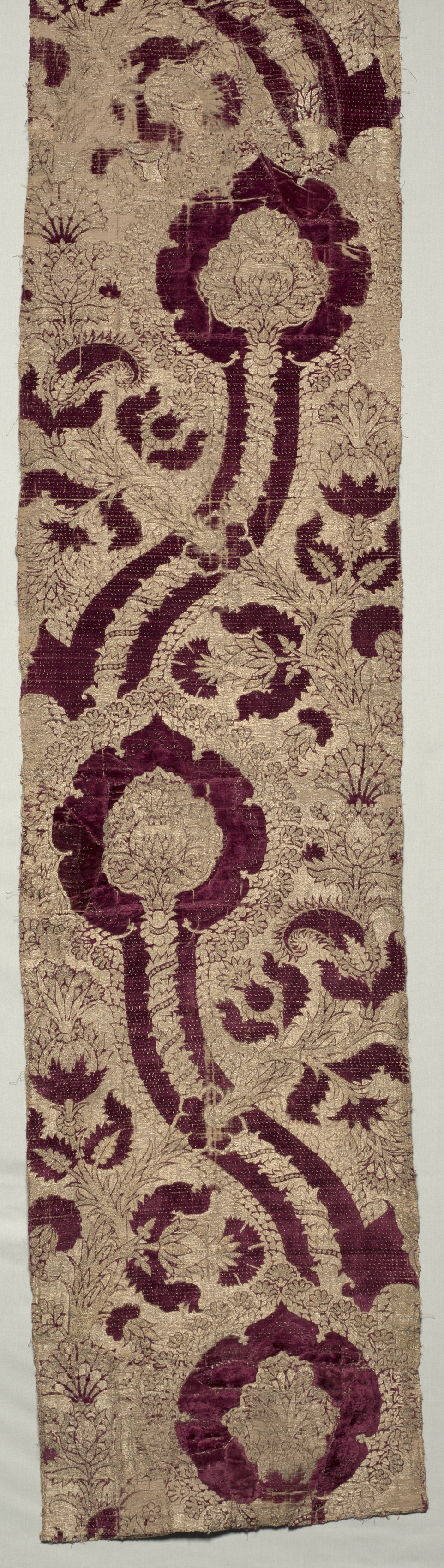
Deconstructing the Renaissance: Velvet with Pomegranate Pattern at Zoey Fashion Lab
At Zoey Fashion Lab, the role of the Chief Fabric Deconstructionist is to dismantle the historical, technical, and aesthetic DNA of textiles, re-synthesizing them into avant-garde statements. Our latest subject—a 15th-century Italian velvet with a pomegranate pattern, originating from Florence—presents a profound challenge and opportunity. This fabric is not merely a relic; it is a complex biological and cultural entity. Its silk and gold thread construction, featuring three heights of cut pile and loops of precious metal, encodes a system of power, craftsmanship, and symbolism. Our task is to decode this system and re-imagine it as a new DNA strand for contemporary fashion, one that disrupts traditional luxury and embraces the radical possibilities of the avant-garde.
Technical Autopsy: The Fabric’s Core Architecture
The technical specifications of this velvet are extraordinary. The base is a silk warp and weft, providing a lustrous, fluid foundation. However, the surface is where the complexity lies. The three heights of cut pile—low, medium, and high—create a sculptural topography. This is not a flat pattern; it is a three-dimensional landscape. The low pile forms the background, the medium pile defines the pomegranate’s leaves and stems, and the high pile elevates the fruit itself, making it tactile and visually dominant. The gold thread loops, woven into the pile through a technique known as allucciolato, add another layer. These loops are not cut; they remain as shimmering, raised circles that catch light and create a kinetic, almost liquid effect. This is a fabric that demands to be touched, to be seen from multiple angles, and to be understood as a dynamic, living surface.
From a deconstructionist perspective, this velvet is a system of controlled excess. The three pile heights create a hierarchy of form, while the gold loops introduce a disruptive, unpredictable element. The fabric’s weight, density, and tension are all calibrated to sustain these structures. The silk provides tensile strength, while the gold thread adds a metallic rigidity that resists draping. This is not a fabric that flows; it holds its shape, asserting its presence. For Zoey Fashion Lab, this technical profile becomes a starting point for deconstruction: how can we fracture this hierarchy? How can we invert the relationship between pile and ground, or between sheen and matte? The answer lies in treating the fabric as a genetic code that can be mutated, spliced, and recombined.
Symbolic DNA: The Pomegranate as a Cultural Meme
The pomegranate pattern is not merely decorative; it is a potent symbol with deep historical roots. In 15th-century Florence, the pomegranate was associated with fertility, abundance, and immortality, often appearing in religious and secular contexts. It was also a symbol of power, used in the heraldry of the Medici family and other elite patrons. The pattern’s repetition across the velvet’s surface creates a rhythm of life and death, growth and decay. The fruit’s seeds, often depicted as bursting open, suggest both fecundity and violence. This duality—beauty and danger, creation and destruction—is central to the avant-garde aesthetic.
In our deconstruction, we treat the pomegranate as a cultural DNA strand that can be re-coded. The traditional symmetry of the pattern, with its repeating motifs and balanced composition, is a form of control. The avant-garde approach is to disrupt this symmetry: to isolate a single pomegranate, to fragment its form, or to exaggerate its scale. We might extract the gold loops and re-embed them into a deconstructed garment, creating a constellation of metallic points that echo the seeds. Or we might use the three pile heights to create a gradient of opacity, where the pomegranate appears to dissolve into the background. The goal is to preserve the symbolic resonance while stripping away its historical context, allowing the pomegranate to become a pure, abstract signifier of life, decay, and rebirth.
The Avant-Garde Imperative: From Relic to Radical
The avant-garde is not about rejection of history but about its radical re-interpretation. At Zoey Fashion Lab, we see this velvet as a fossilized system that must be revived through deconstruction. The traditional techniques—the three pile heights, the gold loops—are not obsolete; they are latent technologies waiting to be hacked. Our approach involves three key strategies:
1. Fragmentation and Reconstruction: We will cut the velvet into irregular, asymmetrical shapes, exposing the raw edges of the silk base. The gold loops will be selectively removed and reattached as standalone elements, perhaps as dangling threads or clustered beads. The three pile heights will be re-ordered, with the highest pile placed in unexpected locations—such as the shoulder of a jacket or the hem of a skirt—creating a sense of imbalance and tension. This fragmentation mirrors the genetic mutation of a DNA strand, where a single change can alter the entire organism.
2. Scale and Proportion: The pomegranate pattern will be enlarged or reduced beyond its original scale, creating a disorienting effect. A single pomegranate might become a full-back motif, its seeds rendered as gold loops that trace the spine. Alternatively, the pattern might be miniaturized, repeated at a micro-scale that requires close inspection to decipher. This manipulation of scale challenges the viewer’s perception, forcing them to engage with the fabric as a living, evolving entity rather than a static object.
3. Material Hybridity: We will integrate the velvet with non-traditional materials, such as industrial rubber, transparent PVC, or recycled plastics. The gold loops will be paired with neon threads or fiber-optic filaments, creating a contrast between historical opulence and contemporary technology. The silk base might be bonded with a metallic mesh, altering its drape and weight. This hybridity is a form of genetic engineering, where the fabric’s original DNA is spliced with new, alien elements to create a mutant, avant-garde textile.
Conclusion: A New DNA Strand for Zoey Fashion Lab
The 15th-century Florentine velvet with pomegranate pattern is not a museum piece; it is a template for transformation. Its technical complexity—the three pile heights, the gold thread loops—and its symbolic depth—the pomegranate as a signifier of life and power—provide the raw material for a radical re-imagining. At Zoey Fashion Lab, we deconstruct this fabric not to destroy it, but to extract its essential code and re-encode it for the avant-garde. The result is a new DNA strand: a textile that retains the memory of its Renaissance origins while embracing the chaos, disruption, and innovation of contemporary fashion. This is not homage; it is evolution. And it is the foundation of our next collection.