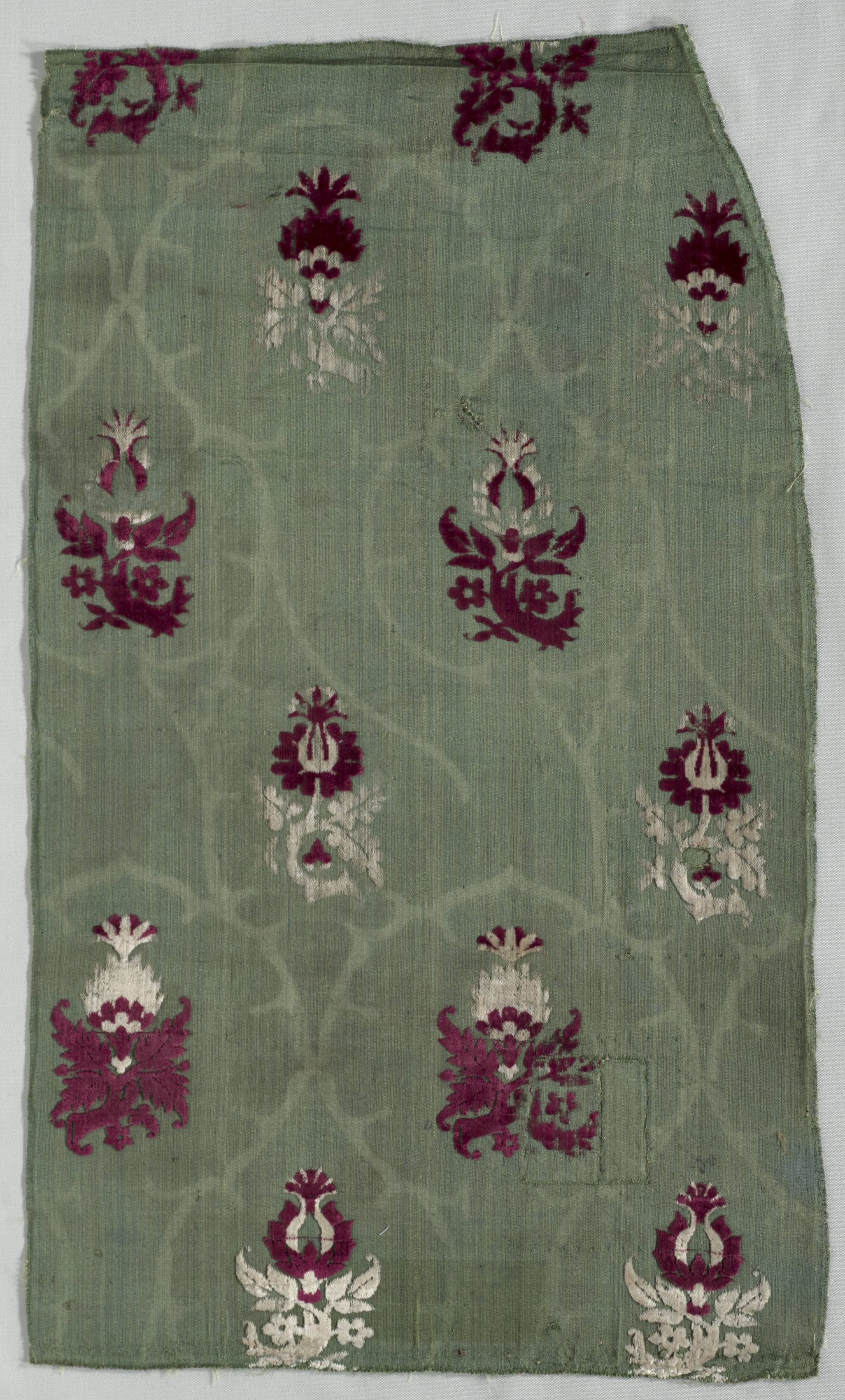
Deconstructing the Velvet Fragment: A Technical and Aesthetic Analysis for Zoey Fashion Lab
As the Chief Fabric Deconstructionist for Zoey Fashion Lab, my role extends beyond mere material analysis; it is a forensic and creative excavation of textile history to inform future avant-garde expression. The subject of this report is a fragment of velvet, originating from early 15th-century Italy, composed of cut and voided silk velvet. This fragment is not merely a historical artifact; it is a New DNA Strand—a genetic blueprint for radical reinterpretation. This analysis dissects its technical construction, historical context, and stylistic potential, proposing a path for its integration into Zoey Fashion Lab’s avant-garde design language.
I. Technical Genesis: The Weave and the Void
The fragment’s primary technical distinction lies in its construction as cut and voided velvet. This is not a simple pile weave. In cut velvet, loops of supplementary warp threads are sheared to create a dense, plush surface. The “voided” aspect is equally critical: areas are deliberately left without pile, exposing the ground weave—a plain or twill foundation of silk. This creates a stark, deliberate contrast between tactile richness and flat, reflective void.
The silk itself is a testament to Renaissance Italian craftsmanship. The warp and weft are likely composed of high-twist, reeled silk filaments, offering both tensile strength and a subtle, natural luster. The pile, however, is where the material’s sensory impact peaks. The cut loops, standing perpendicular to the fabric plane, create a surface that absorbs and scatters light in a unique, almost liquid manner. The voided areas, conversely, act as mirrors, reflecting light with a sharp, metallic sheen. This binary—the soft, absorbent pile versus the hard, reflective void—is a foundational tension.
For Zoey Fashion Lab, this technical duality is a New DNA Strand—a code for deconstructing surface. The void is not an absence but an active negative space. In avant-garde design, this can be replicated through laser-cutting, chemical etching, or selective shearing of synthetic pile fabrics. The fragment teaches us that texture is not monolithic; it is a dialogue between presence and absence, between the hand that touches and the eye that sees.
II. Historical Context: The Renaissance and the Avant-Garde
Early 15th-century Italy, particularly cities like Florence, Venice, and Lucca, was the epicenter of European velvet production. Velvet was a fabric of power—worn by the clergy, nobility, and merchant elite. Its cost was astronomical, due to the labor-intensive process (requiring up to 5,000 silk threads per inch) and the use of precious metal threads for embellishment. This fragment, likely from a liturgical vestment or a ceremonial garment, embodies a society obsessed with hierarchy, opulence, and the divine.
Yet, the avant-garde designer does not seek to replicate this history. Instead, they mine it for subversion. The fragment’s original function—to signify status and sanctity—can be inverted. Zoey Fashion Lab can use this DNA to create garments that challenge notions of luxury. For instance, the pile can be deliberately distressed, the voided areas enlarged to reveal raw edges, or the silk dyed in industrial, non-traditional hues (e.g., neon magenta or matte black). The sacred becomes profane; the opulent becomes anarchic.
The New DNA Strand here is a paradox: the fragment’s historical weight is both a constraint and a liberation. By acknowledging its origins, the designer can engage in a dialogue with the past, not as a museum curator but as a provocateur. The velvet’s original purpose—to be seen, not touched—can be reversed, making the garment a tactile, interactive experience.
III. Stylistic Synthesis: The Avant-Garde Application
For Zoey Fashion Lab, the velvet fragment is not a pattern to be copied but a New DNA Strand to be mutated. The following design directions emerge from this analysis:
1. Deconstructed Drape and Volume: The fragment’s dense pile suggests weight and gravity. In avant-garde design, this can be exploited through exaggerated draping—capes, cowls, or asymmetrical panels that fall with a liquid, almost molten quality. The voided areas can be strategically placed to create windows of transparency, revealing a second layer of contrasting fabric (e.g., sheer organza or metallic mesh). This plays with the original fabric’s binary of hidden/revealed.
2. Surface Manipulation: The cut pile is a surface ripe for intervention. Techniques such as burn-out printing (using chemicals to dissolve the pile in specific areas) can replicate the voided effect with precision. Alternatively, pleating and smocking can distort the pile, creating a topographical map of peaks and valleys. The voided ground weave can be embroidered with conductive threads or fiber optics, transforming the garment into a light-emitting sculpture—a literal “new DNA” of illumination.
3. Hybrid Materiality: The fragment’s silk is a natural protein fiber. For an avant-garde collection, this can be fused with synthetics—e.g., a velvet woven with recycled polyester or biodegradable polymers. The contrast between the historical silk and a futuristic substrate creates a temporal dissonance. A jacket might have a velvet collar (cut and voided) but a body of 3D-printed textile, referencing the fragment’s pile texture through algorithmic pattern.
4. Color and Dye Theory: The original fragment likely featured deep, jewel-toned dyes (crimson, sapphire, emerald) derived from natural sources like kermes insects or woad. The New DNA Strand suggests a chromatic inversion. Use acid dyes to produce iridescent, shifting colors (e.g., cyan to violet) or photochromic dyes that change in sunlight. The voided areas can be left as raw, undyed silk, creating a ghostly, archival aesthetic.
IV. The New DNA Strand as Design Philosophy
The term New DNA Strand is not a metaphor but a methodological directive. Just as DNA carries genetic information that can be edited, spliced, and recombined, this velvet fragment provides a set of design instructions: pile height, void ratio, ground weave density, and fiber type. Each variable can be altered independently.
For example, the pile height (originally ~2mm) can be exaggerated to 10mm for a shag-like effect, or reduced to 0.5mm for a velveteen finish. The void ratio (the percentage of exposed ground) can be increased from 30% to 70%, creating a fabric that is more void than pile—a negative-space textile. The ground weave can be changed from silk to a conductive fabric, allowing the garment to respond to touch or sound. This is not reproduction; it is genetic engineering of material.
Furthermore, the fragment’s voided areas are particularly instructive. In the original, they served as a canvas for brocade or metallic thread. In an avant-garde context, they can be left empty, revealing the body underneath, or filled with transparent resin, creating a fossil-like effect. The void becomes a site of potential, not absence.
V. Conclusion: From Fragment to Future
This 15th-century Italian velvet fragment is not a relic to be preserved but a New DNA Strand to be decoded and mutated. Its technical precision—the cut pile, the voided ground, the silk substrate—offers a vocabulary for surface, texture, and light. Its historical context provides a narrative of power and opulence that can be subverted. For Zoey Fashion Lab, the avant-garde is not about rejecting the past but about reanimating it through radical intervention.
The final design directive is clear: take this velvet’s genetic code—its pile density, void ratio, and fiber integrity—and splice it with contemporary materials, digital fabrication, and conceptual provocation. The result will be a garment that is both a tribute to Renaissance craftsmanship and a declaration of future fashion. The velvet fragment is dead; long live the velvet fragment.