Deconstructing the Avant-Garde: The Baule-Inspired Crocodile Pendant in Zoey Fashion Lab’s Archive
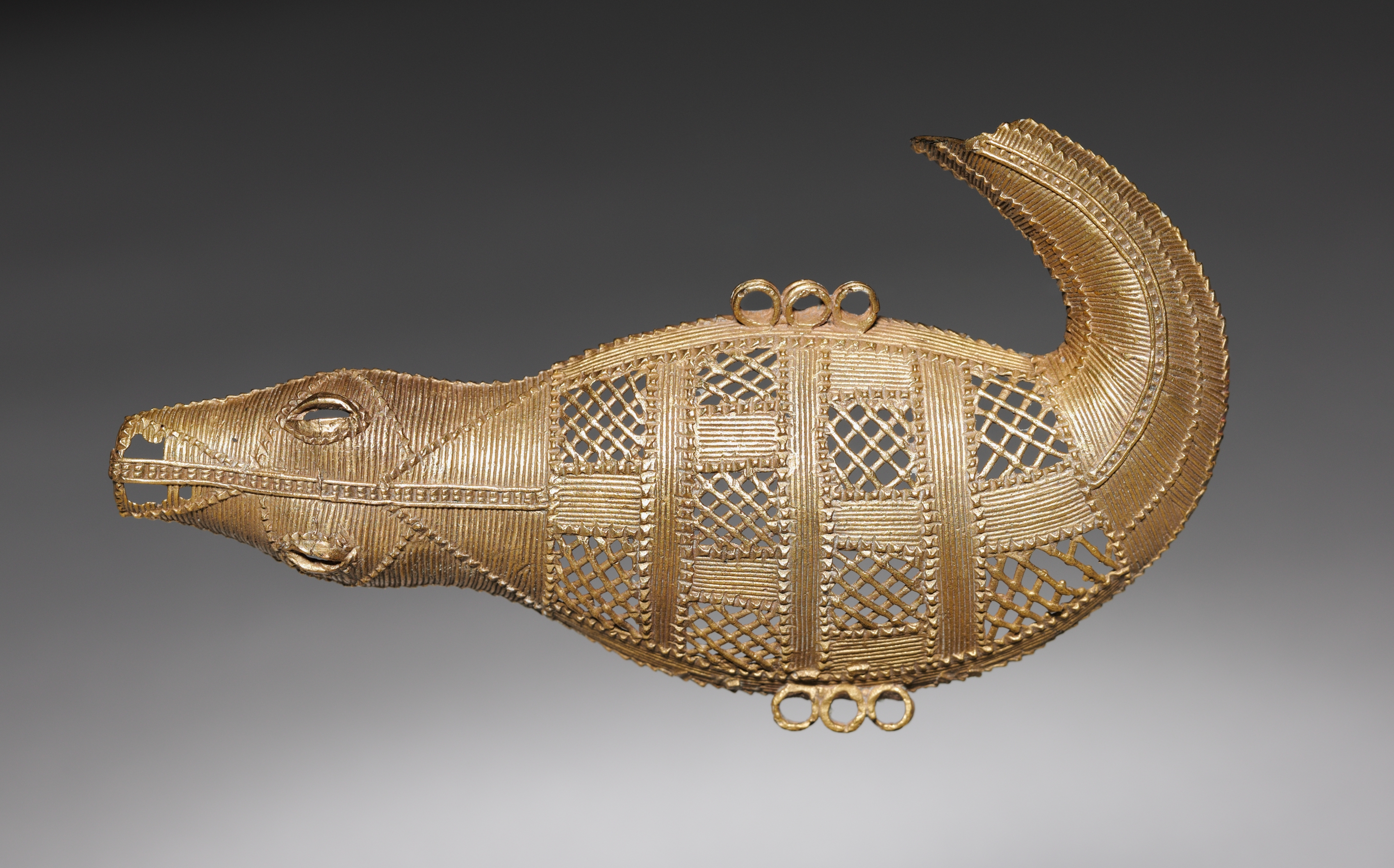
At Zoey Fashion Lab, the act of deconstruction is not merely a technical process; it is a philosophical inquiry into the origins of form, material, and narrative. The subject of this analysis—a pendant depicting a crocodile, originating from West Africa, specifically Côte d'Ivoire, and executed in the Baule-style goldsmith tradition—presents a rich paradox. Crafted in gold, this artifact is not a simple ornament. It is a node of cultural transmission, a technical marvel, and a catalyst for an avant-garde reinterpretation of identity. The reference provided—Archive Resonance: “一面是光洁银镜上以黄金镶嵌的纷繁棕叶纹,另一面是冰冷石棺板上以浮雕诉说的生命叙事——《Mirror with Split-Lea...”—further deepens this paradox, juxtaposing a polished silver mirror inlaid with gold palm leaves against a cold sarcophagus slab engraved with a life narrative. This pendant, therefore, exists in the tension between reflective surface and buried story, between the shimmer of gold and the weight of ancestral memory. For the avant-garde designer, this is not a relic but a living blueprint for reimagining adornment as a dialogue between past and future.
Material and Technique: Gold as a Conductor of Memory
The choice of gold is immediately significant. In Baule culture, gold is not merely a precious metal; it is a substance imbued with spiritual and social power. It signifies status, lineage, and connection to the divine. The technical execution—likely using the lost-wax casting method, a hallmark of Baule goldsmithing—demonstrates a mastery of form that is both fluid and precise. The crocodile, a creature of liminality (water and land, life and death), is rendered with a stylized naturalism. Its scales, jaws, and tail are not literal but symbolic, reduced to essential geometric and organic lines that speak to the Baule aesthetic of blolo (spiritual beauty).
For Zoey Fashion Lab’s avant-garde lens, this technique is a starting point. The gold is not to be preserved as a static object but to be “deconstructed” as a material narrative. The reference to a “光洁银镜” (polished silver mirror) suggests a reflective surface that invites self-examination. If we imagine the pendant’s gold surface as a mirror, it reflects not only the wearer’s image but also the historical gaze of colonialism, appropriation, and reclamation. The “黄金镶嵌的纷繁棕叶纹” (gold-inlaid intricate palm leaf patterns) evoke a sense of organic growth—palm leaves as symbols of life, victory, and resilience. In the avant-garde context, these leaves can be reinterpreted as fragments of a larger text, broken and reassembled to form new meanings. The goldsmith’s skill becomes a form of writing, and the pendant becomes a page in a living archive.
Symbolism and Narrative: The Crocodile as Liminal Guardian
The crocodile holds profound significance in Baule cosmology. It is often associated with the asye usu (earth spirits) and serves as a guardian of thresholds—between the village and the wild, the living and the ancestors. In many West African traditions, the crocodile is both a feared predator and a revered totem, embodying primordial power and wisdom. The pendant, therefore, is not merely decorative; it is a protective amulet, a marker of identity, and a visual prayer. Its presence on the body activates a relationship with the spiritual world.
However, the avant-garde analysis must push beyond traditional symbolism. The reference to “冰冷石棺板上以浮雕诉说的生命叙事” (a cold sarcophagus slab with a life narrative told in relief) introduces a funerary dimension. This pendant, suspended between the living body and the stone slab, becomes a memento mori. It reminds the wearer of mortality while simultaneously celebrating the continuity of lineage through gold’s imperishable nature. The crocodile’s skin, textured like ancient armor, can be seen as a map of scars—each scale a story of survival, adaptation, and transformation. For the avant-garde designer, this narrative is not linear but fragmented. The pendant can be deconstructed into its symbolic components: the jaw as a gate, the tail as a rudder, the eye as a witness. These elements can be recombined in new configurations—perhaps as a series of modular pieces that shift in meaning with each wearer’s context.
Avant-Garde Recontextualization: From Object to Concept
Zoey Fashion Lab’s methodology involves breaking down the artifact to its core conceptual DNA and then rebuilding it within a contemporary, often disruptive, framework. The Baule crocodile pendant, when viewed through an avant-garde lens, becomes a critique of Western notions of luxury and authenticity. The gold is no longer a signifier of wealth but a medium for questioning value. The crocodile is no longer a totem but a symbol of hybridity—a creature that exists in two worlds, much like the contemporary African diaspora navigating multiple cultural identities.
The Archive Resonance reference provides a critical tool: the mirror and the sarcophagus. The mirror side of the pendant (the polished gold surface) invites the wearer to see themselves as part of a lineage, while the sarcophagus side (the detailed relief of the crocodile) tells the story of that lineage’s burial and rebirth. In avant-garde fashion, this duality can be expressed through design elements such as reversible pieces, transparent overlays, or modular components that allow the wearer to “flip” the narrative. Imagine a garment where the crocodile pendant is not a single piece but a series of gold scales that can be detached and rearranged, each scale carrying a different engraved pattern—palm leaves, geometric motifs, or abstract symbols of the wearer’s own story. This transforms the pendant from a fixed symbol into a dynamic language.
Technical and Aesthetic Innovations for Zoey Fashion Lab
To translate this analysis into actionable design, Zoey Fashion Lab can explore several avant-garde techniques. First, material hybridity: combine the traditional lost-wax cast gold with contemporary materials such as recycled silver, resin, or even digital components like micro-LEDs that mimic the reflective quality of the “光洁银镜.” The gold can be treated with patinas or laser-engraved to create a surface that shifts between mirror and relief, echoing the duality of the reference. Second, structural deconstruction: the crocodile’s form can be broken into kinetic parts—a jaw that opens and closes, a tail that articulates—allowing the pendant to “perform” its narrative. Third, narrative layering: embed QR codes or NFC chips within the pendant that link to digital archives of Baule oral histories, thereby making the “life narrative” accessible in a modern context. This bridges the gap between the “cold sarcophagus slab” and the living body, allowing the wearer to engage with the story on their own terms.
Conclusion: The Pendant as a Portal
The Baule-style crocodile pendant, in its original form, is a masterpiece of cultural and technical achievement. For Zoey Fashion Lab, it is also a portal—a threshold between the ancestral and the avant-garde. By deconstructing its material, symbolism, and narrative potential, we uncover a design language that is both deeply rooted and radically forward-looking. The gold is not just metal; it is memory. The crocodile is not just an animal; it is a guardian of transition. The pendant is not just jewelry; it is a mirror and a sarcophagus, reflecting the wearer’s present while preserving the stories of the past. In the hands of the avant-garde, this artifact becomes a living archive, one that continues to resonate, transform, and challenge the boundaries of fashion, identity, and art.