Technical Deconstruction: The Architectural Weave
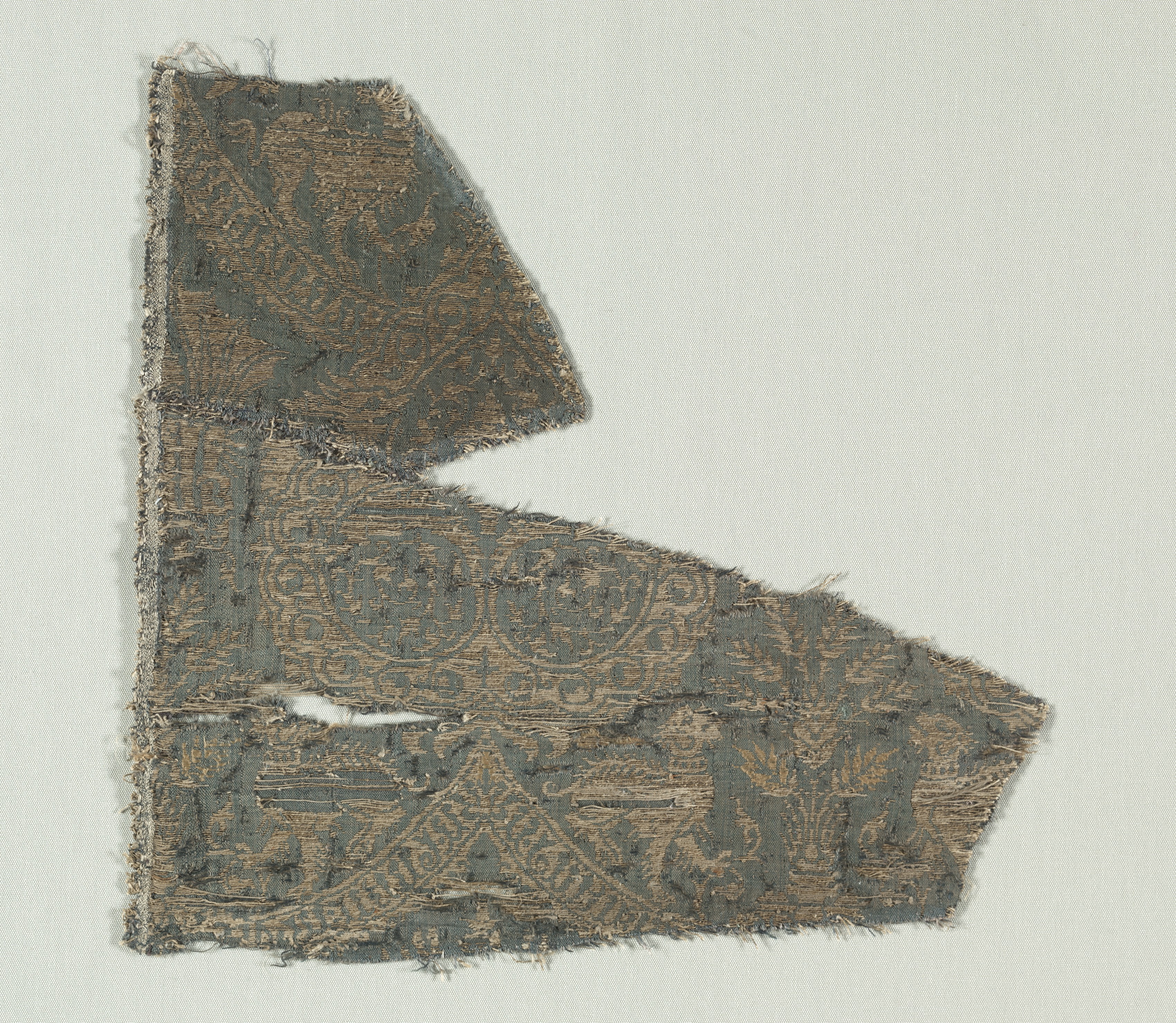
The fabric in question is not merely woven; it is engineered. As Chief Fabric Deconstructionist, my primary focus is on the structural genius that enables its aesthetic audacity. The technical description—a combination of 2/1 twill and 1/5 twill, forming a lampas—is the blueprint for its revolutionary character. Let us decode this. A 2/1 twill is a robust, diagonal weave, offering a solid foundation. The 1/5 twill, however, is a rarity. Here, a single binding warp thread controls five weft threads, creating long, floating spans on the fabric's surface. This is the key to the "swaying bands."
In the lampas structure, these two weaves are combined in a single pass. The 2/1 twill likely forms the ground, the structural canvas. The 1/5 twill is employed as the pattern weft, laid over this ground. Where it is bound, the pattern appears; where it floats freely for five passes, it creates those luminous, raised bands of silk and silver. This float is not a flaw but a deliberate, calculated risk—the "New DNA Strand" of its era. It creates unparalleled visual depth and a tactile, almost three-dimensional quality, but it also renders those shimmering bands vulnerable. This tension between breathtaking beauty and inherent fragility is the essence of avant-garde thinking.
Material Semiotics: Silk, Silver, and Canine Iconography
The material choices are a complex statement of power, piety, and trans-cultural dialogue. Silk itself was a supreme luxury, a symbol of status that traversed the Silk Road. The addition of silver thread (likely silver-wrapped silk) amplifies this, transforming the textile from a fabric into a document of wealth and technological ambition. The metallic threads would have caught the light dynamically, making the Arabic script and canine figures flicker as the wearer moved—a performative, living art piece.
The iconography is where the narrative fractures and recombines. Canine figures in a 14th-century Italian context are multivalent. They could represent loyalty, nobility (as in hunting scenes), or even a specific family emblem. Placed in deliberate dialogue with Arabic script (likely pseudo-Kufic, an ornamental imitation of Arabic writing popular in Mediterranean luxury goods), a profound cultural hybridity emerges. This script was not necessarily meant to be read, but to be seen—as a signifier of the exotic, the sophisticated, and the cosmopolitan. It speaks to a world of trade, crusade, and cultural appropriation, where Islamic artistic superiority in textiles and design was openly admired and emulated by European elites.
Form & Function: The Swaying Band as Avant-Garde Principle
The defining formal element is the "swaying bands." Our technical analysis reveals these are not printed or embroidered motifs, but born from the very architecture of the 1/5 twill weave. This is critical. The bands are the fabric, and the fabric is the bands. Their "sway" is an illusion of movement masterfully engineered through the rhythmic alternation of pattern and ground, of bound and floating thread.
This creates a visual rhythm that is inherently unstable, challenging the static heraldry common in contemporary textiles. The dogs and script are not framed within static medallions, but seem to ride upon or emerge from these undulating currents. This imbues the piece with a kinetic energy that was radically forward-thinking. It rejects rigid order in favor of fluid, wave-like motion—a concept that would not find full expression in Western art until centuries later. This is not decoration; it is textile in motion, a captured waveform.
The Zoey Fashion Lab Interpretation: A Modern Avant-Garde Legacy
For Zoey Fashion Lab, this artifact is not a relic but a direct antecedent. Its "avant-garde" label is earned through three core principles that resonate deeply with our mission:
1. Structural Innovation as Aesthetic Driver: The fabric proves that the most profound beauty arises from reimagining foundational construction. The 1/5 twill was its radical new technology. Our challenge is to identify the equivalent in smart textiles, bio-materials, or 3D weaving, allowing form to emerge from revolutionary function.
2. Cultural Hybridity Without Erasure: The piece does not homogenize its Italian, Islamic, and courtly influences. It lets them coexist in tense, brilliant dialogue. In a modern context, this guides us toward collaborations that are deep, respectful, and synthetical—creating a new language from distinct vocabularies, not a diluted fusion.
3. The Embodying of Contradiction: It is both strong and fragile, legible and abstract, pious (if the script implies religious homage) and proudly secular (in its canine heraldry). Modern avant-garde fashion thrives on such productive contradictions—between digital and tactile, protective and revealing, sustainable and luxurious.
Conclusion: A Blueprint from the 14th Century
This Italian silk lampas is a masterclass in conceptual fashion. It demonstrates that avant-garde is not merely a stylistic choice but a holistic methodology encompassing material science, cultural intelligence, and structural bravery. The "swaying bands" are more than a motif; they are the physical manifestation of a mindset that prized dynamic innovation over static tradition.
For Zoey Fashion Lab, our path forward is illuminated by this ancient textile. Our mandate is to deconstruct its principles and re-weave them for a new millennium: to find our "1/5 twill" in new technologies, our "pseudo-Kufic" in meaningful global dialogue, and our "swaying bands" in garments that embody fluidity, tension, and breathtaking, engineered beauty. The DNA strand has been identified; our task is to sequence it for the future.