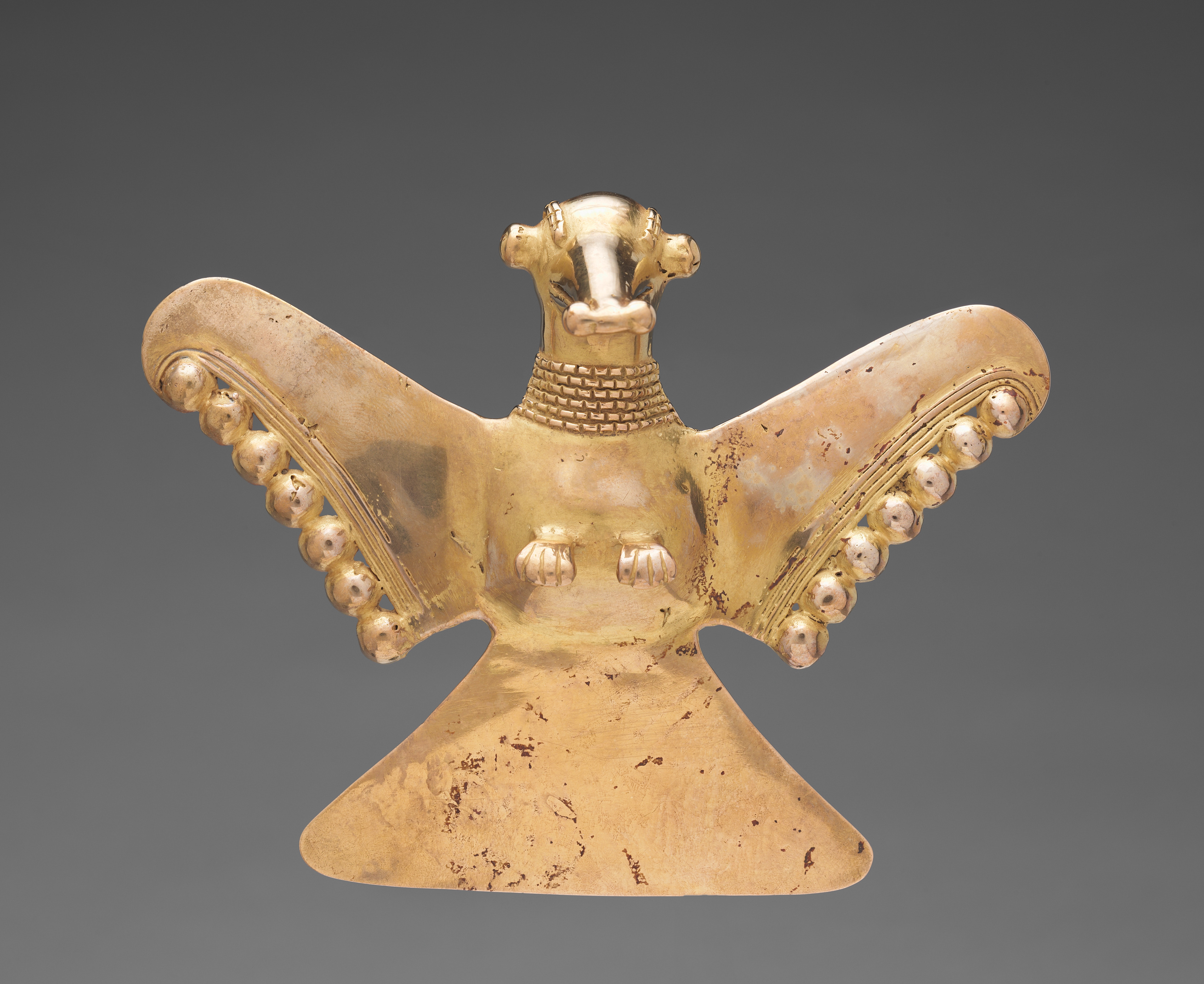
Technical and Material Deconstruction: The Gold Bird Pendant from Veraguas-Chiriquí
At Zoey Fashion Lab, we approach the Bird Pendant from Panama’s Veraguas-Chiriquí style (11th–16th century) as a primal text of metallurgical intelligence. Cast in gold, this object is not merely an ornament but a frozen performance of pre-Columbian technical mastery. The cast gold technique employed by the Veraguas-Chiriquí artisans reveals a sophisticated understanding of lost-wax casting, where the bird’s form was first modeled in wax, encased in clay, and then heated to melt the wax, leaving a negative space for molten gold. This method allowed for intricate, organic details—feathers, beak curvature, and symbolic geometry—that are impossible to achieve through simple hammering or sheet-metal work. The result is a pendant that feels both weighty and ethereal, a paradox that aligns with the Avant-garde ethos of material contradiction.
The gold itself is not pure but an alloy, likely with copper and silver, which gives it a warm, slightly reddish hue—a signature of Central American goldsmithing. This alloying was intentional: it lowered the melting point for easier casting and increased durability for wear. The pendant’s surface, though ancient, retains a polished luster in certain areas, suggesting it was worn against skin or cloth, acquiring a patina over centuries. In Zoey Fashion Lab’s deconstruction, we see this patina as a narrative layer—a record of touch, time, and ritual. The bird’s eye, often a small gold bead or empty socket, invites speculation: was it once inlaid with spondylus shell or turquoise? The absence itself becomes a design element, a void that speaks to loss and transformation.
Form and Symbolism: The Avant-Garde Reading of Avian Geometry
The bird motif in Veraguas-Chiriquí culture is not decorative but deeply symbolic, often representing shamanic flight, solar cycles, or the soul’s journey between worlds. The pendant’s form is stylized, with exaggerated wings, a pronounced beak, and a tail that often curves into a hook or spiral. This is not naturalistic representation; it is geometric abstraction that predates modernism by centuries. The wings are simplified into sweeping arcs, the body into a teardrop or oval, and the beak into a sharp triangle. This reduction to essential shapes resonates with the Avant-garde principle of form following function—here, the function being spiritual communication.
The pendant’s suspension loop, often integrated into the bird’s back or head, is not an afterthought but a structural element that affects the object’s balance and movement. When worn, the bird would swing, catch light, and create a kinetic interplay between gold and skin. This dynamic wearability is a key focus for Zoey Fashion Lab: the pendant is not static art but a performative object. The Avant-garde lens sees this as a precursor to contemporary jewelry that challenges the boundary between object and body, ornament and amulet.
In the context of the reference text—“一面是光洁银镜上以黄金镶嵌的纷繁棕叶纹,另一面是冰冷石棺板上以浮雕诉说的生命叙事”—the Bird Pendant occupies a similar dualism. It is both a mirror (reflecting the wearer’s status and spiritual alignment) and a stone narrative (carrying the weight of ancestral memory). The gold bird, like the silver mirror, is a surface that reflects light, but its underside—the back of the pendant—often bears engraved lines or patterns that tell a story only the wearer or the gods could read. This hidden narrative is a hallmark of Avant-garde design: the deliberate concealment of meaning, inviting intimate discovery.
Archive Resonance: The Bird Pendant as a Bridge Between Mirrors and Tombs
The Archive Resonance provided—“Mirror with Split-Leaf...”—evokes a binary of surfaces: one polished and reflective, the other carved and narrative. The Bird Pendant, when analyzed through this lens, becomes a third object that collapses this binary. Its gold surface is both a mirror (reflecting the sun, the wearer, the environment) and a tomb (containing the spirit of the bird, the ritual of its creation, the culture that produced it). In Zoey Fashion Lab’s methodology, we call this material palimpsest—an object that carries multiple, simultaneous texts.
The split-leaf motif in the reference suggests fragmentation and connection. The Bird Pendant’s wings, often split or separated from the body by negative space, echo this split-leaf aesthetic. The gold is not a solid mass but a series of interconnected planes, creating a visual rhythm of light and shadow. This negative space is crucial: it allows the pendant to breathe, to integrate with the body, and to reference the natural world’s gaps—the spaces between leaves, the intervals between bird calls. For the Avant-garde, negative space is not emptiness but potential, a void that invites the viewer to project meaning.
The cold stone of the sarcophagus in the reference contrasts with the warm gold of the pendant. Yet both are carriers of life narratives. The stone relief tells a story through carved figures; the gold pendant tells a story through its form, wear, and ritual use. In the Veraguas-Chiriquí context, the bird pendant might have been placed in a tomb, accompanying the deceased on their journey. This funerary function aligns with the “stone narrative” of the reference, transforming the pendant from a living ornament to a death companion. The Avant-garde reading celebrates this transformation: the object is not fixed in time but moves between life and death, light and shadow, wear and burial.
Avant-Garde Synthesis: Reimagining the Bird Pendant for Contemporary Fashion
Zoey Fashion Lab’s deconstruction of the Bird Pendant culminates in a call for radical reinterpretation. The Avant-garde is not about preservation but about rupture—breaking the object from its historical context and reinserting it into new narratives. We propose a series of design interventions:
1. Material Subversion: Cast the bird pendant in oxidized silver or matte blackened steel, retaining the geometric abstraction but stripping the gold’s warmth. This creates a tension between the object’s sacred origin and its modern, industrial aesthetic.
2. Scale Disruption: Enlarge the pendant to architectural proportions—a chest piece that covers the torso, transforming the bird from a personal amulet into a wearable sculpture. The negative space between wings becomes a window onto the body.
3. Kinetic Integration: Incorporate hinges or joints into the wings, allowing them to flap or fold. This references the bird’s flight but also introduces a mechanical element, echoing the Avant-garde fascination with movement and machine.
4. Narrative Layering: Engrave the back of the pendant with contemporary text—poetry, code, or fragmented narratives—creating a hidden layer that only the wearer can access. This mirrors the ancient practice of inscribing the underside with ritual meaning.
5. Sound Element: Attach small, tuned gold or silver beads to the pendant’s edges, producing a soft chime when the wearer moves. This introduces an auditory dimension, transforming the pendant into a sonic amulet.
These interventions do not disrespect the original object; they honor its complexity by refusing to treat it as a relic. The Bird Pendant from Veraguas-Chiriquí is not a dead artifact but a living design principle—a testament to how gold, form, and symbolism can merge into a single, potent object. For Zoey Fashion Lab, the Avant-garde is the act of listening to this ancient resonance and translating it into a new language, one that speaks to the body, the spirit, and the future of fashion.