Deconstruction of the Octagonal Pendant: A Study in Avant-Garde Resonance
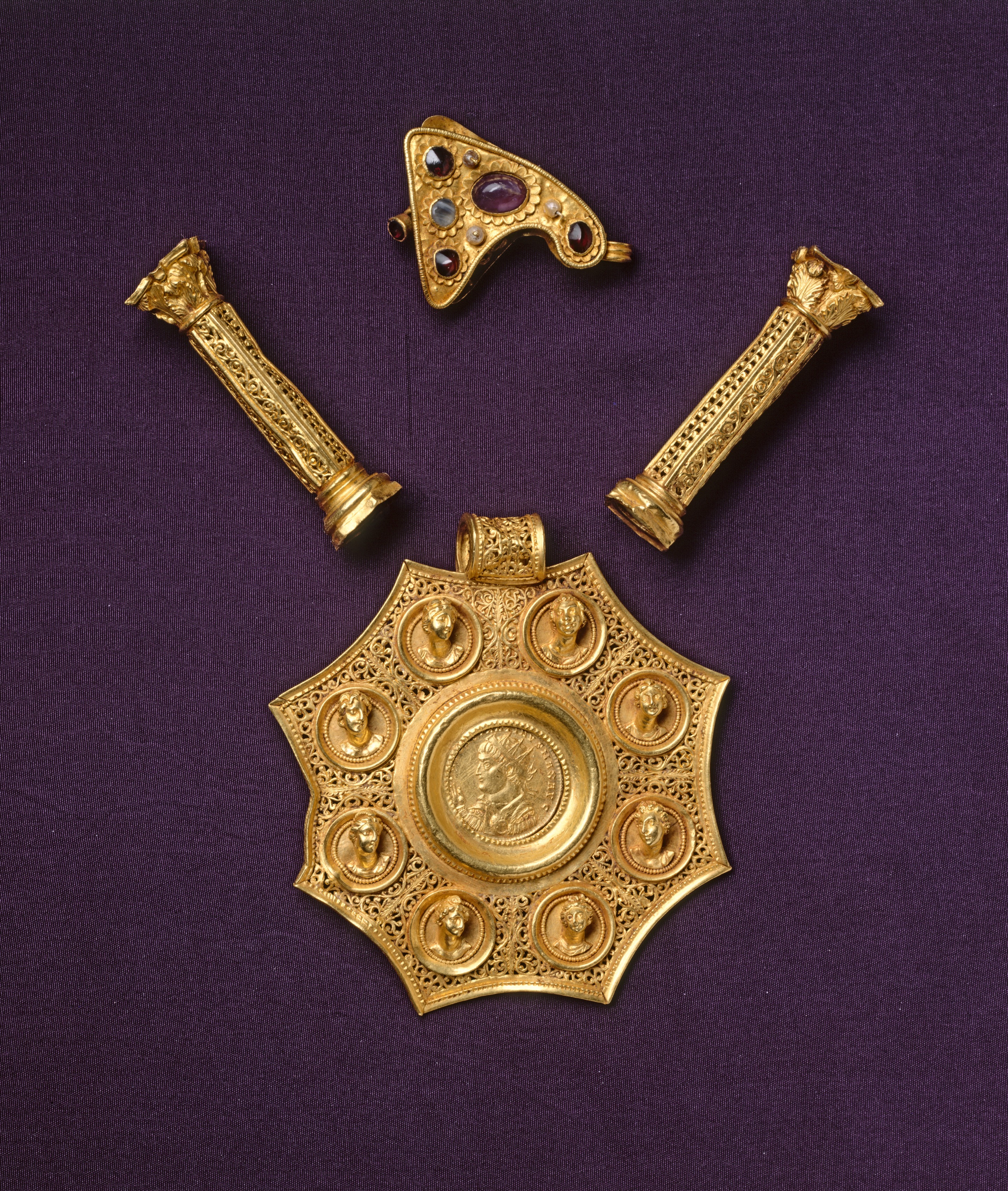
At Zoey Fashion Lab, we engage in the rigorous practice of fabric deconstruction—a methodology that disassembles historical artifacts to extract their core aesthetic, technical, and philosophical DNA. The object under analysis, an Octagonal Pendant with Corinthian Column Spacers and Clasp Set, originating from the Byzantine period in the Eastern Mediterranean (likely Sirium or Nicomedia), presents a uniquely fertile ground for avant-garde reinterpretation. Crafted in gold, this pendant is not merely a relic of late Roman piety or imperial splendor. It is a tectonic collision between two opposing surfaces: one side a polished silver mirror inlaid with intricate golden acanthus leaves, the other a cold, sarcophagus-like stone panel narrating a life through relief. This duality—the reflective versus the narrative, the ornamental versus the funereal—is the precise fulcrum upon which an avant-garde fashion concept can pivot.
The Technical Lexicon: Gold as a Conductor of Contradiction
The pendant’s technical execution in gold is not a display of wealth, but a strategic deployment of material weight. Gold, in Byzantine context, signified divine light and imperial authority. However, in our deconstruction, we treat this gold as a conductive medium—a bridge between the living (the mirror) and the dead (the sarcophagus relief). The octagonal shape, a geometric form often associated with transitional spaces (baptismal fonts, funerary structures), amplifies this tension. Each of the eight sides becomes a facet of identity, a panel that can be rotated, reflected, or obscured.
The Corinthian column spacers are particularly telling. In classical architecture, Corinthian columns were symbols of youthful vigor and ornate beauty. Here, they are miniaturized and repurposed as structural separators, holding the pendant’s disparate elements apart. This is not harmony; it is structural dissonance. The columns do not support a pediment; they support a schism. For an avant-garde garment, these spacers can be translated into articulated joints—gold-plated hinges that allow fabric panels to shift, revealing or concealing the wearer’s skin or a hidden layer of text.
Surface Duality: The Mirror and the Sarcophagus
The most profound aspect of this pendant is its two-faced construction. The first face—a polished silver mirror with gold acanthus inlay—evokes the vanity of the present. The acanthus, a motif of eternal life and rebirth, is rendered in intricate, almost chaotic gold filigree. This is not a calm reflection; it is a fractured mirror, where the viewer’s own image is disrupted by the organic, sprawling leaves. In an avant-garde context, this can be reinterpreted as fabric that reflects and distorts. Imagine a jacket panel embedded with micro-mirrored sequins, each one hand-set with a gold thread acanthus pattern. The garment becomes a living surface, changing with every movement, refusing a stable identity.
The second face—a cold stone sarcophagus panel with a life narrative in relief—is the memory of the past. This is not a sentimental memorial; it is a brutal archive. The relief carvings are compressed, dense, and unyielding. They tell a story without color, without light, only shadow and form. In deconstruction, this translates to textural scarification on fabric. Think of a heavy, blackened wool or a charcoal-grey linen, its surface embossed with repetitive, almost illegible patterns—fragments of faces, hands, or architectural arches. The garment does not narrate clearly; it obscures and whispers, forcing the viewer to engage in archaeological interpretation.
Avant-Garde Application: The Pendant as a Wearable Contradiction
Zoey Fashion Lab’s avant-garde approach demands that we extract principles, not replicas. The octagonal pendant offers three core principles for a new garment system:
1. The Principle of Rotational Duality: The pendant’s ability to be flipped—to show either the mirror or the sarcophagus—suggests a garment that is inherently reversible. However, this is not a simple inside-out design. We propose a modular shell constructed from eight interlocking panels, each one a separate fabric module. One side of each panel is a high-gloss, reflective surface (liquid silver, patent leather, or mirrored PVC) with gold-thread embroidery. The other side is a matte, textured surface (raw silk, distressed velvet, or carbon fiber) with laser-cut relief patterns mimicking the sarcophagus carvings. The wearer can rotate each panel independently, creating a constantly shifting composition of reflection and shadow.
2. The Principle of Structural Separation: The Corinthian column spacers are not decorative; they are functional dividers. In our garment, these become rigid, metallic grommets or cast-bronze joints that connect the eight panels. These joints are not hidden; they are exposed and exaggerated, serving as the garment’s exoskeleton. They allow for air and light to pass between the panels, creating a negative space that reveals the wearer’s body or an underlayer of contrasting fabric. This structural separation is a direct challenge to conventional draping, which seeks to unify. Here, we celebrate the gap, the interval, the pause.
3. The Principle of Narrative Compression: The sarcophagus relief is not a linear story; it is a compressed, hieroglyphic code. For fabric, this means micro-embroidery or digital jacquard weaving that repeats a single, abstracted motif—a hand, a column capital, a leaf—in a dense, almost obsessive grid. The pattern is not meant to be read from a distance; it is a tactile secret, only fully visible upon close inspection. This creates a garment that is intimate and alienating simultaneously, demanding proximity while maintaining an aura of ancient, unyielding formality.
Material Alchemy: From Gold to Fabric
The transition from Byzantine gold to avant-garde fabric requires alchemical thinking. Gold’s weight, reflectivity, and permanence must be translated into textile equivalents. We propose a hybrid material system:
- For the mirror side: A base of liquid metallic organza (woven with fine aluminum threads) overlaid with hand-embroidered gold bullion in acanthus patterns. The organza provides a fluid, reflective surface, while the bullion adds the necessary weight and texture.
- For the sarcophagus side: A base of heavy, unbleached linen treated with a graphite and resin wash to achieve a stone-like patina. The relief patterns are created using thermoformed silicone or 3D-printed bio-resin, applied in irregular, organic shapes that mimic the wear of ancient carving.
- For the spacers: Hand-cast brass or bronze components, left unpolished to retain a dark, oxidized finish. These are not merely functional; they are jewelry-scale architectural elements, each one a miniature column.
Conclusion: The Garment as an Archive of Duality
The Octagonal Pendant with Corinthian Column Spacers is not an accessory to be copied; it is a philosophical blueprint. It teaches us that the most powerful garments are those that hold two truths in tension: the desire to be seen and the need to remember; the fleeting reflection and the enduring stone; the individual’s vanity and the collective’s history. Zoey Fashion Lab’s avant-garde interpretation will not produce a pendant. It will produce a wearable system—a jacket, a cape, a sculptural bodice—that embodies this tension. The wearer becomes a living monument, a mobile sarcophagus that can, with a turn of a panel, become a mirror. This is the resonance of the archive: not a return to the past, but a violent, beautiful collision of past and future, forged in gold and fabric.