Deconstructing the Blueprint: Embroidery as Structural Armature for SS26
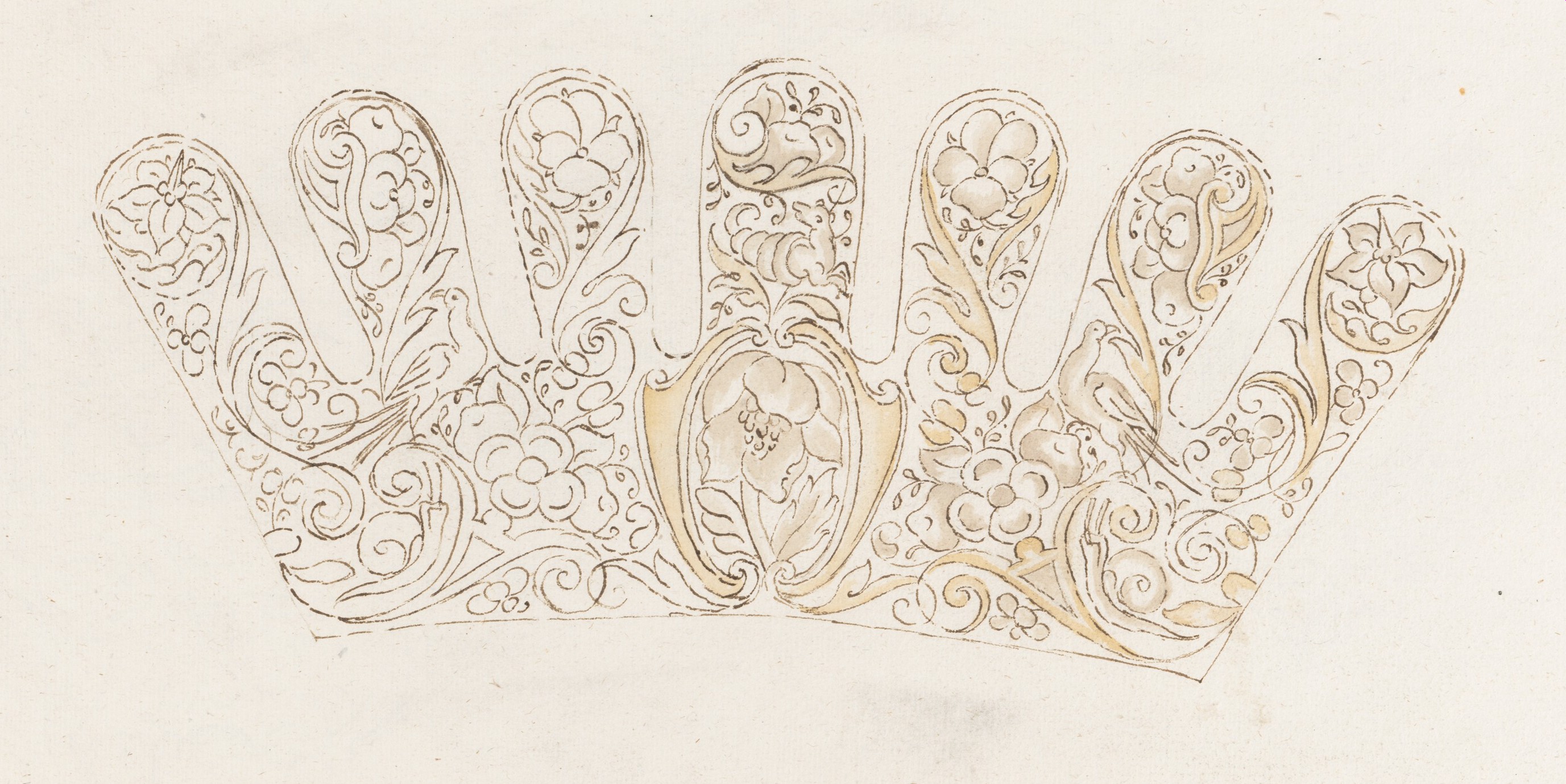
The album page, designated page 50 (recto), presents a radical departure from conventional embroidery as mere surface ornamentation. Within the Zoey Fashion Laboratory’s avant-garde lexicon, this standalone study—executed in pen, ink, and selective wash—transforms embroidery into a primary structural system. The designs for bodices, gauntlets, caps, and bags are not decorative afterthoughts; they are architectural blueprints for a futuristic silhouette that defies the body’s passive role. For SS26, this page articulates a paradigm where thread becomes tensile strength, ink becomes contour, and wash becomes the ethereal residue of movement. The Global Frontier origin imbues these artifacts with a nomadic, post-geographic sensibility, suggesting wearable shelters for a world unbound by terrestrial constraints.
The Bodice as Exoskeletal Lattice
The bodice studies on this recto page are rendered with surgical precision. The pen-and-ink lines evoke a digital wireframe, yet the selective wash introduces a fluid, almost organic bleeding—a tension between the machinic and the biological. The futuristic silhouette here is not a second skin but a third skin: an exoskeletal lattice that redefines the torso as a load-bearing structure. The embroidery patterns are not floral or geometric in any traditional sense; they mimic the tensile networks of carbon fiber or the webbing of a space suit’s inner lining. The wash suggests zones of transparency, where the body’s heat might escape or where light could refract through a membrane of silk and metal thread. This is not about covering but about structural innovation: the bodice becomes a cantilevered framework, with embroidered ribs that curve away from the sternum, creating negative space. The ink lines indicate bifurcations—points where the embroidery splits to allow articulation, a nod to biomechanics. For SS26, this bodice is a manifesto: fashion as engineered mobility, where every stitch is a calculated stress point.
Gauntlets: The Hand as Command Interface
The gauntlet designs on page 50 (recto) are perhaps the most provocative elements. They extend beyond the wrist, morphing into articulated shields that encase the forearm and hand. The pen-and-ink work here is dense, almost calligraphic, suggesting a language of control. The futuristic silhouette of these gauntlets is asymmetrical: one might be a sleek, aerodynamic sheath, while its counterpart is a bulky, geometric exoskeleton. The wash introduces a gradient from opaque to translucent, implying that the embroidery itself is a sensor network. The patterns are not stitched onto a pre-existing form; they are the form. The threads are woven into a lattice that can flex, lock, or even store energy. This is structural innovation at the level of the appendage—a reimagining of the hand as a command interface. The gauntlets are not gloves; they are instruments. They suggest a future where touch is mediated through embroidered circuits, where the act of reaching is also an act of programming. The wash indicates zones where the skin might be visible, a reminder that the body is both operator and raw material.
Caps and Bags: The Head and the Load
The caps and bags on this recto page are treated with equal architectural rigor. The caps are not headwear but cranial extensions, with embroidery that follows the contours of the skull like a geodesic dome. The ink lines are sharp, angular, suggesting a faceted surface that could deflect impact or channel airflow. The futuristic silhouette here is streamlined, almost aerodynamic, with the wash creating a sense of depth—a visor-like effect that obscures the face while amplifying the crown. This is a cap that does not sit on the head; it hovers, anchored by embroidered tension points. The bags, meanwhile, are the most utilitarian yet the most radical. They are not containers but structural innovations in load distribution. The embroidery patterns are reminiscent of tensegrity structures: a network of threads that holds a form without a rigid frame. The wash suggests that the bag can collapse into a flat plane or expand into a volume, depending on the tension of its embroidered seams. This is a bag that is also a garment, a piece of architecture that adapts to its contents. The Global Frontier origin is palpable here: these are objects for a nomadic existence, where every item must be multifunctional and structurally self-sufficient.
The Wash as Temporal Marker
The selective application of wash on page 50 (recto) is not accidental; it is a deliberate structural innovation in the drawing itself. The wash bleeds into the ink, creating zones of ambiguity where the embroidery seems to dissolve or reform. This is a commentary on the transient nature of the avant-garde: the designs are not fixed but are in a state of becoming. The futuristic silhouette is not a final form but a potentiality. The wash suggests that these embroidered structures are responsive—to light, to moisture, to the wearer’s own energy. For SS26, this is a critical insight: fashion must be mutable. The bodice, gauntlet, cap, and bag are not static objects but adaptive systems. The wash also introduces a temporal dimension—a sense that the ink lines are the present, while the wash is the future bleeding into it. This is the avant-garde imperative: to design for a time that has not yet arrived.
Conclusion: The Embroidery as Blueprint for a New Silhouette
Page 50 (recto) of the album is not a collection of decorative motifs; it is a treatise on structural innovation. The pen-and-ink lines are the bones, the wash is the breath, and the embroidery is the sinew. The futuristic silhouette that emerges for SS26 is one of controlled chaos—a silhouette that is simultaneously exoskeletal and organic, rigid and fluid. The bodice, gauntlet, cap, and bag are not separate items but nodes in a networked garment system. The Global Frontier origin speaks to a world without borders, where fashion is a language of survival and expression. At Zoey Fashion Laboratory, this page is a definitive statement: embroidery is no longer a craft; it is a science. It is the architecture of the next body, the one that will inhabit the frontier of tomorrow. The ink and wash are not media; they are manifestos. And the avant-garde curator’s role is to read them as such—to translate these lines and washes into garments that redefine what it means to be clothed, to be human, to be future.