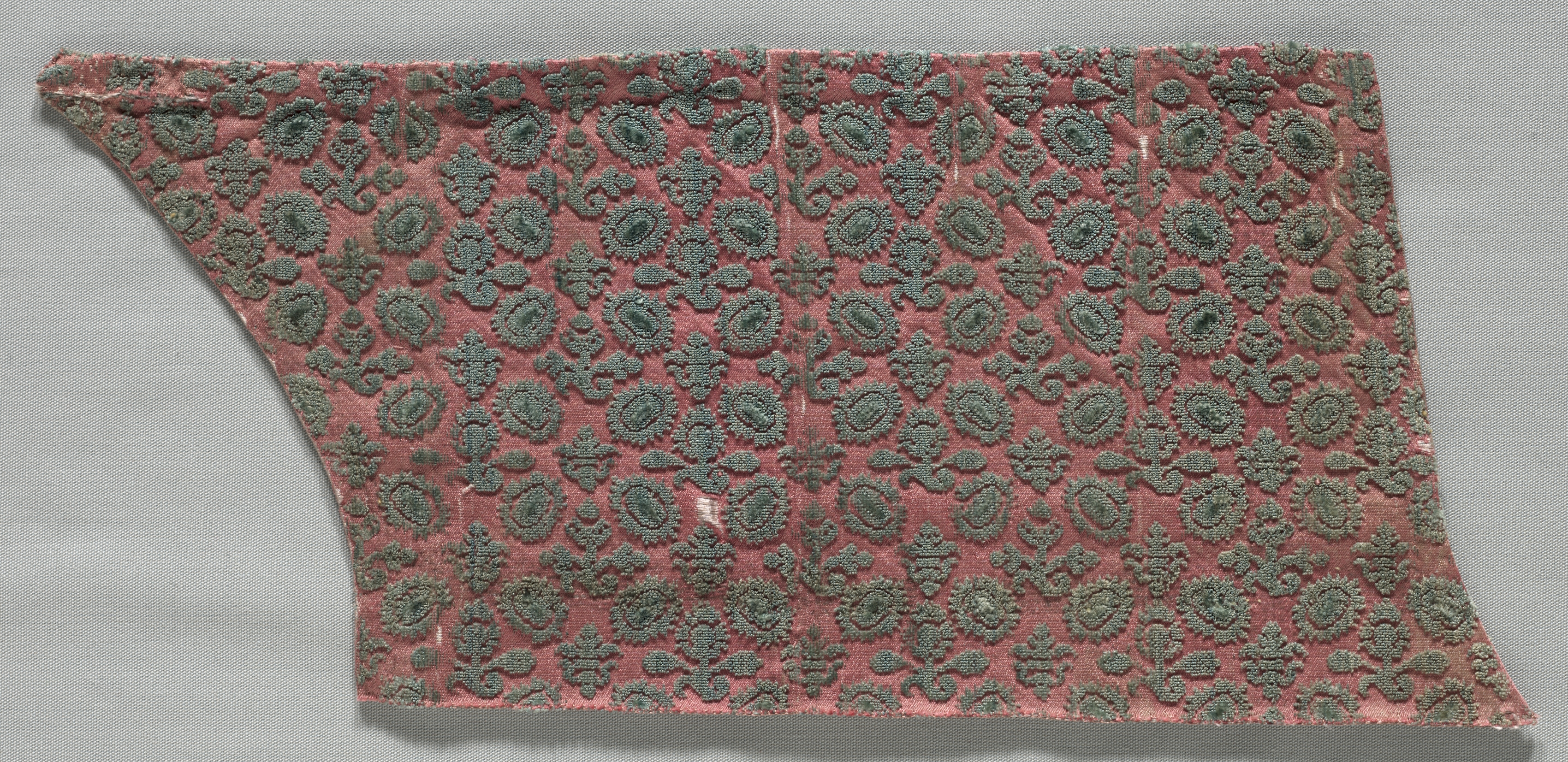
Deconstructing the Velvet Fragment: A Zoey Fashion Lab Analysis
At Zoey Fashion Lab, our mission is to interrogate the material past to forge the future of fashion. Today, we examine a singular artifact: a velvet fragment originating from Italy, dating between the late 16th and 17th centuries. This is not merely a relic; it is a New DNA Strand—a genetic blueprint for avant-garde design. Our analysis will deconstruct its technical, historical, and aesthetic properties, revealing how this fragment can inspire radical reinterpretation in contemporary fashion.
Technical Deconstruction: Cut and Uncut Velvet
The fragment employs a sophisticated technique known as cut and uncut velvet (also called ciselé or ciselé velvet). This method involves weaving two types of pile loops: some are left intact (uncut), while others are sliced open (cut) to create a contrast in texture, light absorption, and surface depth. The uncut loops produce a matte, granular effect, while the cut pile yields a lustrous, smooth surface that catches light with movement. In this fragment, the interplay between these two surfaces forms a dynamic, almost sculptural composition.
The silk base is a warp-faced satin weave, providing a dense, fluid foundation. The pile is woven from additional warp threads, typically of a finer silk filament. The uncut loops are formed by inserting a temporary metal wire between the warp and weft, which is later removed. For cut velvet, the wire is sharpened to slice the loops as it is withdrawn. This labor-intensive process—requiring exacting tension and skilled hand-weaving—was a hallmark of Italian Renaissance luxury, particularly in Venice, Genoa, and Florence. The fragment’s survival suggests it was part of a larger garment or furnishing textile, likely a vestment, court gown, or upholstery for a noble household.
From a material science perspective, the silk’s molecular structure—composed of fibroin proteins—offers exceptional tensile strength and natural luster. However, the pile is vulnerable to crushing, abrasion, and light degradation. The fragment shows signs of wear: the cut pile is slightly flattened in areas, and the uncut loops are partially distorted. These imperfections are not flaws but historical inscriptions, recording the object’s journey through time. For Zoey Fashion Lab, this fragility is a design constraint—and an opportunity. We can re-engineer the velvet’s structure using modern techniques, such as 3D-knitted pile or laser-cut microfibers, to replicate its textural complexity while enhancing durability and washability.
Historical Context: The Italian Velvet Trade (Late 16th–17th Century)
This fragment emerged during a period of intense artistic and economic ferment. By the late 1500s, Italian velvet production had reached its zenith, driven by demand from European courts and the Catholic Church. The city-states of Venice, Genoa, Florence, and Lucca competed to produce the richest textiles, often incorporating gold and silver threads. However, our fragment is purely silk—a choice that may reflect a shift toward more restrained luxury following the Counter-Reformation, which emphasized piety over ostentation.
The design motifs typical of this era include pomegranates, thistles, acanthus leaves, and geometric arabesques, often arranged in symmetrical, repeating patterns. Our fragment’s specific pattern is partially obscured by wear, but traces of a serpentine or undulating vine are visible, suggesting a naturalistic influence from the late Renaissance. The uncut loops form the background, while the cut pile defines the motif, creating a chiaroscuro effect reminiscent of contemporary painting. This visual tension—between flatness and depth, matte and shine—is a precursor to the avant-garde’s fascination with surface manipulation.
The fragment’s provenance as an Italian artifact is significant. Italy’s textile workshops were the epicenter of European luxury, and their techniques were closely guarded secrets. The silk itself was imported from the Ottoman Empire and China via the Silk Road, making each fragment a node in a global network of trade and cultural exchange. For Zoey Fashion Lab, this fragment is not just a material object but a connector—linking Renaissance commerce, colonial extraction, and contemporary supply chains. Our deconstruction must acknowledge this history, even as we reimagine it.
Avant-Garde Interpretation: The Fragment as New DNA Strand
We designate this velvet fragment as a New DNA Strand—a term that signifies its potential to encode new design languages. In avant-garde fashion, the past is not preserved but mutated. We extract its genetic material—its texture, structure, and symbolism—and splice it with contemporary technologies. Here are three pathways for reinterpretation:
1. Texture as Interface: The cut-and-uncut velvet creates a tactile map that invites touch. We can digitize this surface using 3D scanning and recreate it as a programmable textile. Imagine a garment where the pile height and density are controlled by micro-actuators, shifting from matte to glossy in response to body heat or movement. This would transform the fragment’s static contrast into a dynamic, interactive surface—a living velvet that communicates with its wearer and environment.
2. Deconstruction and Reassembly: The fragment’s worn edges and missing sections are not deficits but design elements. We can cut the velvet into irregular shards, then reassemble them using transparent polymer threads or laser-welded seams. This creates a patchwork that exposes the textile’s internal structure—the warp, weft, and pile—as a visual language. The resulting garment would be a deconstructed archive, where history is visible in every seam. This approach echoes the work of avant-garde designers like Martin Margiela and Rei Kawakubo, who celebrate imperfection and fragmentation.
3. Biological Translation: Silk is a protein fiber, and velvet’s pile can be seen as a forest of microfilaments. We can engineer a synthetic velvet using bio-fabricated silk (e.g., from genetically modified yeast) or biodegradable polymers. The cut-and-uncut contrast could be achieved through differential curing or etching. This would create a living velvet that is compostable at end of life, aligning with circular fashion principles. The fragment’s historical DNA—its silk heritage—is thus translated into a sustainable, future-ready material.
Conclusion: The Fragment as a Catalyst
This Italian velvet fragment is far more than a decorative curiosity. It is a technical manual written in silk and loops, a historical document of trade and artistry, and a creative catalyst for avant-garde experimentation. At Zoey Fashion Lab, we do not preserve the past under glass; we activate it. By deconstructing its cut and uncut piles, we uncover a system of contrasts that can be amplified, mutated, and recontextualized. The fragment’s wear and fragility become design constraints that push us toward innovation. Its Italian origins remind us that fashion has always been a global, hybrid practice—a truth that resonates in our interconnected present.
As we analyze this New DNA Strand, we see not a relic but a blueprint. The velvet’s genetic code—its weave, its texture, its history—is ready to be decoded, edited, and expressed in forms that defy expectation. This is the work of the Chief Fabric Deconstructionist: to see the future in the fabric of the past, and to weave it anew.