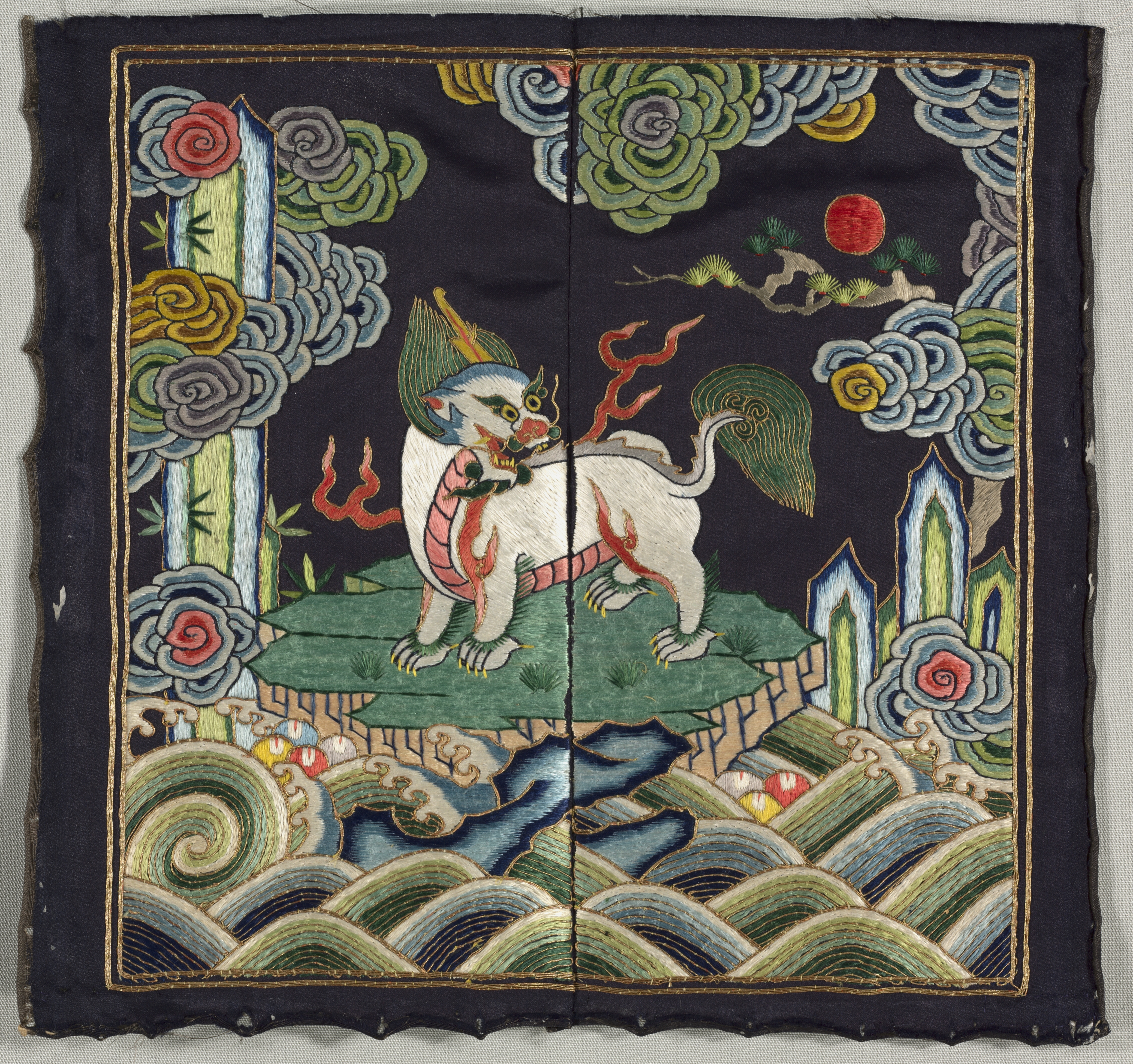
Fabric Deconstruction Analysis: Qing Dynasty Rank Badge (Buzi) for Avant-Garde Application
As Chief Fabric Deconstructionist for Zoey Fashion Lab, I present a comprehensive analysis of a Qing dynasty rank badge (buzi) from the Qianlong reign (1736–95). This artifact, a silk satin weave embroidered with silk and metal thread, is examined through the lens of avant-garde fashion reconstruction. The badge’s structural, symbolic, and material properties offer a rich foundation for deconstruction, reinterpretation, and integration into contemporary, boundary-pushing design.
Material and Textile Analysis
The buzi is constructed from a silk satin weave base, characterized by its lustrous surface and smooth texture. Satin weave, with its long floats and minimal interlacing, provides a reflective quality that enhances the vibrancy of the embroidered motifs. The silk threads used in the embroidery are finely twisted, allowing for intricate detailing and a soft, supple hand. The metal threads, likely composed of gilded silver or silk-wrapped gold, add a rigid, reflective contrast. These threads are couched onto the surface, creating raised, linear patterns that catch light differently than the satin ground. For deconstruction, the differential behavior of these materials under stress—silk’s tensile strength and metal’s brittleness—must be considered. The satin weave is prone to fraying along cut edges, while metal threads can snap or tarnish if exposed to moisture or friction. In an avant-garde context, these vulnerabilities can be exploited: frayed edges become decorative fringes, and tarnished metal threads introduce a patina of age, evoking decay and transformation.
Structural and Symbolic Deconstruction
The buzi is a square or rectangular patch, typically measuring 30–40 cm per side, designed to be sewn onto the front and back of a court robe. Its composition is hierarchical: a central motif of a mythical beast or bird (here, likely a qilin or crane for civil or military rank) surrounded by auspicious clouds, waves, and Buddhist symbols. The symmetry is rigid, with the central figure facing forward or slightly right, representing authority and cosmic order. The border is often a repeating geometric pattern, reinforcing the frame’s containment. For avant-garde deconstruction, this symmetry can be disrupted. The central motif can be extracted and recontextualized as a standalone emblem, while the border patterns can be fragmented into modular strips. The directional orientation of the beast—traditionally facing outward to ward off evil—can be inverted or multiplied, creating a sense of disorientation. The hierarchical layers—ground, clouds, central figure, border—can be physically separated, allowing each to become a distinct design element: the satin ground as a draped base, the cloud embroidery as appliquéd patches, and the central figure as a sculptural brooch.
Color and Contrast in Avant-Garde Context
The buzi employs a restrained palette dominated by deep blues, greens, and golds, with accents of coral, white, and black. The satin base is typically a dark navy or indigo, providing a backdrop for the vibrant embroidery. The metal threads in gold or silver create high contrast, drawing the eye to the central motif. In an avant-garde setting, this color scheme can be manipulated through digital printing, dye sublimation, or reactive dyeing. The deep blue can be lightened to a cyan or faded to a ghostly pale, while the gold can be replaced with neon yellow or reflective silver. The contrast can be exaggerated: the metal threads can be woven into a conductive fabric, enabling light-responsive elements. Alternatively, the entire color palette can be inverted—black satin with white embroidery—to create a negative space effect, challenging the original hierarchy of visibility. The traditional symbolism of colors (blue for heaven, gold for imperial power) can be subverted: blue becomes a symbol of digital surveillance, gold of economic precarity.
Techniques for Deconstruction and Reconstruction
Several techniques are proposed for transforming the buzi into avant-garde fashion elements:
Laser Cutting: The satin weave can be precision-cut to remove the central motif, leaving a negative space that reveals underlying layers. The metal threads, however, require careful handling to avoid melting; a CO2 laser at low power can etch patterns without full penetration.
Dissolvable Embroidery: Using water-soluble stabilizer, the silk and metal threads can be stitched onto a temporary substrate, then washed away to create a freestanding lace-like structure. This technique isolates the embroidery from the satin ground, allowing it to float as a translucent overlay.
Thermal Bonding: The metal threads can be fused with thermoplastic films to create rigid, moldable shapes. When heated, the metal-thread sections can be bent into three-dimensional forms—spikes, curls, or geometric structures—that contrast with the soft silk base.
Deconstruction into Modules: The badge can be cut into irregular polygons, each containing a fragment of the original design (e.g., a cloud, a claw, a wave). These modules can be reassembled on a new garment using visible stitching, creating a patchwork that references the original while breaking its unity. The modules can be rotated, mirrored, or overlapped to generate new visual rhythms.
Symbolic Reinterpretation for Avant-Garde Narrative
The buzi originally signified rank, authority, and cosmic harmony. In an avant-garde context, these symbols can be recontextualized to critique or deconstruct power structures. The central beast, traditionally a symbol of imperial might, can be rendered as a fragmented, decaying figure—perhaps using distressed silk or unraveled threads—to suggest the erosion of authority. The clouds and waves, representing the cosmic order, can be abstracted into chaotic, overlapping forms, evoking entropy. The border, once a frame of containment, can be broken into jagged edges that bleed into the garment, symbolizing the collapse of boundaries. The metal threads, originally signifying wealth and permanence, can be replaced with recycled materials—e-waste wires or industrial foil—to comment on consumerism and sustainability. The badge’s square shape, a symbol of stability, can be deconstructed into a dynamic, asymmetrical silhouette that challenges traditional garment construction.
Integration into Avant-Garde Garments
For Zoey Fashion Lab, the deconstructed buzi can be integrated into several avant-garde garment types:
Deconstructed Outerwear: A trench coat or cape can feature the badge’s modules as detachable panels, secured by magnetic closures or visible zippers. The satin ground can be used as a lining, visible when the garment is open, while the embroidery modules are attached to the exterior. The asymmetry of the modules creates a sense of imbalance, challenging traditional tailoring.
Structural Gowns: The metal-thread sections can be bonded into a corset-like structure, forming a rigid bodice that contrasts with a flowing silk skirt. The central beast motif can be placed at the sternum or lower back, its directional orientation altered to face inward or downward, subverting its protective symbolism. The clouds can be embroidered onto sheer mesh panels, creating a layered, ethereal effect.
Accessories: The modules can be repurposed as statement pieces: a choker with the central beast as a pendant, earrings with cloud fragments, or a belt with wave motifs. The metal threads can be woven into a mesh for a futuristic headpiece, while the silk satin can be pleated into a fan or a bag.
Conclusion
The Qing dynasty buzi from the Qianlong reign is not merely a historical artifact but a dynamic textile system ripe for avant-garde deconstruction. Its silk satin base, silk and metal thread embroidery, and hierarchical composition offer a palette of material behaviors and symbolic meanings that can be subverted, fragmented, and reimagined. By exploiting the vulnerabilities of its materials—fraying, tarnishing, brittleness—and disrupting its symmetrical structure, Zoey Fashion Lab can create garments that challenge traditional notions of power, order, and beauty. The resulting designs will embody the New DNA Strand aesthetic: a fusion of historical depth and radical innovation, where the past is not preserved but transformed into a provocative, living commentary on the present.