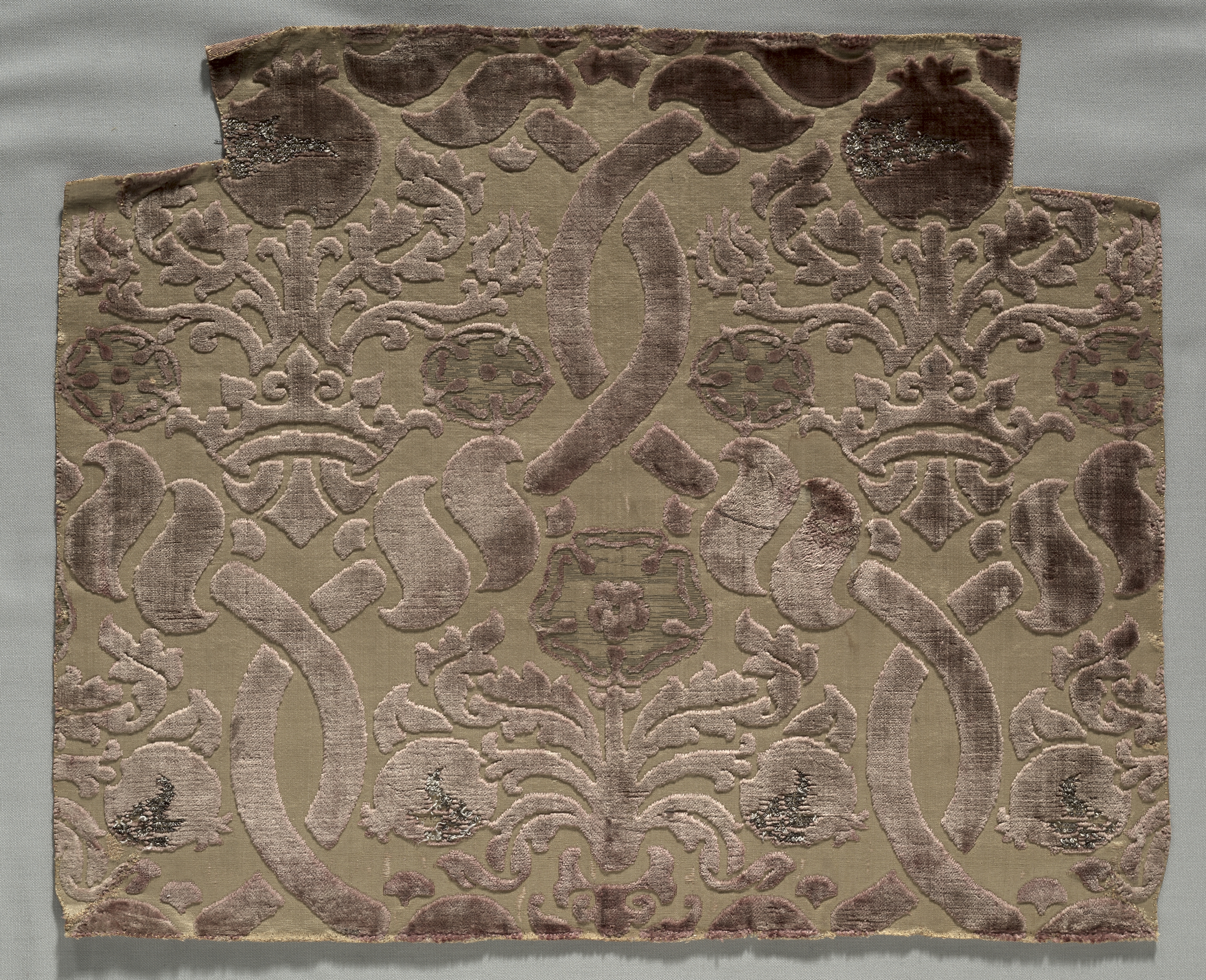
Fabric Deconstruction Report: Velvet Fragment, Italy, 16th Century
Executive Summary
This report presents a comprehensive deconstruction analysis of a velvet fragment originating from 16th-century Italy, commissioned by Zoey Fashion Lab under the directive of the Chief Fabric Deconstructionist. The fragment, composed of silk with a complex velvet construction—incorporating cut, uncut, voided, and brocaded techniques—is examined through the lens of avant-garde fashion design. Referenced as a “New DNA Strand,” this analysis aims to decode the fragment’s structural, aesthetic, and historical DNA, proposing innovative reinterpretations for contemporary design. The findings reveal a rich interplay of texture, light, and form that can inspire radical, forward-thinking collections.
Historical and Technical Context
The 16th-century Italian velvet fragment represents a pinnacle of Renaissance textile artistry, produced in major centers such as Florence, Venice, and Genoa. These velvets were luxury goods, often commissioned for ecclesiastical vestments, aristocratic garments, and courtly furnishings. The fragment’s construction—combining cut and uncut velvet, voided areas, and brocaded details—demonstrates sophisticated weaving on a drawloom, requiring skilled artisans to manipulate warp and weft threads. Cut velvet (velluto cesellato) features loops sheared to create a plush pile, while uncut velvet (velluto riccio) retains loops for a textured, matte effect. Voided velvet (velluto a risparmio) leaves areas of ground fabric exposed, creating contrast, and brocaded velvet (velluto broccato) incorporates supplementary wefts of gold or silver thread for opulent patterns.
This technical complexity is not merely decorative; it reflects a deep understanding of material behavior. The silk fibers, derived from Bombyx mori, offer a natural luster and strength, while the pile height variations create dynamic optical effects. For Zoey Fashion Lab, this fragment serves as a “New DNA Strand”—a foundational element for deconstructing and reconstructing textile language. The avant-garde lens demands we move beyond historical reverence, instead treating the fragment as a raw material for innovation.
Structural Deconstruction: The Four Velvet Techniques
The fragment’s anatomy reveals a layered interplay of techniques that can be isolated and reimagined. Cut velvet provides a dense, soft pile that absorbs and reflects light unevenly, creating a sense of depth. In avant-garde design, this can be exaggerated through laser-cutting or chemical etching to produce irregular, sculptural surfaces. Uncut velvet, with its looped structure, offers a tactile contrast—rough yet resilient. Deconstruction suggests extracting these loops via hand-pulling or mechanical distortion to create frayed, organic edges that challenge traditional finishings.
Voided velvet introduces negative space, where the ground silk is exposed. This technique is crucial for avant-garde deconstruction, as it allows for transparency and layering. By isolating voided areas, designers can create cutouts that reveal underlying garments or skin, aligning with the trend of deconstructed silhouettes. Brocaded velvet, with its metallic threads, adds a rigid, reflective element. Deconstruction can involve removing these threads to create linear tears or embedding them into new substrates, such as neoprene or recycled synthetics, to merge historical opulence with modern sustainability.
The fragment’s weave structure—a combination of warp-pile and weft-pile—offers a blueprint for hybrid textiles. For instance, the pile can be selectively shaved using digital fabrication tools, producing gradients from dense to sparse. This technique, when applied to a garment, can mimic the fragment’s original chiaroscuro effect while introducing a contemporary, data-driven precision.
Material Analysis: Silk as a Living Fiber
The silk substrate is a key focus for deconstruction. Historically, silk’s protein-based structure allows for dyeing, weighting, and finishing processes that alter its drape and luster. In the 16th century, silk was often weighted with metallic salts to enhance its body, a practice that now presents conservation challenges. For avant-garde applications, Zoey Fashion Lab can exploit silk’s reactivity. Enzymatic treatments can soften or stiffen specific areas, creating memory fabrics that hold sculptural forms. Alternatively, silk can be combined with biodegradable polymers to produce “living” textiles that change texture in response to humidity or temperature—a nod to the fragment’s original sensitivity to light.
The brocaded metal threads, typically silver-gilt, are a source of rigidity. Deconstruction involves separating these threads from the silk ground, potentially recycling them into conductive fibers for wearable technology. This aligns with the “New DNA Strand” concept, where historical materials are repurposed for futuristic functions, such as integrated sensors or LED embellishments.
Avant-Garde Design Implications
The fragment’s DNA offers three primary design directions for Zoey Fashion Lab: texture manipulation, negative space exploration, and historical hybridity. Texture manipulation involves using the cut/uncut contrast to create garments that shift between matte and gloss, hard and soft. For example, a coat could feature cut velvet panels on the shoulders (for structure) and uncut velvet on the sleeves (for fluidity), with voided sections at the seams to reveal a metallic underlayer.
Negative space exploration, derived from voided velvet, can inform deconstructed silhouettes where fabric is removed to expose the body or secondary textiles. This technique is prevalent in avant-garde fashion, as seen in the work of designers like Rei Kawakubo or Yohji Yamamoto. By adapting the fragment’s voided patterns—often floral or geometric—into laser-cut motifs, Zoey Fashion Lab can create garments that are both archival and disruptive.
Historical hybridity merges the fragment’s opulence with industrial materials. For instance, brocaded velvet can be fused with carbon fiber to produce lightweight, armored forms that reference both Renaissance armor and modern tech wear. The “New DNA Strand” metaphor suggests a genetic recombination: the fragment’s silk pile becomes a “base pair” that can be spliced with nylon, polyester, or even recycled ocean plastics to create a new textile species.
Conservation and Innovation: A Balanced Approach
While deconstruction is central to this analysis, conservation ethics must be considered. The fragment is a historical artifact, and any physical manipulation for design purposes should be non-destructive. Zoey Fashion Lab can employ digital scanning (3D and multispectral) to capture the fragment’s precise weave and pile heights. This data can then be used to generate algorithmic patterns for jacquard looms, producing new textiles that emulate the original’s complexity without damaging it. Additionally, the fragment’s color palette—often deep crimson, gold, and green—can be extracted using spectrophotometry and translated into modern dyes, including those derived from natural sources like madder root or cochineal.
The “New DNA Strand” also implies a biological approach to design. Silk’s protein structure can be replicated using synthetic biology, producing spider-silk analogs that mimic velvet’s pile but with enhanced durability. This aligns with Zoey Fashion Lab’s commitment to sustainable innovation, reducing reliance on traditional silk production while preserving the fragment’s aesthetic DNA.
Conclusion: From Fragment to Future
The 16th-century Italian velvet fragment is not a relic but a blueprint. Its cut, uncut, voided, and brocaded techniques offer a vocabulary of texture, light, and form that is ripe for avant-garde reinterpretation. For Zoey Fashion Lab, this analysis provides a foundation for collections that deconstruct historical luxury into radical, wearable art. By treating the fragment as a “New DNA Strand,” we unlock possibilities for hybrid materials, digital fabrication, and sustainable practices that honor the past while redefining the future of fashion. The next step involves prototyping a capsule collection that extracts the fragment’s core elements—pile contrast, negative space, and metallic accents—into garments that challenge conventional tailoring and embrace the unpredictable beauty of deconstruction.