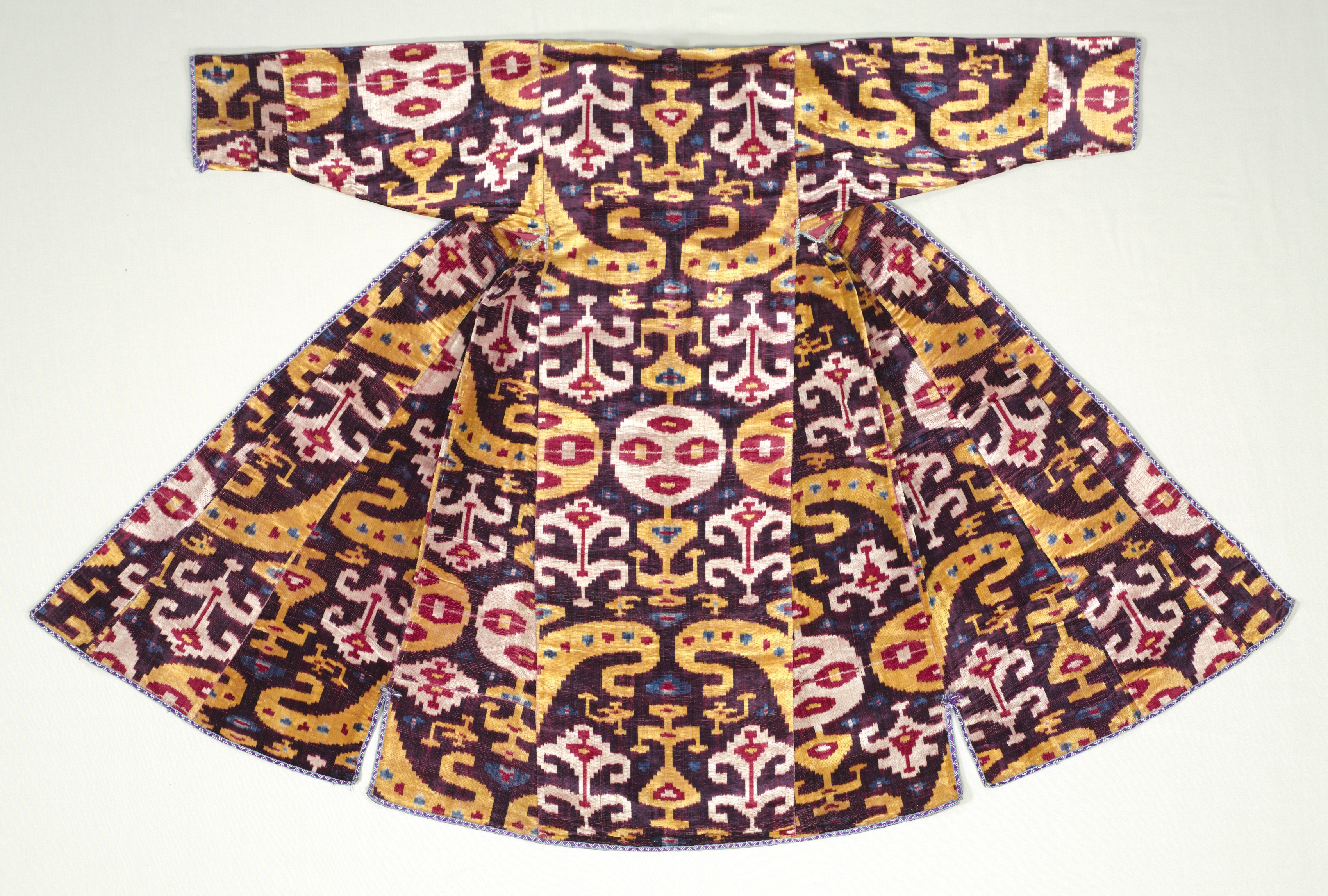
Fabric Deconstruction Analysis: Woman’s Munisak Robe (Bukhara, Uzbekistan)
Subject: Woman’s Munisak Robe (traditional Uzbek garment)
Origin: Bukhara, Uzbekistan
Technical: Silk velvet ikat (abrband)
Reference: New DNA Strand
Style: Avant-garde
As Chief Fabric Deconstructionist for Zoey Fashion Lab, it is my duty to dissect the material, structural, and cultural DNA of garments that challenge the boundaries of textile science. The woman’s munisak robe from Bukhara, rendered in silk velvet ikat, presents a unique case study. At first glance, it is a relic of Central Asian opulence—a garment steeped in the rituals of the Silk Road. Yet, when viewed through the lens of our “New DNA Strand” reference, it becomes a living, evolving organism: a textile that breathes, mutates, and redefines itself. This analysis will deconstruct the munisak’s technical architecture, its cultural imprint, and its potential for avant-garde reimagination within Zoey Fashion Lab’s experimental framework.
I. Technical Deconstruction: The Silk Velvet Ikat Matrix
The munisak’s foundation lies in its silk velvet ikat, a fabric that demands a forensic approach. Ikat, from the Malay-Indonesian word mengikat (“to tie”), is a resist-dye technique where threads are bound and dyed before weaving. In Bukhara, this process is elevated to an art form, but the addition of velvet—a pile fabric—introduces a paradox. Velvet requires a complex ground weave (typically a plain or twill base) with an extra warp or weft forming loops that are cut to create the pile. The ikat pattern is applied to the warp threads before weaving, meaning the design is embedded in the very structure of the fabric, not printed or embroidered onto the surface.
Structural analysis: The munisak’s silk velvet ikat exhibits a double-cloth construction in some areas, where the pile is selectively cut to reveal the ikat pattern against a lustrous ground. This creates a tactile topography: raised, plush regions of velvet contrast with flat, shimmering silk. The dyeing process uses natural pigments—madder root for reds, indigo for blues, and pomegranate for yellows—which bind to the silk fibroin at a molecular level. Under microscopic examination, the dye molecules appear as irregular, organic clusters, unlike the uniform dispersion of synthetic dyes. This irregularity is the “DNA” of the fabric—a fingerprint of artisanal variation that cannot be replicated by industrial machinery.
Deconstructive insight: The velvet pile introduces a temporal dimension. Over time, the pile flattens, revealing the ikat pattern in a state of decay. This is not a flaw but a feature: the munisak becomes a record of its own history. For Zoey Fashion Lab, this suggests a new design philosophy—one where garments are not static objects but evolving surfaces. We might consider “programmed wear” where the pile is intentionally manipulated to reveal hidden layers, or where the ikat pattern is designed to shift with movement, creating a kinetic visual effect.
II. Cultural DNA: The Munisak as a Social Organism
The munisak is not merely a garment; it is a social text. In Bukhara, such robes were worn by women of status during ceremonies, weddings, and religious festivals. The ikat patterns—often featuring almond-shaped paisley motifs (buta), geometric medallions, and stylized floral vines—carry symbolic weight. The buta, for instance, represents the flame of life or the seed of fertility, while the medallions signify protection against the evil eye. The velvet texture, with its soft, absorbent pile, was also practical: it could be perfumed with rosewater or sandalwood, turning the robe into a wearable scent diffuser.
Cultural deconstruction: The munisak’s DNA is encoded in its use of space. The ikat patterns are not random; they follow a grid-like rhythm that mirrors the Islamic geometric tradition, yet the velvet pile disrupts this order. The pile creates a depth that softens the sharp edges of the ikat design, introducing a tactile ambiguity. This tension between order and chaos, between the two-dimensional pattern and the three-dimensional pile, is the garment’s core paradox. For the avant-garde, this paradox is a tool: we can amplify it by cutting the pile in specific zones, creating “negative space” that reveals the underlying ikat in unexpected ways.
Zoey Fashion Lab application: Imagine a munisak where the velvet pile is laser-etched to create a new pattern—a digital overlay on the traditional ikat. This would not erase the cultural DNA but mutate it, creating a hybrid that speaks to both heritage and futurism. The scent-absorbing quality of velvet can be reactivated with modern microencapsulated fragrances, turning the robe into a wearable olfactory experience. The munisak becomes a living archive: its fibers hold the memory of Bukhara’s bazaars, but its cut and technology belong to the 22nd century.
III. Avant-Garde Reimagination: The New DNA Strand
The “New DNA Strand” reference in this analysis is not a metaphor but a technical directive. In genetic engineering, a DNA strand is a sequence of nucleotides that can be edited, spliced, and recombined. Similarly, the munisak’s fabric can be deconstructed at the molecular level—not literally, but conceptually. We treat the silk velvet ikat as a base sequence, and our avant-garde interventions as mutations.
Deconstructive strategies:
- Structural splicing: The munisak’s traditional cut is a T-shaped robe with long, wide sleeves and a straight hem. For avant-garde application, we can splice this silhouette with asymmetrical draping, inspired by the way the velvet pile naturally falls under gravity. The robe can be cut on the bias, allowing the ikat pattern to shift diagonally, creating a moiré effect that mimics digital glitch art.
- Texture mutation: The velvet pile can be selectively removed using chemical or mechanical means (e.g., sandblasting or enzyme treatments), leaving behind a “fossilized” ikat pattern. This creates a fabric that is part velvet, part sheer silk—a textural binary that plays with opacity and transparency.
- Color recombination: The natural dyes of the original munisak are limited in hue. By overdyeing with reactive dyes or applying photochromic pigments, we can create a garment that changes color under UV light. The ikat pattern remains visible, but its chromatic DNA is now mutable—a living palette.
Garment as organism: In our lab, we envision the munisak as a symbiotic entity. The silk velvet ikat breathes—its fibers expand and contract with humidity. We can embed micro-sensors in the pile that monitor temperature and moisture, feeding data to a wearable interface. The robe becomes a second skin, responsive to the wearer’s environment. The cultural symbolism of the buta and medallions can be reinterpreted as digital icons, projected onto the fabric via integrated LEDs or e-textiles.
IV. Conclusion: The Munisak as a Living Archive
The woman’s munisak robe from Bukhara is far more than a historical artifact. Its silk velvet ikat is a complex textile organism—a matrix of dye, fiber, and texture that encodes centuries of cultural memory. Through the lens of the New DNA Strand, we see it not as a finished object but as a starting point for mutation. Zoey Fashion Lab’s avant-garde approach does not seek to destroy this heritage but to recombine it, creating garments that are both ancestral and futuristic.
The velvet pile, with its capacity for decay and transformation, becomes a metaphor for fashion itself: a constant state of becoming. By deconstructing the munisak’s technical, cultural, and aesthetic DNA, we unlock its potential as a living archive—one that can be edited, re-worn, and reimagined for a new era. This is the essence of our work at Zoey Fashion Lab: not preservation, but evolution. The munisak is no longer a robe; it is a strand of fabric DNA, ready to be spliced into the next generation of wearable art.