Deconstructing the Lacquered Void: The Suzuribako as a Blueprint for SS26 Avant-Garde Couture
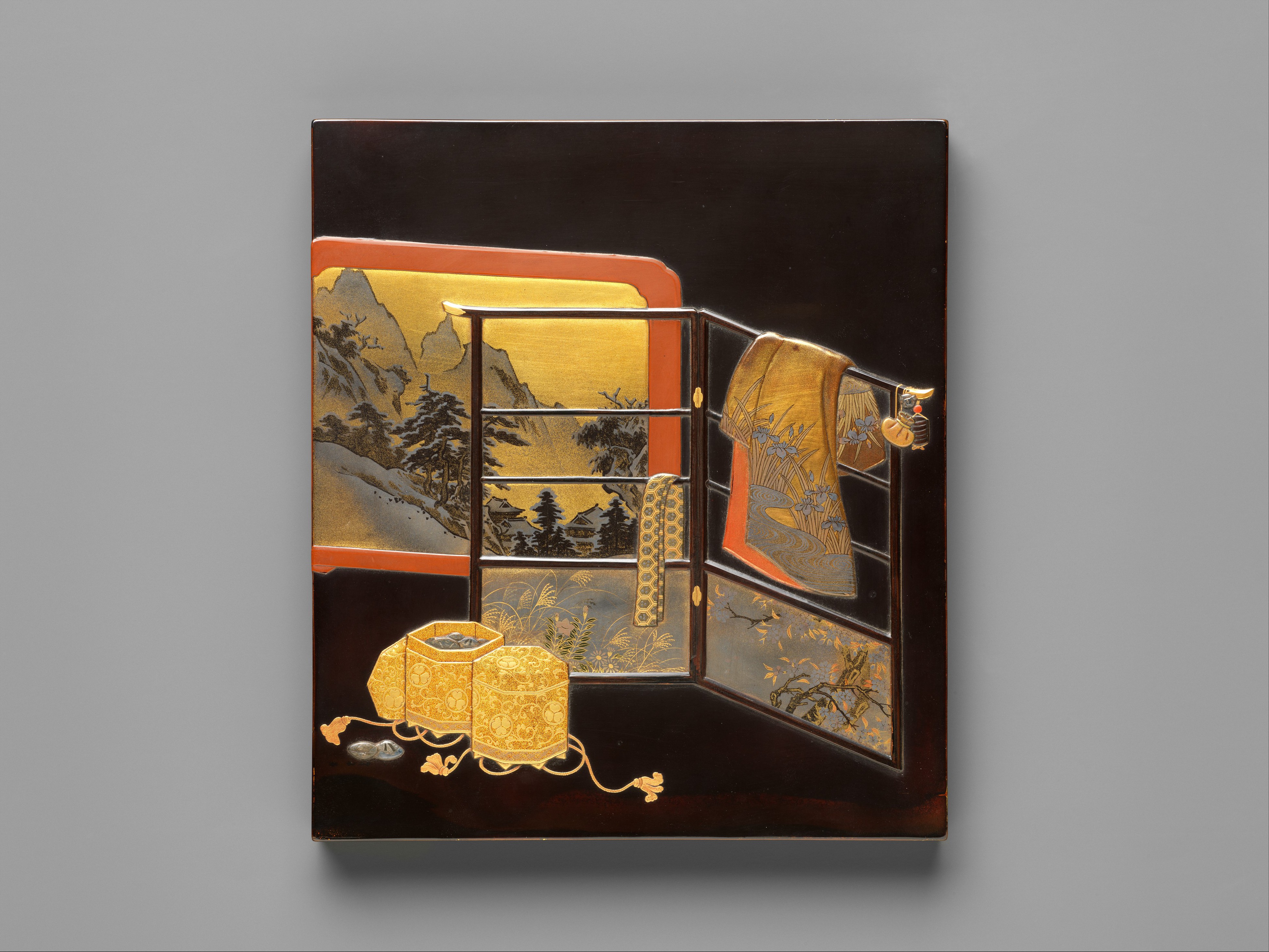
The Writing Box (Suzuribako) with Screen, Robe Rack, and Shell-Matching Game Set—a 17th-century Japanese masterpiece of lacquered wood, gold, and silver maki-e—is not a garment. It is a manifesto. For Zoey Fashion Laboratory’s SS26 collection, this object transcends its historical function as a portable stationery and leisure kit. It becomes a radical architectural blueprint for the body, a treatise on the interplay between containment and release, surface depth, and kinetic structure. This analysis dissects the Suzuribako’s material and spatial logic to forge a new vocabulary of futuristic silhouettes and structural innovation, where tradition is not preserved but violently, beautifully, reborn.
The Geometry of Containment: From Box to Bodice
The Suzuribako’s primary innovation is its lidded, compartmentalized architecture. It is a self-contained universe of drawers, trays, and recesses. For SS26, this translates directly into a silhouette defined by negative space and modular encasement. Imagine a coat that is not a single piece of fabric, but a series of interlocking, lacquered panels. Each panel—a shoulder, a hip, a sleeve—is a discrete “drawer” that slides, rotates, or hinges open to reveal an inner layer. The futuristic silhouette is not a draped form but a geometric exoskeleton; a hard, polished shell that houses a softer, more fluid interior. The black ground of the lacquer becomes a deep, absorbent void in the garment’s base, while the gold and silver takamaki-e (high-relief sprinkled design) are translated into raised, 3D-printed polymer appliqués that act as structural ribs, locking the panels in place. The silhouette is simultaneously rigid and transformable, a wearable container for the self.
Surface as Structure: The Maki-E Revolution in Fabric
The takamaki-e, hiramaki-e, and togidashimaki-e techniques—where metal powders are sprinkled onto wet lacquer and polished—offer a radical departure from traditional textile manipulation. The SS26 collection eschews print for tactile, sculpted surface. The gold and silver are not mere decoration; they are functional stress points. Using a combination of laser-sintered metal mesh and hand-applied resin, the garment’s surface becomes a topographic map of tension and release. A sleeve’s hiramaki-e (flat sprinkled design) pattern is reinterpreted as a series of micro-pleats that catch light and create a moiré effect, while the togidashimaki-e (polished-out design) inspires a burnished, mirror-like finish on the garment’s seams, reflecting the wearer’s environment and creating a dialogue between the body and its surroundings. The red lacquer accents are injected into the seams as a liquid, heat-set polymer that hardens into a flexible, glowing joint—a structural innovation that allows for unprecedented movement within a rigid form.
The Screen and the Robe Rack: Kinetic Draping and Architectural Unfolding
The inclusion of the Screen and Robe Rack within the set is not incidental. They are the key to the collection’s kinetic potential. The screen’s folded, hinged structure inspires a new category of garment: the “Fold-Back Silhouette.” A long, severe coat is segmented into vertical panels, each connected by a hidden, flexible hinge. The wearer can “unfold” the coat into a flat, trapezoidal screen that can stand alone, creating a private, architectural space around the body. This is wearable architecture that transforms the human form into a living, mutable structure. The Robe Rack—a horizontal bar for hanging garments—is deconstructed into a series of cantilevered shoulders and suspended hip panels. The garment’s fabric is not draped over the body but hung from a rigid, carbon-fiber “rack” that sits on the clavicle and hips. The fabric falls in clean, vertical planes, creating a silhouette that is both weightless and structurally defiant. The shell-matching game set—with its paired, interlocking halves—inspires the collection’s modular fastening system: magnetic, interlocking “shells” that snap together to form seamless, invisible closures, allowing for instant reconfiguration of the garment’s volume.
Futuristic Silhouettes: The Lacquered Void and the Bio-Mechanical Body
The SS26 silhouette is a hybrid of the organic and the mechanical. The black ground of the Suzuribako becomes a second skin—a matte, liquid-crystal polymer that shifts from opaque to translucent under movement, revealing the body beneath as a living artifact. The gold and silver maki-e are translated into bio-mechanical circuitry, running along the spine, the arms, and the ribs. These are not just decorative; they house flexible, micro-LEDs that pulse with the wearer’s heartbeat, turning the garment into a responsive, living organism. The red lacquer accents are concentrated at the joints—elbows, knees, neck—as glowing, semi-transparent capsules that contain a viscous, magnetic fluid, creating a sense of internal energy and potential movement. The overall silhouette is exaggerated, elongated, and severe: impossibly long limbs, a compressed, armored torso, and a head that appears to float within a collar that is a facsimile of the Suzuribako’s lid—a halo of polished black lacquer that frames the face as a precious object.
Structural Innovation: The Shell-Matching Closure and the Togidashi Seam
The most radical innovation is the Shell-Matching Closure System. Inspired by the game’s paired shells, each garment features a series of bi-stable, interlocking polymer plates that can be snapped together in multiple configurations. This allows the wearer to alter the garment’s volume, length, and silhouette in seconds. A straight, columnar dress can be transformed into a flared, A-line shape by disengaging the side plates; a sleeve can be detached and reattached at a different angle. The Togidashi Seam—a direct translation of the togidashimaki-e technique—is a seamless, polished joint where two panels of the garment are fused using a heat-activated resin that is then sanded to a mirror finish. The seam disappears, creating a monolithic, lacquer-like surface that defies traditional construction. This eliminates the need for stitching, allowing for a zero-waste, single-surface garment that is both structurally pure and visually breathtaking.
Conclusion: The Object as Oracle
The Suzuribako is not a relic. It is a prophecy. For Zoey Fashion Laboratory’s SS26, it dictates a future where the garment is no longer a passive covering but an active, intelligent, and mutable structure. The futuristic silhouette is not about speed or minimalism; it is about containment, revelation, and transformation. The structural innovation lies in the marriage of ancient lacquer techniques with bio-mechanical engineering, creating a new taxonomy of form that is both deeply historical and aggressively forward. The wearer is not adorned; they are housed. The garment becomes a portable architecture, a lacquered void that contains infinite possibility. This is the avant-garde of SS26: a dialogue between the hand and the machine, the past and the future, the box and the body. The Suzuribako has spoken. The collection is the response.