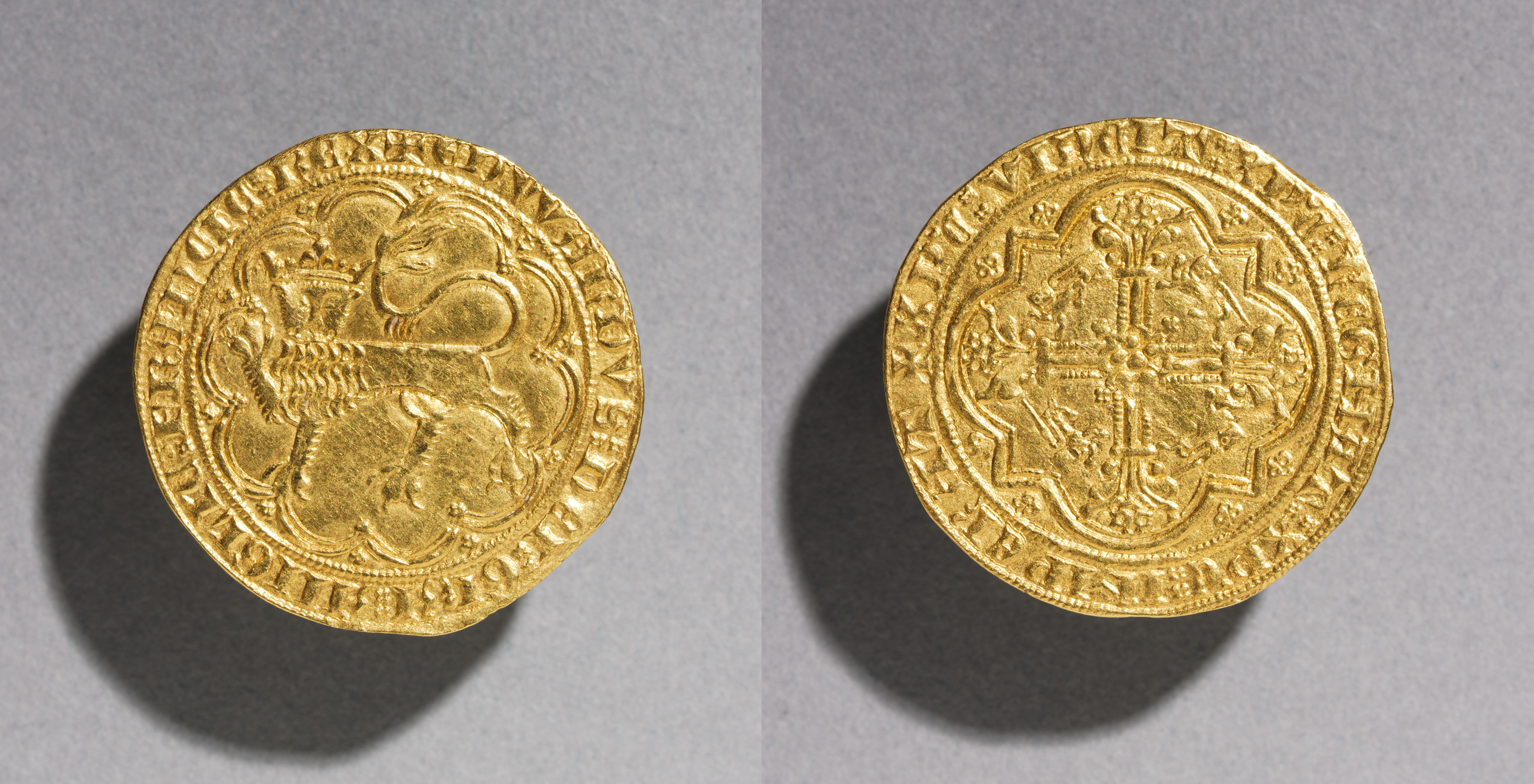
Technical Analysis & Historical Resonance: The Leopard d'Or of Edward III
The artifact known as the Leopard d'Or—a gold noble coin minted under Edward III of England in the 14th century—presents a profound case study for deconstruction. Its existence straddles the material and the symbolic, a duality perfectly encapsulated in its referenced archival resonance: "one side is the intricate acanthus leaf pattern inlaid in gold on a smooth silver mirror, the other is the narrative of life told in relief on a cold stone coffin plate." This is not merely currency; it is a compressed narrative of power, identity, and Gothic aesthetics, rendered in the most unyielding of mediums: gold.
Deconstructing the Gothic Matrix: Form as Ideology
Originating in the Anglo-Gallic context of the 14th century, the coin is a product of the High Gothic period—an era defined by verticality, light, and intricate structural logic in architecture. The Leopard d'Or translates this spatial philosophy into a micro-engraved tableau. The obverse typically features the king enthroned, a rigid, hieratic image of divinely-ordained authority. This is the "cold stone coffin plate"—a fixed, eternal claim to sovereignty and lineage, a final statement meant to outlast flesh. The reverse, however, reveals the dynamic, interconnected spirit of the age: a intricate, quartered shield held within a ornate, flowing tressure—a stylized architectural frame reminiscent of a cathedral's window tracery or the delicate, rhythmic patterns of manuscript illumination.
This is the "smooth silver mirror" adorned with golden foliage. The tressure and heraldic details are not mere decoration; they are a micro-architecture of power. The flowing lines and foliate motifs echo the burgeoning naturalism in Gothic art, a move away from pure abstraction toward observed form. The gold, hammered and engraved, captures and refracts light like stained glass, making the coin not just a token of exchange but a portable, luminous object of symbolic capital. Its very material—gold—serves a dual purpose: it is the ultimate economic guarantor (the foundation of the coin's value in international trade, particularly with Flanders) and the ultimate aesthetic signifier of the sun, divinity, and incorruptible royal virtue.
Heraldry as Avant-Garde Branding: The Fractured Identity
The core tension—and thus the core inspiration for an avant-garde methodology—lies in its heraldry and name. The "Leopard" (actually a lion passant guardant in heraldic terms) represents the Plantagenet claim to the Kingdom of England. The fleurs-de-lis on the shield assert the claim to the Crown of France, a claim that ignited the Hundred Years' War. This coin is, therefore, a wearable manifesto of geopolitical ambition. It performs identity not as a unified whole, but as a contested, fragmented, and aspirational collage. The Anglo-Gallic origin is key: it is an object from a hyphenated reality, belonging fully to neither England nor France but to the imagined, claimed, and fought-over space between them.
This fragmentation is avant-garde. It rejects a singular, stable national narrative in favor of a layered, conflicting, and politically charged identity. For Zoey Fashion Lab, this suggests a design philosophy where garments are not monolithic but are constructed from conflicting narratives—a sleeve that tells one story of structure, a bodice that asserts another of fluidity, with seams that highlight, rather than hide, their points of contention. The "split-leaf" of the archive reference is the perfect metaphor: a natural, organic form (the leaf, the body) deliberately fractured and re-patterned to create a new, more complex order.
Proposed Avant-Garde Translation: The "Écu Fracturé" Collection
Translating this analysis into an avant-garde style requires moving beyond literal leopard prints or heraldic embroidery. The Leopard d'Or offers a deeper structural and philosophical blueprint.
Material Dialectic: Embrace the mirror/coffin plate duality. Develop fabrics that are bi-facial—one side, a "cold," rigid, sculptural material (like a technical foam or fused leather molded into Gothic tracery patterns) finished to a matte stone-like texture. The reverse, a "luminous," smooth, liquid metal cloth (gold Lurex knit, mirrored silk) engraved or jacquard-woven with intricate, flowing acanthus or vine motifs. Garments become reversible narratives of constraint and release, mortality and spectacle.
Structural Heraldry: Silhouettes should reference Gothic architecture not through costume, but through engineering. Asymmetric draping that creates flying buttress-like forms, sharp gothic arches in necklines and seams, and sleeves constructed like articulated armor (the "coffin plate" rigidity) that open to reveal delicate, gold-chainmail linings (the "mirror" luminosity). Tailoring should feel both monastic and martial.
The Fractured Pattern: Deconstruct the heraldic shield. Use laser-cutting or precision printing to break the quartered fields (imagine fields of rich velvet, slick patent leather, raw silk, and metallic brocade) and reassemble them in a non-linear, fragmented manner across the body. A coat's panels may not match, telling different parts of the political story. The leopard/lion motif should be disintegrated—appearing as a single, powerful eye in an embroidery, or as a trail of paw-print stitches, suggesting the animal's movement and elusiveness rather than its static, symbolic form.
Color Alchemy: The palette is dictated by the medium: the alchemy of gold. Explore a spectrum from the deep, somber tones of the stone coffin (slate, tomb grey, oxidized bronze) to the radiant warmth of the metal (pale champagne, burnished yellow gold, rosy alloy). All should be punctuated by the stark, clean contrast of ivory white (the silver mirror) and the heraldic azure and gules (blue and red), used sparingly as shocking, symbolic flashes.
In conclusion, the Leopard d'Or is a masterpiece of compressed conflict. It is an object of economics and eschatology, of English soil and French aspiration, rendered in the eternal yet malleable medium of gold. For Zoey Fashion Lab, it provides a rigorous historical framework to explore an avant-garde ethos centered on duality, fragmentation, and symbolic density. The resulting designs should not look medieval, but should feel as conceptually layered, politically charged, and architecturally profound as the coin itself—wearable artifacts for a modern, hyphenated world.