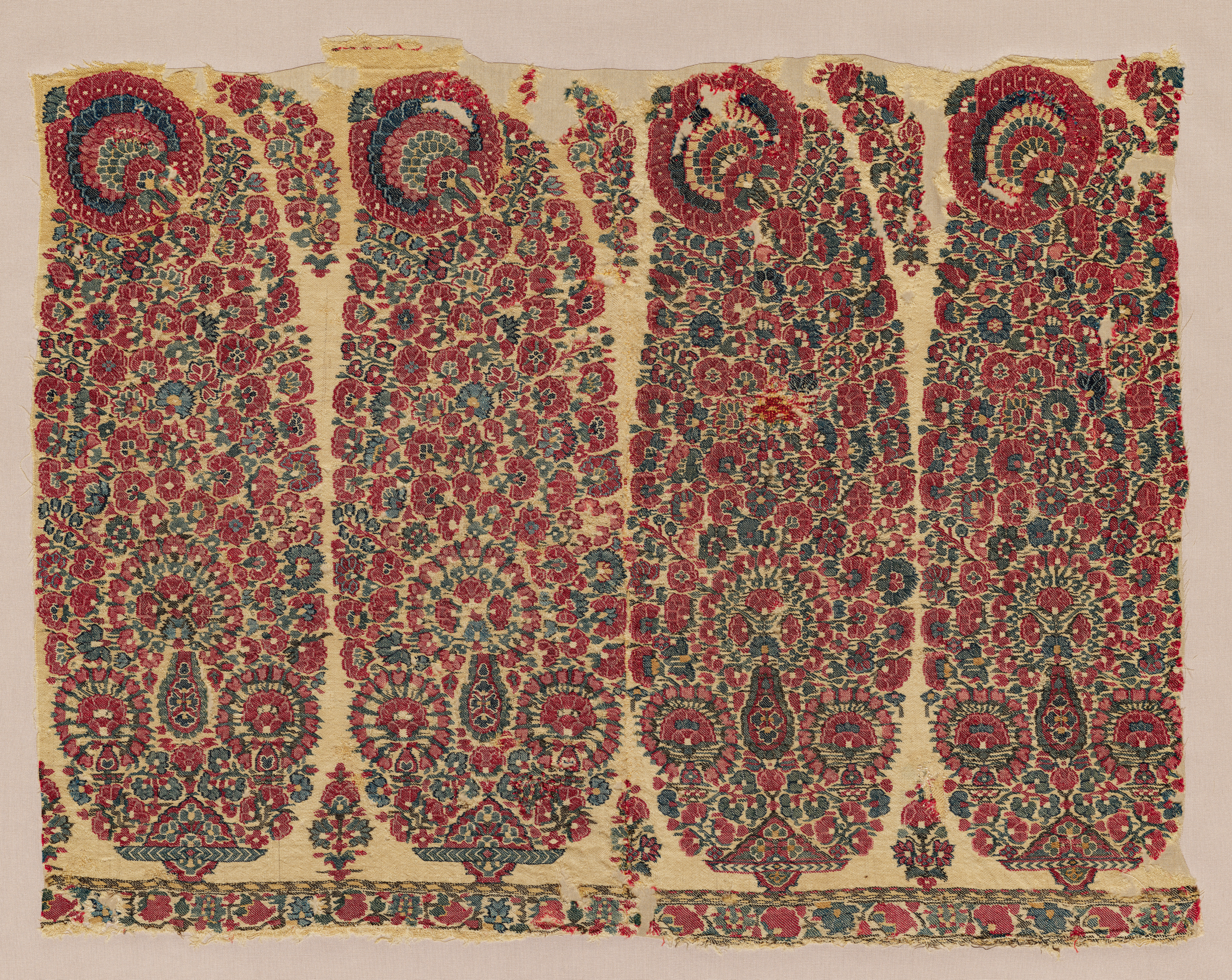
Deconstructing the Kashmir Shawl Border: An Avant-Garde Analysis from Zoey Fashion Lab
At Zoey Fashion Lab, our role as Chief Fabric Deconstructionist is to dismantle the conventional narratives of textile history. We do not merely observe; we interrogate. We take the revered, the traditional, and the technically perfect, and we ask: What happens when we break this? Our subject today is the border of a shawl from Kashmir, India—a piece woven in wool using the intricate tapestry twill technique. This object, typically lauded for its timeless beauty and cultural significance, becomes, under our lens, a radical blueprint for an avant-garde future.
To understand the border's potential for disruption, we must first acknowledge its technical and historical resonance. The tapestry twill weave is a marvel of engineering, allowing for sharp, fluid color transitions without the use of a shuttle. The wool, often from the Changthangi goat (Pashmina), provides a luminous, almost painterly depth. The border itself—the hashiya—is not a mere frame. It is a structured, rhythmic composition of floral motifs, often the buta (paisley) or the cypress tree, repeated in a precise, mirrored sequence. This repetition creates a visual pulse, a heartbeat that contains the chaos of the central field. In the 16th and 17th centuries, under the Mughal Empire, this border became a symbol of imperial power, a fusion of Persian design, Central Asian weaving techniques, and Indian craftsmanship. It is a document of cultural convergence, a silent witness to trade routes, conquests, and artistic exchange.
Archive Resonance: The Silent Witness
Our reference, Archive Resonance, speaks to this very idea: "在人类文明的长河中,器物与绘画不仅是时代技艺的结晶,更是文化碰撞与美学交融的无声见证。" (In the long river of human civilization, artifacts and paintings are not only the crystallization of the skills of an era, but also the silent witnesses of cultural collision and aesthetic fusion.) This shawl border is precisely such a witness. Its geometric precision and floral abundance tell a story of a world in motion—of Safavid painters influencing Mughal ateliers, of Hindu motifs being absorbed into Islamic design, of a luxury economy that stretched from the Himalayas to the courts of Europe. The border’s repetitive pattern is not monotonous; it is a meditative chant, a visual mantra that encodes centuries of exchange.
But for the avant-garde designer, this archive is not a museum. It is a site of extraction. We extract the logic, the tension, and the technology, and we discard the reverence. The border’s perfection is its prison. Our task is to liberate it.
Deconstruction Protocol: Breaking the Border
Our deconstruction of this Kashmir shawl border begins with three key actions: fracture, scale, and re-contextualize.
1. Fracture the Rhythm. The border’s power lies in its rigid, mirrored repetition. The avant-garde intervention is to break this rhythm. Imagine taking the hashiya and cutting it into uneven, jagged segments. One section of the paisley motif is preserved in its full, intricate glory. The adjacent section is reduced to a single, threadbare outline. Another piece is rotated 90 degrees, its floral stems now pointing aggressively outward, not inward. This is not destruction for its own sake; it is a deliberate act of rhythmic disruption. We are creating a visual stutter, a pause that forces the eye to re-engage with the pattern’s DNA. The wool, with its inherent softness, now carries the tension of a broken promise—the promise of symmetry.
2. Scale the Motif to Absurdity. The traditional Kashmir border is a study in micro-scale detail; a single buta might be two inches tall. For the avant-garde, we blow this motif up to monumental proportions. Using digital jacquard or hand-tufting, we render a single paisley from the border as a three-foot-wide, distorted, pixelated form. The fine, painterly lines of the tapestry twill become chunky, almost brutalist. The delicate cypress tree becomes a towering, monolithic structure. This act of extreme magnification transforms the intimate, wearable art into an architectural statement. The border is no longer a frame; it is the entire canvas. The viewer can no longer appreciate the precision; they are overwhelmed by the scale of the original pattern’s ambition.
3. Re-contextualize the Material. The original shawl is pure, fine wool. Our deconstruction demands a clash of textures. We weave the tapestry twill border using wool, yes, but we introduce alien threads: a single strand of recycled metallic fiber that glints with an industrial, cold light; a section of the border woven with unspun, raw wool that feels coarse and unfinished against the smooth Pashmina; a deliberate inclusion of a synthetic, heat-sensitive yarn that changes color with body temperature. This is not a fusion; it is a confrontation. The organic, natural history of the Kashmir wool is violently collided with the synthetic, hyper-modern. The result is a textile that speaks of displacement, of the 21st-century’s anxiety about tradition, of a material that cannot decide if it belongs to a Mughal court or a Tokyo runway.
The Avant-Garde Silhouette: Beyond the Shawl
How does this deconstructed border exist on the body? It does not return to the form of a shawl. That would be a restoration, not a creation. Instead, we propose a series of non-garments.
Consider a corset constructed entirely from the border segments. The rigid, repetitive pattern is cut into strips and woven into a lattice that hugs the torso, leaving the skin exposed in the gaps. The traditional, modest shawl becomes a structure of exposure and constraint. Or, imagine a cape where the entire back panel is a single, massive, distorted paisley from the border, rendered in the coarse, raw wool. The front is left as a bare, unfinished edge, the tapestry twill unraveling into loose threads that trail on the floor. The garment is a study in decay and monumentality.
Another possibility is a modular garment—a series of panels, each a different fractured segment of the border, connected by industrial snaps. The wearer can choose to assemble a full, symmetrical shawl, or they can create an asymmetrical, deconstructed piece that reveals the body in unexpected places. The garment becomes a tool for identity construction, a choice between tradition and chaos.
Conclusion: The Witness Reborn
The Kashmir shawl border is not a relic. It is a reservoir of potential. By deconstructing its rhythm, scaling its motifs, and re-contextualizing its materials, we do not erase the silent witness of cultural collision. We amplify it. We force the viewer to see not just the beauty of the 16th-century fusion, but the violence, the labor, and the ongoing tension of cultural exchange. The avant-garde is not about ignoring the past; it is about re-animating the archive in a way that is uncomfortable, provocative, and undeniably new.
At Zoey Fashion Lab, we do not preserve. We resonate. And this border, broken and rebuilt, will resonate with the future.