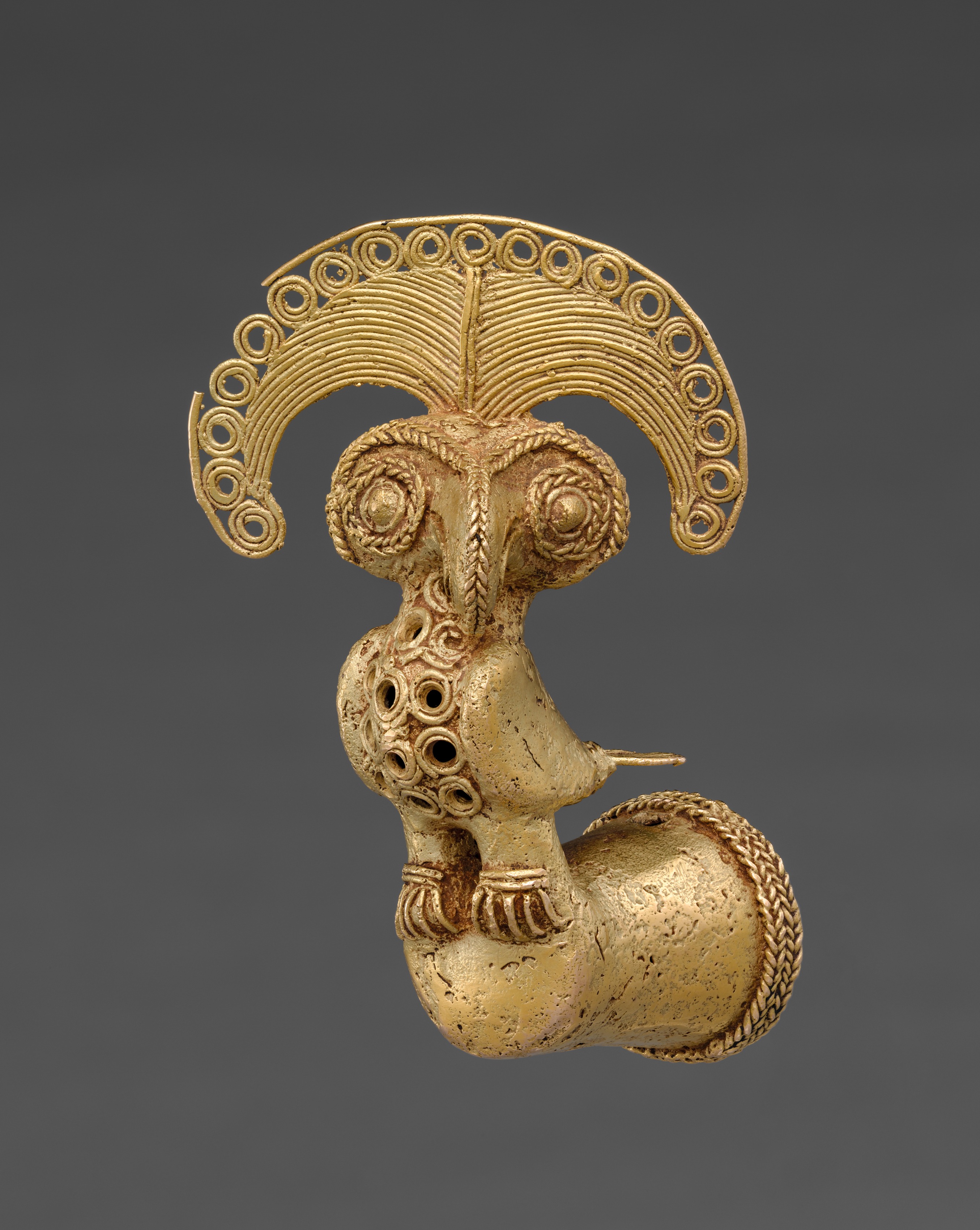
Deconstructing the Avian Sovereign: A Zoey Fashion Lab Analysis of the Sinú Finial with Bird
At Zoey Fashion Lab, we do not merely observe artifacts; we interrogate them. We extract their latent narratives, their structural philosophies, and their vibrational frequencies to inform the next wave of avant-garde design. The subject of this analysis—a gold cast finial from the Sinú culture of the Isthmian Region (modern-day Colombia), dated between the 5th and 11th centuries—presents a profound challenge and opportunity. Depicting a harpy eagle whose crest is fused with the flamboyant plume of a royal flycatcher, this object is not a simple ornament. It is a sovereign statement, a technological marvel, and a bridge between the terrestrial and the divine. Our deconstruction will focus on three key axes: Material Alchemy, Hybrid Morphology, and Narrative Resonance.
I. Material Alchemy: The Logic of Gold and Void
The Sinú were masters of the lost-wax casting technique, a process of meticulous destruction and creation. A wax model is formed, encased in clay, heated to melt the wax away, and then filled with molten gold. This finial is the result of a controlled, sacrificial act. For Zoey Fashion Lab, this process is a direct analogue to our design philosophy: the garment is born from the absence of the pattern. The finial’s gold is not merely a display of wealth; it is a recording of light. Its surface, polished and textured, captures and scatters ambient illumination, creating a dynamic, living skin.
Critically, the finial is a composite of positive and negative space. The bird’s form is defined as much by the gold that is present as by the voids left by the casting core. This interplay is the core of avant-garde construction. We see in this finial a lesson in structural aerodynamics: the bird’s wings are not solid plates but filigree-like networks of gold. This suggests a principle of weightless strength. In a Zoey Fashion Lab collection, this translates to garments that are built from interlocking, openwork structures—lattice-like bodices, chainmail-adjacent sleeves, and cage-like skirts that define the body through its negative space. The gold is not a heavy drape; it is a scaffold for light.
Furthermore, the choice of gold is a statement of eternal value. It resists tarnish, symbolizing an unbroken lineage of power. For our avant-garde practice, this challenges the notion of fast fashion’s disposability. A Zoey Fashion Lab piece inspired by this finial would be designed for permanence, not trend. The material itself—whether gold leaf on resin, gilded stainless steel mesh, or bio-fabricated metallic threads—would be chosen for its capacity to endure and to hold memory.
II. Hybrid Morphology: The Harpy Eagle Meets the Royal Flycatcher
This finial is a deliberate biological paradox. The harpy eagle is the apex predator of the Neotropics—massive, taloned, a creature of silent, crushing power. The royal flycatcher, in contrast, is small, insectivorous, and known for its spectacular, fan-shaped crest that is typically displayed only during courtship or alarm. To merge these two creatures is to create a being of contradictory agency: the strength of the eagle and the flamboyant, communicative crest of the flycatcher.
This is not a mistake; it is a synthetic mythology. The Sinú artist was not bound by biological taxonomy. They were constructing a symbol of authority that encompassed both martial prowess (the eagle’s body) and ritualistic display (the flycatcher’s crest). For Zoey Fashion Lab, this is a masterclass in morphological fusion. Our designs must not be constrained by the human form. We can borrow the eagle’s broad, protective shoulder silhouette and the flycatcher’s exaggerated, dynamic headdress. Imagine a cape cut with the severe, geometric sweep of a harpy’s wing, but whose collar erupts into a fan of kinetic, feather-like filaments—a structure that can be raised or lowered, signifying a shift from combat to ceremony.
The finial’s crest is the focal point of its signaling system. In an avant-garde context, this translates to wearable architecture that communicates status and intent. The crest is not static; it is a mutable form. Zoey Fashion Lab would explore this through garments with integrated, adjustable elements—cuffs that flare like a bird’s ruff, necklaces that fan out into a headdress, or sleeves that can be cinched to reveal a hidden, structural skeleton. The wearer becomes a living totem, capable of modulating their presence from predatory focus to spectacular display.
III. Narrative Resonance: The Archive of Power
The reference provided—Archive Resonance: 一面是光洁银镜上以黄金镶嵌的纷繁棕叶纹,另一面是冰冷石棺板上以浮雕诉说的生命叙事—frames this object within a duality of reflection and burial. The finial, however, is neither a mirror nor a sarcophagus. It is a connector. It likely adorned a staff or a ceremonial object, serving as a point of contact between the human hand and the spiritual realm. The harpy eagle is a messenger between earth and sky; the flycatcher crest is a signal to the living.
Zoey Fashion Lab’s interpretation of this narrative resonance is to design garments that function as portals. The finial’s role as a finial—an apex, a termination point—suggests a design language of capping and crowning. Our pieces would emphasize the head, the shoulders, and the hands—the points of human agency and connection. A headpiece inspired by the crest would not be a simple tiara; it would be a biomimetic antenna, a structure that collects and refracts attention. Gloves would extend into talon-like claws, not for grasping, but for gesturing with deliberate, predatory grace.
The “cold sarcophagus” mentioned in the archive reference speaks to the finial’s survival beyond its original context. It has been extracted from its ceremonial use and placed in a museum case. For Zoey Fashion Lab, this displacement is a source of creative friction. Our designs must acknowledge the object’s history while propelling it into a new, living context. We would create a “ceremonial survival suit”—a garment that is both a museum piece and a functional tool for the contemporary ritual of self-presentation. The gold is not dead metal; it is a fossilized gesture, waiting to be reanimated by the wearer’s movement.
Conclusion: The Avant-Garde as Ritual Technology
The Sinú finial with bird is not a relic. It is a proposition. It proposes that power is a hybrid of strength and spectacle, that material is a vessel for light and void, and that the object is a node in a network of meaning. For Zoey Fashion Lab, this analysis yields a clear directive: design garments that are totemic, mutable, and structurally honest. We will not copy the finial’s form; we will internalize its logic. Our collections will feature gold-infused fabrics that capture light like a cast surface, silhouettes that merge predator and performer, and pieces that function as wearable archives—connecting the wearer to a lineage of ritual power. The harpy eagle and the royal flycatcher are not just birds; they are design principles. And we are their new interpreters.