Deconstructing Heraldry: The Silver Gilt Tray as a Blueprint for SS26 Avant-Garde Couture
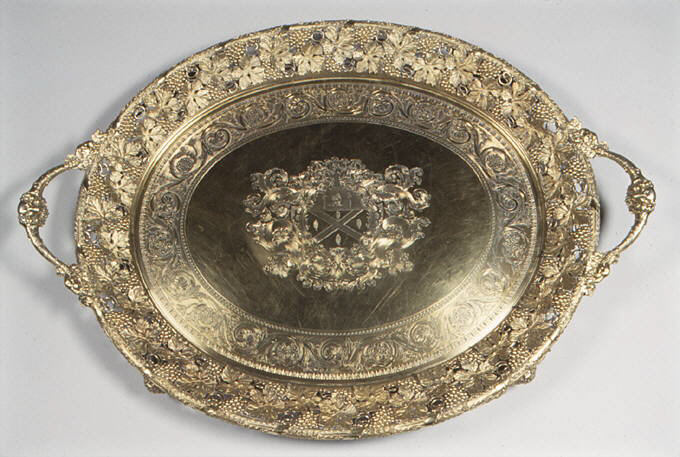
In the hallowed halls of decorative arts, the Tray with arms of William Burrell (1791–1847) stands as a testament to the opulence of the early 19th century. Yet, for the Zoey Fashion Laboratory, this Global Frontier artifact—crafted from silver gilt—transcends its domestic origins. It becomes a radical manifesto for SS26, a deconstruction of lineage, light, and structural logic. The tray’s heraldic arms, its reflective metallic surface, and its functional flatness are not relics to be preserved but springboards for a new vocabulary of futuristic silhouettes. This analysis dissects how the Burrell tray informs a collection defined by architectural rigidity, liquid metal draping, and the subversion of emblematic power.
I. The Armorial as Armature: Structural Innovation from Heraldic Geometry
The Burrell tray’s most immediate feature is its engraved coat of arms, a dense matrix of shields, crests, and mantling. In traditional couture, such motifs are often applied as surface decoration—embroidery or jacquard. For SS26, we invert this logic. The heraldic elements are extruded into three-dimensional armatures, transforming the garment’s skeleton into a living emblem. Imagine a skeletal bustier where the shield form is laser-cut from silver-gilt alloy and articulated like medieval armor, but with a futuristic, biomorphic twist. The mantling—the decorative drapery around the shield—becomes a lattice of carbon-fiber filaments that weave through the torso, creating a structural corset that is both rigid and breathable. The tray’s flatness is negated; the arms rise from the body as exoskeletal appendages, echoing the futuristic silhouettes of cybernetic armor. Each crest is a node, a point of tension from which the garment’s geometry emanates, challenging the idea of heritage as static and instead proposing it as a dynamic, load-bearing system.
II. Silver Gilt as Living Membrane: Metamorphic Materiality and Light
The material of the Burrell tray—silver gilt, a composite of silver and gold—offers a dualistic narrative: the cool, reflective silver and the warm, lustrous gold. For SS26, this is not a mere color palette but a material philosophy. We propose a new textile called “Gilt-Morph”: a smart fabric that shifts its reflective properties based on body heat and movement. When static, the fabric presents a matte, oxidized silver surface, reminiscent of tarnished heirlooms. As the wearer moves, embedded micro-capsules of gold leaf activate, creating a liquid, mercurial sheen that ripples across the silhouette. This is structural innovation at the molecular level. The tray’s function as a serving vessel—a container for light and reflection—is reimagined as the garment’s ability to capture and redirect ambient light. A gown’s train, for instance, might be a sweeping expanse of silver-gilt chainmail, each link a tiny mirror that fractures the body’s outline into a constellation of points. The armorial tray’s polished surface, once a symbol of domestic pride, becomes a futuristic camouflage, dissolving the figure into a shimmering, deconstructed silhouette.
III. Deconstructing the Tray: From Flat Function to Volumetric Provocation
The tray’s defining characteristic is its extreme horizontality—a flat, circular plane designed to hold objects. In avant-garde couture, we weaponize this flatness. The SS26 collection features a series of “Burrell Volumes”: garments that are constructed from a single, continuous plane of silver-gilt mesh, folded and pinned into radical, asymmetrical silhouettes. Think of a cocoon coat that begins as a perfect disc across the shoulders, then cascades downward in a single, unbroken fold, creating a futuristic, almost architectural negative space around the waist. The tray’s rim, often scalloped or notched, is translated into sharp, angular hemlines that cut across the body at unexpected angles. The armorial engraving, once a dense pattern, is laser-ablated into the fabric as a series of voids—negative space that reveals the skin beneath. This is not decoration; it is structural subtraction. The garment’s silhouette is defined by what is removed, mirroring the tray’s function as a vessel that is defined by its empty center. The deconstructive aesthetic is pushed to its logical extreme: the tray is no longer a support for objects but a support for the body, transformed into a wearable sculpture that challenges the very notion of clothing as covering.
IV. The Global Frontier: Heraldry as a Language of Future Power
The Burrell tray’s context as a Global Frontier artifact—a piece from a Scottish landowner’s collection, yet made with materials from the Americas and Asia—speaks to a colonial past. For SS26, we reclaim this narrative. The heraldic arms are abstracted and de-territorialized, stripped of their specific lineage and re-coded as a universal language of power and protection. The futuristic silhouettes are designed for a nomadic elite, a global citizen who carries their own armorial identity on their body. A dramatic, floor-length cape features a single, enormous, laser-cut shield across the back, its surface etched with a fragmented, abstracted version of the original arms—a code that only the wearer can interpret. The silver gilt is not a sign of wealth but of technological mastery, a material that bridges the historical and the speculative. The tray’s function as a ceremonial object is reimagined as a garment of ritual and defiance, worn at the frontiers of fashion, where heritage is not preserved but violently, beautifully, re-invented.
V. Conclusion: The Tray as a Portal to SS26
The Tray with arms of William Burrell is, on the surface, a relic of a bygone era. Yet, for Zoey Fashion Laboratory, it is a catalyst for structural innovation and a redefinition of futuristic silhouettes. By deconstructing its heraldic geometry, metamorphosing its materiality, and subverting its flat function, we have derived a collection that is both a homage and a violent departure. The SS26 avant-garde couture is not about wearing history—it is about wearing the future’s interpretation of history. The silver gilt tray, once a passive vessel, becomes an active, dynamic exoskeleton. The arms of William Burrell are no longer a mark of personal lineage but a universal code of architectural power, inscribed on the body of the future. This is not fashion; this is wearable manifesto, forged from the forgotten flatness of a serving tray, ready to serve a new world order.