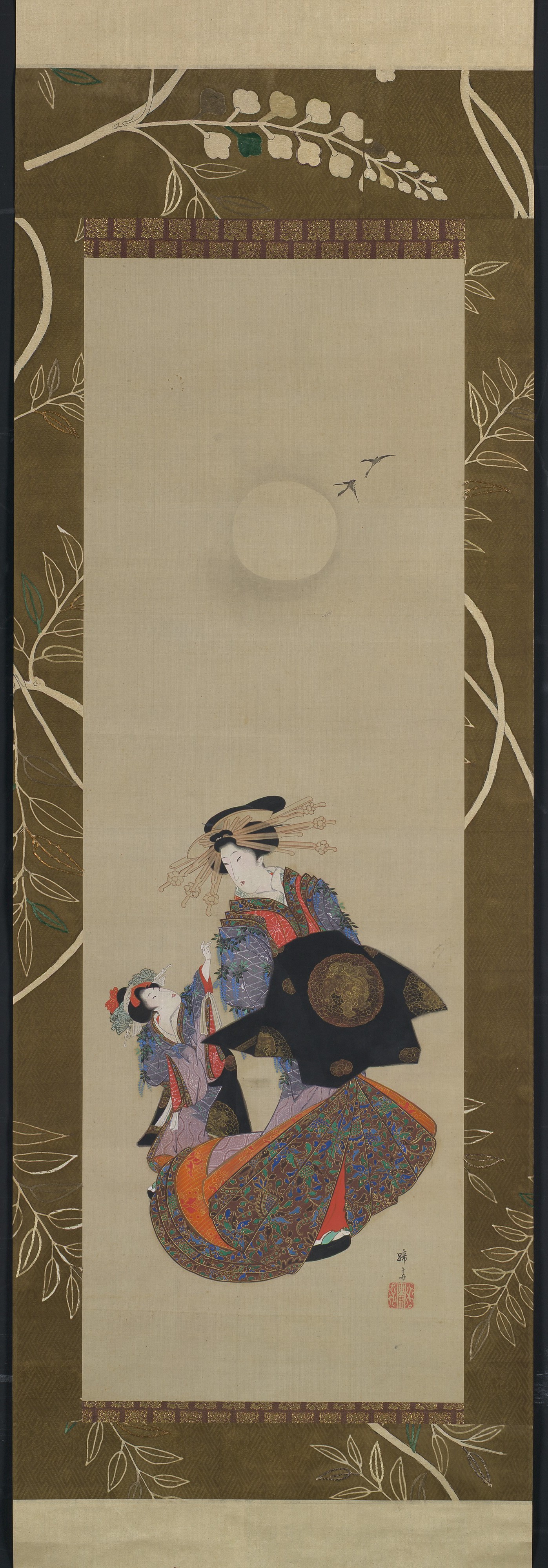
Deconstructing the Floating World: Yoshiwara as a Blueprint for SS26 Structural Innovation
The aesthetic lineage of the Japanese floating world, or *ukiyo-e*, has long served as a fertile ground for fashion’s most radical visions. Yet, the specific tableau of *Beauty of the Yoshiwara with Apprentice in Moonlight*—a hanging scroll executed in ink, color, and gold on silk—offers a unique, non-linear departure point for Zoey Fashion Laboratory’s SS26. This is not a study of historical reproduction but a rigorous deconstruction of its architectural principles. The scroll’s interplay of layered depth, suspended gravity, and luminous surface becomes a manifesto for futuristic silhouettes that defy the body’s static boundaries. Here, the courtesan and her apprentice are not subjects of nostalgia but vectors of structural innovation, their forms translated into garments that exist as dynamic, kinetic sculptures.
The core of this analysis lies in the scroll’s spatial paradox: the illusion of a confined, intimate interior (the Yoshiwara pleasure quarter) rendered through an expansive, almost celestial use of gold leaf and negative space. For SS26, this translates into a radical redefinition of volume. Traditional couture relies on the body as a central pillar; our approach inverts this. The silhouette must become a floating architecture, a garment that suspends itself around the wearer without direct, continuous contact. Think of the apprentice’s obi, not as a cinched waistband, but as a structural fulcrum—a rigid, sculptural ring of reinforced silk and carbon fiber that hovers inches from the torso, anchored only by a single, tensioned strap. The fabric above and below this ring falls in asymmetrical, anti-gravitational cascades, mimicking the scroll’s depiction of moonlight spilling across layered silk robes. This is not draping; it is spatial engineering.
Material Alchemy: From Gold Leaf to Luminous Armor
The scroll’s material palette—ink, color, and gold on silk—demands a translation into high-performance, futuristic textiles. The gold leaf is not a decorative afterthought but a primary structural material. For SS26, we propose electro-luminescent organza woven with micro-thin, flexible gold alloy threads. This fabric, when charged, emits a soft, directional glow, replicating the moonlit sheen of the original while allowing for programmable luminosity. The courtesan’s layered kimono sleeves become a study in dynamic opacity. Outer layers of black, ink-dyed liquid silicone (mimicking sumi-e washes) are laser-cut into geometric, fractal patterns. As the wearer moves, these layers shift, revealing flashes of the gold-infused underlayer. The apprentice’s simpler garment is reimagined as a second skin of compressed, recycled silk pulp—a material that is both rigid and breathable, molded into a single, continuous piece that wraps the torso in a spiral, echoing the scroll’s calligraphic brushstrokes.
The ink itself becomes a textural narrative. We utilize a bio-engineered, self-healing polymer that mimics the viscosity and depth of sumi ink. Applied in gestural splatters and controlled drips onto the garment’s surface, it creates a topography of raised, jet-black ridges. This is not print; it is three-dimensional calligraphy. The polymer responds to body heat, subtly shifting its texture from matte to gloss as the wearer’s temperature rises, creating a living, reactive surface. The gold on silk is not a flat application but a layered, holographic interference. Through advanced nano-layering, the gold thread appears to float above the fabric’s surface, creating an optical depth that shifts with the viewer’s angle, just as the scroll’s gold leaf catches candlelight from different perspectives.
Structural Innovation: The Floating Obi and the Suspended Silhouette
The most radical departure from conventional couture is the elimination of the shoulder as a primary support structure. The scroll’s figures are defined by the horizontal line of the obi and the vertical fall of the fabric—a T-shaped silhouette that is both restrictive and liberating. For SS26, we extrapolate this into a gravity-defying framework. The primary garment is a lattice of 3D-printed, titanium-alloy nodes connected by tension cables of braided Kevlar and silk. This exoskeleton is worn over the body but does not rest on the shoulders. Instead, it is anchored at the hips via a lightweight, flexible corset of carbon fiber and molded leather. From this hip anchor, the structure extends upward and outward, creating a series of cantilevered platforms.
Upon these platforms, the fabric—the gold-infused organza and liquid silicone—is draped not as cloth but as suspended membranes. The courtesan’s layered sleeves become a series of independent, floating panels that are attached to the exoskeleton at only two or three points. They flutter and rotate with the wearer’s movement, creating a kinetic, ever-shifting silhouette. The apprentice’s garment is a single, continuous sheet of the compressed silk pulp that is attached to the exoskeleton at the back of the neck and the front of the hips, creating a parabolic curve that arcs away from the body, leaving a negative space between fabric and skin. This is the *ma*—the essential void—of Japanese aesthetics, rendered as a structural reality.
Color and Light: The Moonlit Palette of SS26
The color story is deliberately limited to the scroll’s core elements: midnight black, oxidized gold, and pearl white. Black is not a neutral but a light-absorbing, depth-creating agent. We use a matte, carbon-fiber weave for the exoskeleton’s primary structure, which swallows ambient light. Gold is reserved for the electro-luminescent threads and the holographic interference layers, creating points of intense, localized luminosity. White is the color of the moon and of the apprentice’s skin—a phosphorescent, bio-luminescent coating applied to the inner surfaces of the suspended membranes. When the wearer moves, the interior of the garment glows, casting a soft, ethereal light onto the body, as if the moon itself were trapped within the fabric.
The final structural innovation is the integration of sound and motion. The scroll’s silence is broken by the imagined rustle of silk. For SS26, this becomes a sonic, haptic feedback system. Micro-sensors woven into the tension cables detect the wearer’s movement and trigger subtle vibrations in the nodes. The gold alloy threads resonate at specific frequencies, producing a faint, metallic hum that is felt through the exoskeleton. This is not a performance; it is a sensory extension of the garment, a dialogue between the body, the structure, and the surrounding space. The *Beauty of the Yoshiwara* is no longer a static image but a living, breathing system of architecture, light, and sound—a definitive avant-garde statement for a future where couture is not worn, but inhabited.