Deconstructing the Diplomat: A Sartorial Manifesto from the Global Frontier
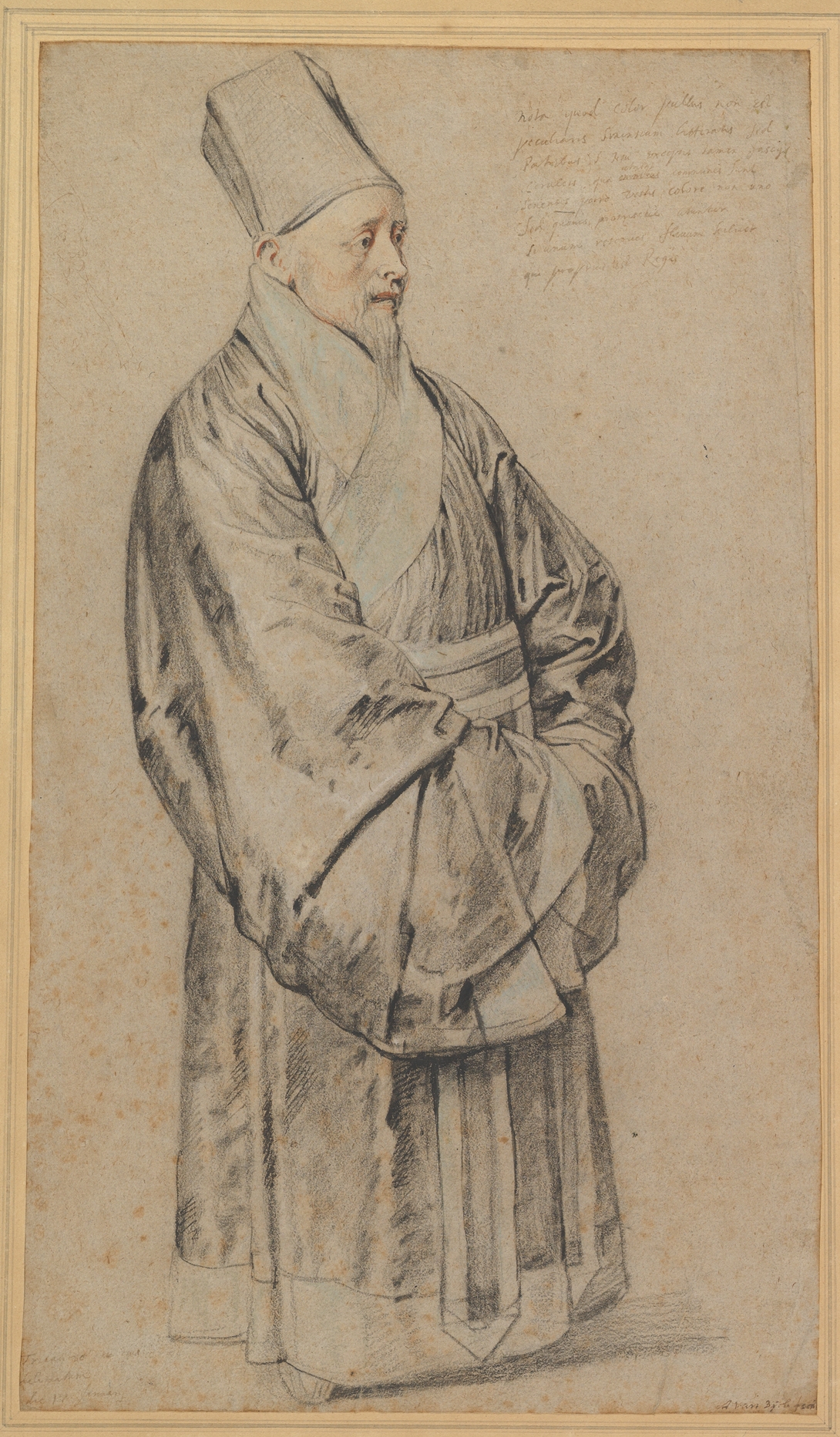
The Portrait of Nicolas Trigault in Chinese Costume is not merely a 17th-century artifact; it is a primordial data packet from the Global Frontier, a complex cipher of cross-cultural negotiation encoded in silk and gesture. For Zoey Fashion Laboratory’s SS26, this portrait serves as our core algorithm. We do not seek to replicate its sinicized Jesuit aesthetic, but to decompile its very essence—the tension between structure and fluidity, the negotiation of identity through layered symbols, and the profound act of sartorial translation. Our analysis yields a collection predicated on architectural hybridity and kinetic drapery, where the historical collision of East and West propels us into a future of conscious garment construction.
Silhouette as Negotiated Space: The Deconstructed Robe
Trigault’s posture—the assertive hand, the draped robe—presents a silhouette that is both authoritative and assimilative. SS26 interrogates this through asymmetric volumetric construction. Imagine the traditional scholar’s robe subjected to a digital glitch: one shoulder erupts in a sharp, geometric origami form, constructed from rigid, paper-like technical taffeta, while the opposite side cascades into a fluid column of liquid crepe. This is not a garment worn, but a space inhabited. The waist, rather than being cinched by a belt, becomes a focal point of structural negotiation, with intersecting straps and tensile bands creating a exoskeletal corsetry that references both European bodice architecture and the wrap philosophy of Asian garments. The silhouette oscillates between containment and release, mirroring Trigault’s own poised duality.
Material Dialectics: Chalk, Ink, and the Memory of Touch
The specified media—chalk, pastel, ink on laid paper—are not just materials but records of process. SS26 translates this into a tactile manifesto of contrasting hand-feels and finishes. The "black, red, and white chalk" manifests as matte, powdered coatings on laser-cut neoprene, creating a fragile, dust-like surface that sheds with movement. The "blue pastel" becomes an ethereal, smudged ombré on layers of translucent organza, engineered to hold color in a nebulous, cloud-like state. Crucially, the "pen and brown and black ink" inform our most radical innovation: photochromatic and thermochromatic inks are embedded into precise, ink-blot trajectories on bias-cut panels. These lines shift from brown to black to clear in response to light and body heat, making the wearer’s journey a dynamic, living drawing. The "light brown laid paper" is echoed in our foundational fabric: a crumple-memory technical silk that holds the creases and impressions of touch, a literal parchment for the body.
Structural Innovation: The Exoskeletal Framework and Kinetic Pleating
Beneath the poetic drapery lies a radical framework. Inspired by the portrait’s dignified rigidity and the implied movement of its robes, we introduce the “floating armature”. This is an internal system of lightweight, flexible carbon-fiber rods, not unlike the bones of a paper lantern, sewn into channel seams. They allow vast, architectural shapes—a hyperbolic sleeve, a fan-like collar—to be collapsible and adaptable. Furthermore, we pioneer directional memory pleating. Using heat-set polymers on silk georgette, pleats are programmed to react to specific movements: a stride might release a cascade of red pleats on one thigh, while a turn of the head contracts a hood into a structured cowl. This is clothing as responsive architecture, where the garment’s form is completed by the choreography of the wearer.
Chromatics of Code: Black, Red, White, Blue as Semantic Layers
Our color palette is stripped to its symbolic core and then technologically augmented. Black is not monolithic; it is the void, rendered in ultra-matte, light-absorbing jacquards. Red, the color of seals, authority, and passion, appears as sudden, laser-cut apertures revealing subcutaneous layers, or as pressurized capsules of dye that release upon a seam’s rupture. White is the negative space, the laid paper, expressed as raw selvedge edges, transparent mesh, and bleached denim substrates that show the blueprint of construction. The blue pastel—the outlier, the spiritual—manifests as an eerie, electroluminescent wire tracing meridians on the body, or as a coolant gel embedded in collar structures, literalizing the concept of a "cooling" cultural buffer.
Conclusion: The Autonomous Garment as Frontier
For Zoey Fashion Laboratory, SS26 is a proposition. The Portrait of Nicolas Trigault teaches us that clothing is the primary interface for identity in uncharted territories. Our collection, therefore, designs for the next frontier: a world of fluid selves and digital-physical hybridity. These garments are autonomous partners in expression. They are designed to transform, to record, and to negotiate their environment. They deconstruct the very idea of a "costume," be it Chinese or European, to build a new language of dress that is both deeply considered and thrillingly unstable. This is not fashion as homage, but as progressive anthropology—using the latent data of the past to write the sartorial code for a future self, constantly in translation. The Global Frontier is not a place; it is the condition of being dressed.