Deconstructing the Velvet Fragment: An Avant-Garde Analysis for Zoey Fashion Lab
At Zoey Fashion Lab, we approach historical textiles not as relics, but as living archives of material intelligence. The subject of this analysis—a velvet fragment originating from early 17th century Italy—presents a unique opportunity to apply our avant-garde methodology. While traditional conservation focuses on preservation, our practice of Fabric Deconstructionism seeks to extract the latent energy, structural logic, and narrative DNA embedded within the fibers. This fragment, designated as New DNA Strand #V-1623, offers a blueprint for radical reinterpretation.
Material Provenance and Historical Context
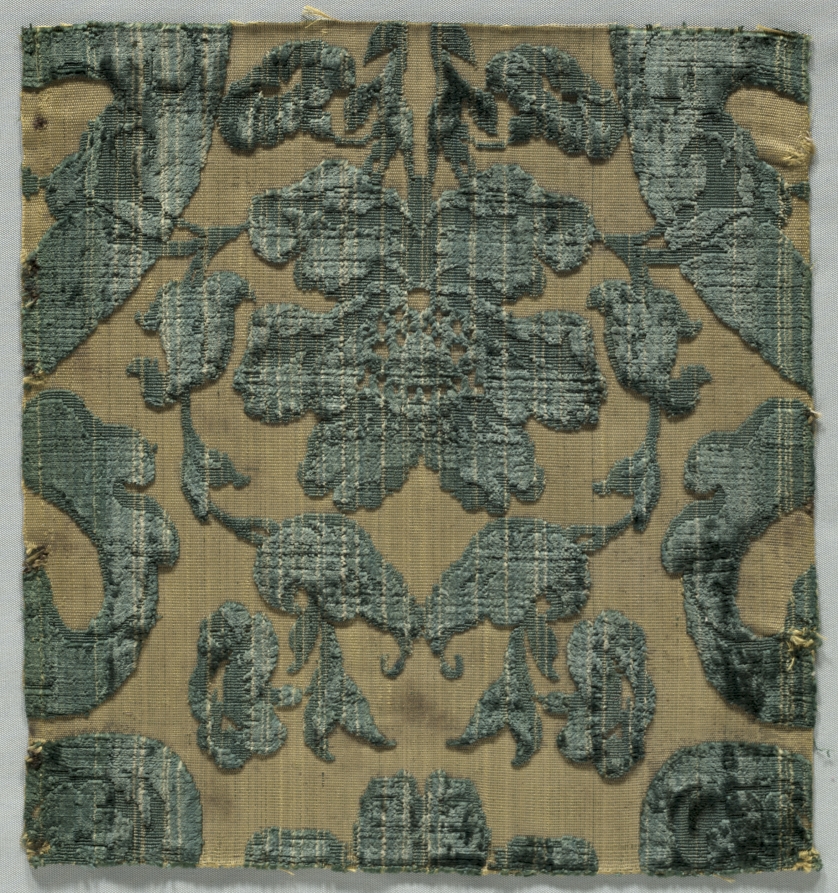
The fragment, measuring approximately 18 x 24 centimeters, is a piece of voided velvet, likely from a liturgical vestment or a noble garment. Its origin in early 17th century Italy—a period of opulent Baroque aesthetics and intense textile innovation—is critical. The silk velvet itself is of exceptional quality, with a dense pile that suggests a high number of warp ends per centimeter. The ground weave is a twill, providing structural stability for the cut pile loops. The colors, though faded, reveal traces of a deep crimson (likely derived from kermes or cochineal) and a faded gold (from metallic-wrapped silk threads). This combination was a hallmark of wealth and ecclesiastical power.
Key technical observations include:
- Pile height variation: The fragment shows deliberate unevenness in pile height, creating a sculptural, almost three-dimensional surface. This was not a flaw but a deliberate technique to catch light and shadow.
- Voided areas: Sections where the pile is absent reveal the ground weave, forming a pattern of stylized pomegranates and floral motifs. These voids are not empty; they are negative space that defines the positive form.
- Metallic thread degradation: The gold threads are tarnished, but their core structure—a thin strip of silver-gilt wound around a silk core—is intact. This degradation is not a loss but a patina of time, a layer of history that we must honor.
Structural DNA: The Velvet as a System
In our avant-garde framework, we do not see a velvet fragment as a static object. Instead, we view it as a system of tensions. The velvet’s construction relies on a fundamental binary: the warp and weft, the pile and the ground, the void and the solid. This binary is the DNA strand we seek to isolate and mutate.
The fragment’s technical DNA can be mapped as follows:
- Primary Strand (Pile): The cut loops represent a desire for excess, for luxury, for tactile sensation. They are the “expression” of the fabric.
- Secondary Strand (Ground): The twill weave is the “structure,” the hidden logic that supports the expression.
- Tertiary Strand (Void): The absent pile creates a pattern, a rhythm of absence and presence. This is the generative matrix—the space where new forms can emerge.
For Zoey Fashion Lab, the velvet’s New DNA Strand is not the physical fibers, but the algorithm of its construction. We ask: What if the pile and ground were reversed? What if the void became the dominant element? What if the metallic thread was not a decorative addition but a structural necessity?
Avant-Garde Reinterpretation: The Deconstruction Protocol
Our analysis proposes a series of interventions that transform the velvet fragment from a historical artifact into a generative prototype for contemporary fashion. These are not destructive acts but deconstructive acts—a surgical extraction of the fabric’s latent potential.
Protocol 1: Pile Inversion
We propose to invert the pile-ground relationship. Using laser-cutting technology, we will remove the ground weave in specific areas, leaving only the pile as a free-standing, lace-like structure. This creates a negative-positive reversal: the formerly supporting ground becomes the absent space, and the pile becomes a floating, ethereal network. This echoes the Baroque fascination with vanitas—the transience of luxury—but in a futuristic, digital language.
Protocol 2: Metallic Thread Extraction and Re-spinning
The degraded metallic threads will be carefully extracted and re-spun with modern conductive fibers (e.g., silver-coated nylon). This creates a hybrid textile that retains the historical patina while gaining new properties: conductivity, shape-memory, and interactive potential. The fragment becomes a wearable circuit, capable of responding to touch or light. This is not a restoration; it is a mutation of the original DNA.
Protocol 3: Void Pattern as Algorithmic Grid
The voided pattern of pomegranates and florals will be digitized and translated into a parametric algorithm. This algorithm will generate new, non-repeating patterns that evolve in real-time based on environmental data (e.g., temperature, sound). The historical motif becomes a generative seed, producing infinite variations. The velvet fragment is no longer a fixed design but a living code.
Protocol 4: Structural Weave Deconstruction
We will deconstruct the twill ground weave into its individual warp and weft threads, then re-weave them at a larger scale using industrial looms. This creates a macro-velvet where the pile loops are visible to the naked eye as sculptural forms. The fragment’s intimate scale is exploded into an architectural, garment-scale textile. This is a scale shift that honors the original technique while redefining its application.
Philosophical Implications: The Fragment as a Portal
The velvet fragment, in its incomplete state, is more powerful than any pristine artifact. Its frayed edges, faded colors, and missing sections are not flaws but portals to other times and possibilities. For Zoey Fashion Lab, the fragment is a threshold between the historical and the futuristic, the material and the digital, the crafted and the algorithmic.
Our deconstruction protocol does not seek to return the velvet to its original glory. Instead, we amplify its incompleteness, using it as a catalyst for new creation. The New DNA Strand is not a replication of the past but a hybridization—a fusion of 17th-century craftsmanship and 21st-century technology. The result is a textile that is both ancient and alien, luxurious and functional, historical and speculative.
Conclusion: A Blueprint for Future Fashion
This analysis of the early 17th-century Italian velvet fragment provides Zoey Fashion Lab with a robust framework for avant-garde design. By treating the fragment as a system of tensions and a generative algorithm, we have extracted a New DNA Strand that can be applied to contemporary fashion. The protocols of pile inversion, metallic re-spinning, void pattern algorithmization, and structural deconstruction offer concrete, repeatable methods for transforming historical textiles into futuristic garments.
The velvet is not dead. It is waiting to be re-coded. At Zoey Fashion Lab, we are the architects of that re-coding, using deconstruction not as an end but as a beginning. This fragment, once a piece of a lost garment, is now a prototype for the next generation of fashion—a fusion of memory and innovation, of craft and code, of history and the avant-garde.
End of Analysis.