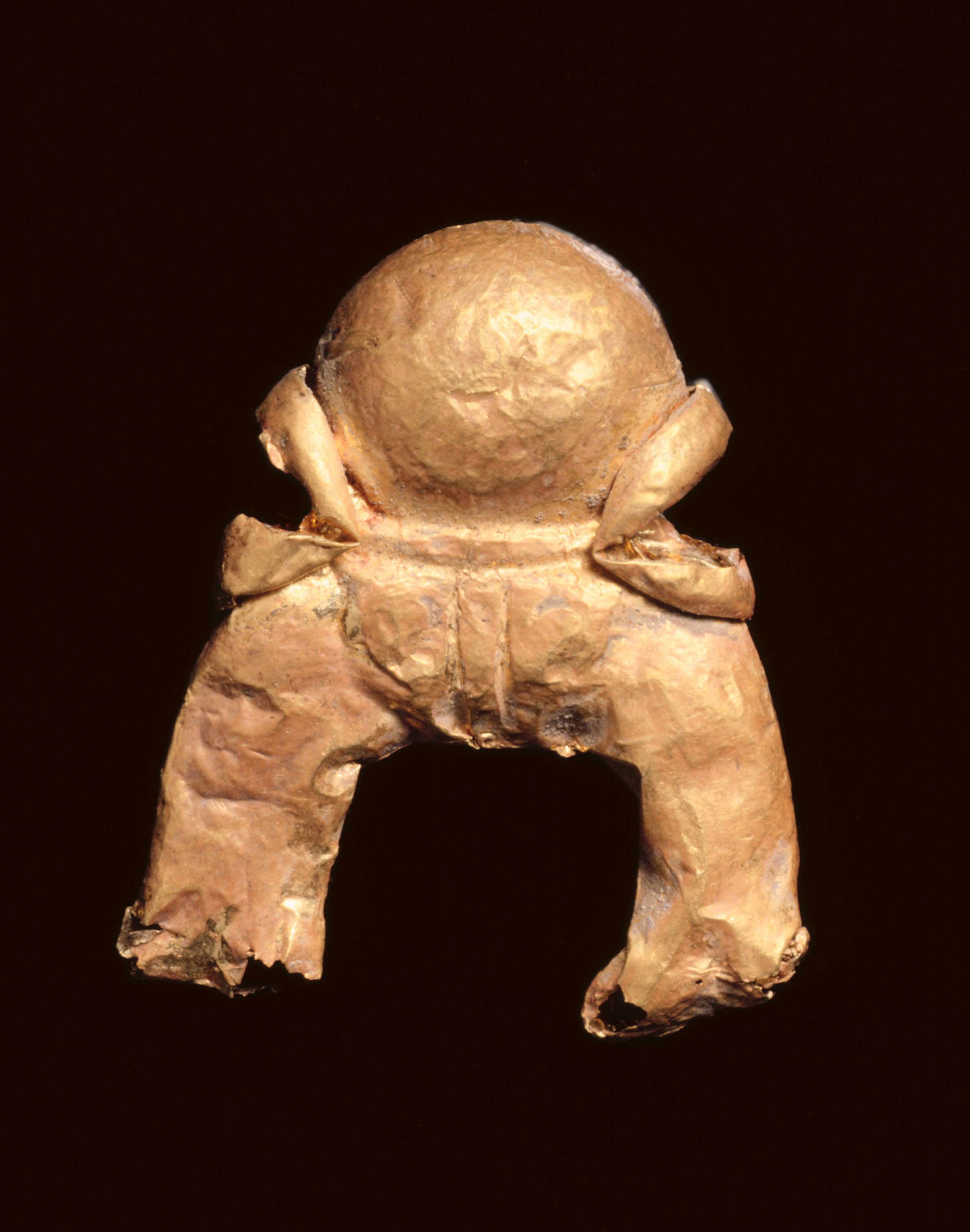
Analysis of a Shunga Gold Triratna: Avant-Garde Deconstruction at Zoey Fashion Lab
At Zoey Fashion Lab, the role of the Chief Fabric Deconstructionist extends beyond the mere analysis of textiles; it encompasses the radical reinterpretation of historical artifacts as foundational elements for avant-garde design. The subject of this analysis—a gold piece in the shape of a Triratna from the Shunga period (185–78 BCE), originating in India—presents a unique opportunity to bridge ancient symbolism with contemporary fashion innovation. This artifact, rendered in pure gold, embodies a convergence of spiritual geometry and material opulence, which, when examined through the lens of our lab’s deconstructive methodology, reveals profound insights for textile and garment construction.
Historical and Symbolic Context: The Triratna as a Structural Archetype
The Triratna, or "Three Jewels," is a foundational symbol in Buddhism, representing the Buddha, the Dharma (teachings), and the Sangha (community). In the Shunga period, a time of political transition and artistic flourishing in India, gold artifacts like this piece were not merely decorative but served as talismans of spiritual authority. The Triratna’s form—often depicted as three interconnected circles, a central trident-like shape, or a composite of three gems—embodies a triadic structure that resonates with principles of balance, unity, and transcendence. For Zoey Fashion Lab, this geometric configuration is a primary archetype for deconstructing garment silhouettes. The three-pronged form suggests a modular approach to design: each "jewel" can be isolated as a distinct element (e.g., a collar, a sleeve, a hemline), while their interconnection implies a seamless integration of disparate parts. This mirrors the avant-garde practice of fragmenting and reassembling fabric to create garments that defy traditional linearity.
The material—gold—adds another layer of significance. Gold is both malleable and durable, a paradox that aligns with the deconstructionist ethos of challenging material integrity. In the Shunga context, gold’s permanence symbolized eternal truth; in our lab, it becomes a metaphor for transforming rigid structures into fluid forms. The Triratna’s gold composition invites us to consider how precious metals can be translated into textile equivalents—metallic threads, foil laminates, or embroidered applications—that retain the luster of gold while introducing the pliability required for avant-garde fashion.
Technical Analysis: Deconstructing the Gold Piece for Textile Innovation
From a technical standpoint, the Shunga gold Triratna is a masterclass in precision craftsmanship. The piece likely employed techniques such as repoussé (hammering from the reverse side to create relief), granulation (applying tiny gold spheres for texture), and filigree (intricate wirework). These methods are directly transferable to textile deconstruction at Zoey Fashion Lab. For instance, the repoussé effect can be emulated through fabric manipulation techniques like trapunto quilting or smocking, where layers of fabric are stitched and padded to create raised, sculptural surfaces. The granulation suggests a micro-texture that could inspire the use of beaded or sequined fabrics, where each element is individually applied to create a cohesive, luminous surface. Filigree, with its openwork patterns, parallels the use of laser-cut textiles or negative-space embroidery, where fabric is removed to reveal underlying layers—a technique that aligns with our lab’s focus on revealing hidden structures.
The Triratna’s shape, likely symmetrical and axial, provides a template for pattern cutting. We can deconstruct this geometry into modular components: a central axis (the spine of a garment), two lateral elements (sleeves or panels), and a base (the hem). This tripartite division challenges the binary (front/back) structure of traditional garments, offering a triadic configuration that can be articulated through asymmetrical draping or interlocking seams. The gold’s reflective quality further suggests the use of metallic-coated fabrics or mirror-like finishes, which, when combined with the Triratna’s form, create a garment that interacts with light and movement—a core tenet of avant-garde design.
Avant-Garde Interpretation: From Artifact to Garment
The reference to the "Mirror with Split-Lea..." in the Archive Resonance points to a duality: one side a polished silver mirror with gold inlay of palm-leaf patterns, the other a cold stone coffin with relief narratives. This juxtaposition of reflection and burial, light and darkness, ornamentation and austerity, is central to our deconstruction of the Triratna. The gold piece, as a Triratna, embodies a similar duality: it is both a sacred emblem and a material object, a symbol of enlightenment and a product of earthly craftsmanship. For Zoey Fashion Lab, this duality informs a design philosophy of contrast—combining opulent gold elements with raw, unfinished edges, or pairing reflective surfaces with matte, textured fabrics.
In an avant-garde context, the Triratna can be reimagined as a wearable sculpture. Consider a garment where the Triratna’s form is deconstructed into a series of gold-plated metal rings or chainmail-like panels, connected by translucent fabric or exposed stitching. The three "jewels" could become detachable brooches or modular components that allow the wearer to reconfigure the garment’s silhouette. Alternatively, the Triratna’s triadic structure could inspire a three-layer garment: an inner layer of gold-threaded mesh (representing the Buddha), a middle layer of sheer, embroidered organza (the Dharma), and an outer layer of structured, gold-lamé (the Sangha). Each layer would be partially visible through the others, creating a palimpsest of meaning—a visual echo of the artifact’s layered symbolism.
The Shunga period’s emphasis on narrative relief (as seen in the stone coffin) also suggests a storytelling approach to garment design. The Triratna’s gold surface could be embellished with micro-embroidered scenes from Buddhist iconography, using gold thread and beads. These narratives would be hidden within the folds of the garment, revealed only through movement or intentional interaction—a nod to the deconstructionist principle of unveiling hidden histories. This aligns with the Archive Resonance’s mention of "life narrative" on the stone coffin, transforming the garment into a wearable archive that carries the weight of ancient symbolism into contemporary fashion.
Material and Process: Translating Gold into Textile
The technical challenges of translating a gold artifact into textile are addressed through material innovation. At Zoey Fashion Lab, we explore gold-infused fibers—such as Lurex or metallic-coated nylon—that mimic the luster of gold while maintaining fabric flexibility. For structural elements, we consider gold-plated hardware (grommets, chains, or clasps) that echo the Triratna’s metallic integrity. The piece’s small scale (likely a pendant or amulet) suggests a focus on detail; thus, our deconstruction emphasizes micro-design—intricate gold embroidery, beadwork, or appliqué that replicates the Triratna’s geometry on a garment’s surface.
The process of deconstruction involves reverse-engineering the artifact. We begin by mapping the Triratna’s geometry onto a dress form, using gold thread to outline its shape. This outline becomes a pattern for cutouts in a base fabric, such as black silk or wool, creating negative spaces that reveal a gold underlayer. The granulation effect is achieved through hand-sewn gold beads clustered in triangular formations, while the filigree is replicated with laser-cut gold leather strips that are woven into the fabric. The result is a garment that oscillates between solid and void, light and shadow—a direct reference to the Triratna’s symbolic interplay of unity and multiplicity.
Conclusion: The Triratna as a Blueprint for Avant-Garde Deconstruction
The Shunga gold Triratna, when subjected to the deconstructive methodology of Zoey Fashion Lab, becomes more than a historical artifact; it is a blueprint for avant-garde design. Its triadic structure, material opulence, and spiritual symbolism offer a rich vocabulary for reimagining garment construction. By fragmenting its form, translating its techniques, and embracing its dualities, we create garments that are not merely clothing but wearable statements of cultural and temporal transcendence. This analysis underscores the lab’s commitment to deconstructing the past to reconstruct the future of fashion, where every thread carries the resonance of ancient wisdom, and every silhouette defies conventional boundaries.