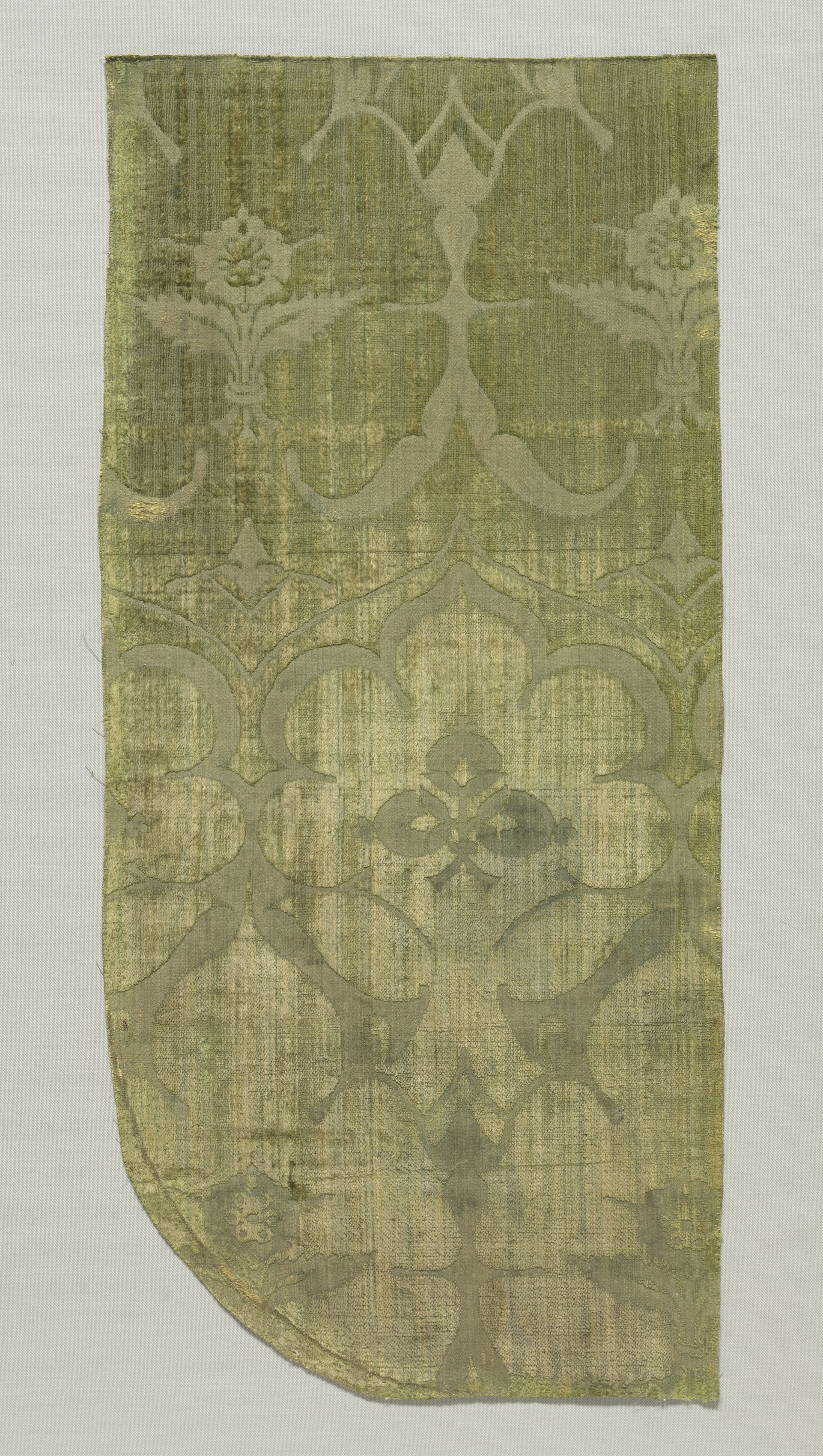
Deconstructing the Fragment: An Avant-Garde Analysis of an Italian Silk Cut and Voided Velvet Chasuble
At Zoey Fashion Lab, the role of the Chief Fabric Deconstructionist transcends mere material analysis; it is an act of archaeological excavation into the soul of textile history, followed by a radical reinterpretation for the future. The subject of this report—a fragment, likely from a 17th or 18th-century Italian chasuble, composed of silk with cut and voided velvet—presents a unique paradox. It is a relic of liturgical opulence, yet its technical DNA pulses with the very essence of avant-garde design. This analysis will dissect the fragment’s structural, aesthetic, and symbolic components, revealing how its inherent contradictions form a blueprint for Zoey Fashion Lab’s next collection: a dialogue between sacred tradition and disruptive modernity.
I. Technical Autopsy: The Cut and Voided Velvet Matrix
The fragment’s primary technical narrative is its construction: a silk foundation overlaid with a cut and voided velvet pile. This is not a simple fabric; it is a woven sculpture. The process involves a complex system of warp and weft threads, where a supplementary warp is raised to create a dense, lustrous pile (the cut velvet) while simultaneously being omitted in specific areas (the voided sections) to expose the underlying silk ground. In this fragment, the voided areas are not merely negative space; they are deliberate, engineered silences that define the pattern’s rhythm.
From a deconstructionist perspective, this technique is a precursor to digital pixelation and parametric design. The velvet pile acts as a high-resolution, tactile pixel, while the voided ground is the background canvas. The fragment’s pattern—likely a pomegranate, acanthus leaf, or floral motif common to ecclesiastical textiles—is rendered through this binary of presence and absence. For Zoey Fashion Lab, this is a direct reference to the New DNA Strand of our design philosophy: the manipulation of surface and void to create dynamic, living forms. The velvet’s pile direction, when brushed or crushed, alters light reflection, making the pattern mutable—a quality we can exploit through engineered, directional pile in future collections.
II. Liturgical Legacy vs. Avant-Garde Disruption
The fragment’s origin as part of a chasuble—the outermost garment worn by a priest during the Eucharist—imbues it with a weight of ritual and hierarchy. The chasuble was a vestment of sacred authority, often heavily embroidered or woven with gold and silk to signify divine light. Yet, this fragment, now severed from its original context, becomes a relic of de-sanctification. The cut edges, frayed threads, and faded colors speak to decay, a process that the avant-garde celebrates as a form of beauty.
Zoey Fashion Lab’s approach to this fragment is to invert its original purpose. Where the chasuble was designed to cover, conceal, and elevate the wearer into a spiritual realm, our deconstruction will expose, fragment, and ground the garment in the corporeal. The voided velvet becomes a metaphor for absence—the missing body, the lost ritual, the erased history. In our hands, this void is not a flaw but a design feature. We will replicate the voided technique not as a pattern of flowers, but as a pattern of deconstructed garments: a sleeve cut away to reveal the arm, a neckline voided to expose the clavicle, a hem left raw to show the warp and weft of the weave itself.
III. Material Alchemy: Silk, Light, and Texture
The silk ground of the fragment is a luminous, almost liquid surface, while the cut velvet pile is matte and dense. This contrast in light absorption and reflection creates a visual depth that is inherently sculptural. In the original chasuble, this interplay was meant to evoke the shimmer of heaven. For us, it becomes a tool for kinetic fashion—garments that change appearance with movement, light, and the viewer’s perspective.
The avant-garde application of this material alchemy lies in its tactile dissonance. The velvet is soft, inviting touch, yet its cut pile is fragile, prone to crushing and wear. This fragility is a design asset. Zoey Fashion Lab will intentionally distress the velvet in specific zones—shoulders, elbows, hips—to mimic the wear of centuries, creating a patina of time that adds narrative to the garment. The silk ground, conversely, will be left pristine, creating a tension between the old and the new, the sacred and the profane.
IV. Pattern Language: From Liturgical Motif to Abstract Code
The fragment’s pattern, though incomplete, suggests a symmetrical, repeating motif typical of Italian Baroque textiles. These motifs were often derived from Persian and Ottoman sources, reflecting the cross-cultural exchange of the Silk Road. The pomegranate, a symbol of fertility and resurrection, is a likely candidate. For Zoey Fashion Lab, this pattern is not a decorative element but a code—a DNA strand of historical and cultural information.
Our deconstruction will abstract this code. We will extract the motif’s geometric skeleton—its curves, intersections, and voids—and translate it into a parametric pattern for laser-cutting, knitting, or 3D-printing. The original motif’s symmetry will be broken, its scale altered, and its repetition randomized. The result will be a fractal-like design that references the past while existing in a state of perpetual flux. This is the New DNA Strand of our collection: a pattern that evolves, mutates, and adapts, just as the fragment has adapted to centuries of decay and rediscovery.
V. Avant-Garde Application: The Zoey Fashion Lab Collection
This fragment will serve as the master template for a capsule collection titled Void and Vestige. The collection will feature:
1. The Deconstructed Chasuble Coat: A long, oversized coat in black silk and voided velvet, with the velvet pile removed in asymmetrical, jagged patterns that mimic the fragment’s frayed edges. The coat will be reversible, with the voided side exposing a raw silk lining printed with the fragment’s original motif in a ghostly, faded tone.
2. The Parametric Bodice: A fitted bodice constructed from laser-cut silk velvet, where the voided areas are replaced with transparent mesh or cutouts. The pattern will be derived from the fragment’s motif but scaled to fit the human form, creating a second skin that is both armor and vulnerability.
3. The Distressed Velvet Trousers: Wide-leg trousers in cut velvet, with intentional crushing and abrasion at the knees and hem. The voided pattern will appear as vertical stripes, elongating the silhouette while referencing the fragment’s liturgical verticality.
4. The Relic Accessories: Scarves, gloves, and bags that incorporate actual fragments of the chasuble (or replicas) as appliqués, encased in clear resin or stitched with metallic thread. These pieces will be wearable artifacts, blurring the line between garment and museum object.
VI. Conclusion: The Fragment as Future
The fragment of an Italian silk cut and voided velvet chasuble is not a relic to be preserved in amber. It is a living document of textile intelligence, a code that can be deciphered, broken, and reassembled into new forms. For Zoey Fashion Lab, this fragment is the New DNA Strand of our avant-garde identity: a fusion of historical technique and radical disruption, of sacred symbolism and profane materiality. By deconstructing its weave, we reconstruct the future of fashion—one where every thread tells a story of decay, resilience, and rebirth.
This analysis concludes that the fragment’s true value lies not in its preservation but in its potential for transformation. It is a call to action: to cut, to void, to re-weave, and to wear the past as a badge of the future.