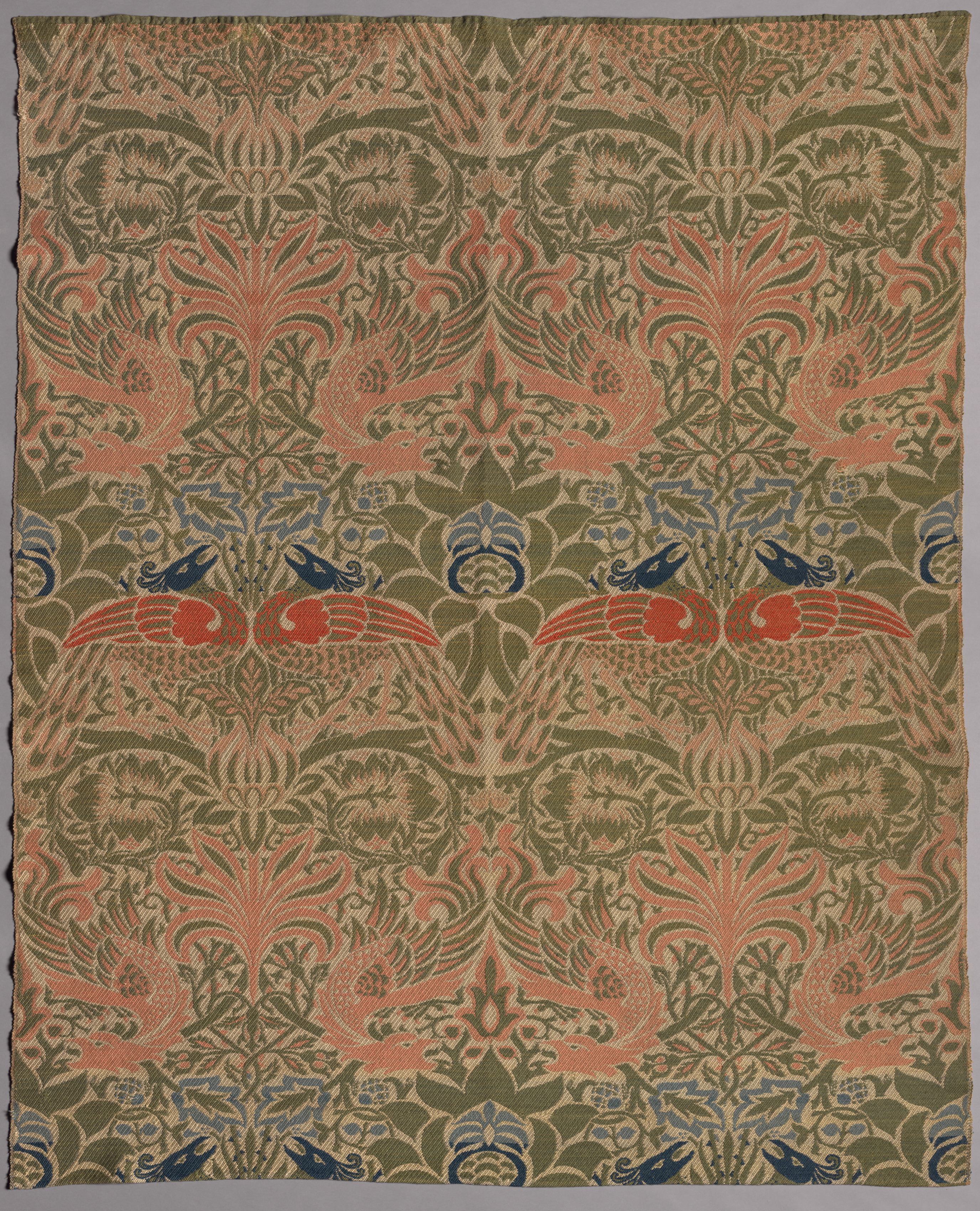
Technical Deconstruction & Material Analysis: The Merton Abbey Textile
The specified artifact—a weft-faced compound twill in wool, originating from Merton Abbey, Surrey, England, with iconography centered on the Peacock and Dragon—presents a formidable and rich foundation for avant-garde exploration. Technically, the weft-faced structure is paramount. Unlike warp-dominant fabrics, this technique buries the warp threads, allowing the weft yarns to create dense, uninterrupted pictorial fields. The compound twill adds dimensional complexity, enabling the interlacing of multiple weft series, historically used for color variation. For Zoey Fashion Lab, this translates to a core principle: the supremacy of surface narrative over structural scaffolding. The wool medium, with its inherent memory, loft, and capacity for fulling, suggests a textural dialogue between defined imagery and a malleable, almost living ground.
Archive Resonance: Decoding the Iconographic Collision
The provided archival context—"在人类文明的长河中,器物与绘画不仅是时代技艺的结晶,更是文化碰撞与美学交融的无声见证。十六至十七世纪...." (In the long river of human civilization, artifacts and paintings are not only the crystallization of contemporary skill but also silent witnesses to cultural collision and aesthetic integration. The 16th to 17th centuries...)—is critical. This period, particularly in England, was an era of global exploration, trade (notably with the Ottoman Empire and Asia), and resultant cultural hybridity.
The Peacock and Dragon motif is a quintessential product of this collision. The peacock, with its connotations of immortality and paradise in Eastern traditions, and of pride and resurrection in Western iconography, meets the dragon, a symbol of imperial power in the East and of chaotic menace in the West. Their coexistence on a single English textile, woven in the monastic-turned-industrial setting of Merton Abbey (later associated with the Arts and Crafts movement), is a silent witness to transcultural appropriation, reinterpretation, and synthesis. This is not mere decoration; it is a woven document of early modern globalization.
Avant-Garde Translation: From Silent Witness to Vocal Manifesto
For an avant-garde methodology, we do not merely replicate this artifact. We must activate its latent energies of collision and witness, propelling its historical dialogue into a contemporary confrontation. The goal is to deconstruct its constituent elements—technical, iconographic, and historical—and reassemble them into a fashion manifesto that speaks to modern identity, cultural fragmentation, and synthetic beauty.
Conceptual Framework: The Dismantled Menagerie
The collection, tentatively titled "The Dismantled Menagerie: Archives of Collision", will treat the original textile not as a pattern but as a coded system to be hacked.
1. Structural Avant-Garde: The weft-faced compound twill inspires a design philosophy of appliquéd and layered surfaces. We will develop modern techniques: heat-bonded wool felts laser-cut with peacock eye motifs, layered over sheer dragon-scale mesh. Garment architecture will play with concealment and revelation—a tailored wool coat (honoring the ground) opens to reveal a lining of iridescent, scaled jacquard, mimicking the weft's hidden complexity. Seams will be exaggerated, becoming topographical lines that reference the twill's diagonal progression.
2. Iconographic Deconstruction: The Peacock and Dragon are separated, abstracted, and forced into new dialogues. The peacock's fan becomes a modular, articulated bustle or collar, constructed from recycled feather-shaped wool felt and iridescent 3D-printed filaments. The dragon's sinuous body transforms into asymmetric sleeve structures and coiled, parametric spiral seams. Their collision is rendered literally in garment closures: dragon-head hooks clasping peacock-eye eyelets.
3. Material Re-interpretation: We honor wool's primacy but subject it to avant-garde processes. Techniques will include: digital printing on felted wool to distort the original motifs; devoré on wool blends to "burn" dragon scales into the fabric; and needle-punching synthetic, luminous fibers into wool grounds to create hybrid textures. The "archive" is made tactile through deliberate degradation—acid washing, controlled moth-holing (as a conceptual gesture), and patchwork repairs using technical fabrics.
The Avant-Garde Silhouette: Witnessing the Present
The silhouette embodies the tension of the archive. It oscillates between structured, almost armorial tailoring (referencing the heraldic nature of the beasts) and deconstructed, fluid drapery (suggesting the unraveling and reinterpretation of history). A key piece might be a "Witness Coat"—a double-face garment where one side presents a fragmented, abstracted version of the original pattern in muted archive tones, while the reverse is a vibrant, chaotic re-imagining in hyper-modern materials.
This collection positions the wearer as the contemporary vessel of this long resonance. They become the active witness, carrying the artifacts of cultural collision on their body, not as historical pastiche but as a re-engineered, personal armor for navigating a globally connected, culturally layered world. The Merton Abbey textile provided the code; Zoey Fashion Lab writes the new, disruptive, and beautiful program.
Conclusion: The Peacock and Dragon of Merton Abbey are liberated from their static, weft-faced plane. Through avant-garde deconstruction, their collision is re-staged in three dimensions. The technical mastery of the past becomes a springboard for innovative construction; the silent cultural witness finds a bold, contemporary voice. This analysis confirms the artifact's profound potential to generate a collection that is intellectually rigorous, technically pioneering, and visually stunning—a true testament to fashion's power to resonate with and reanimate the archives of human creativity.