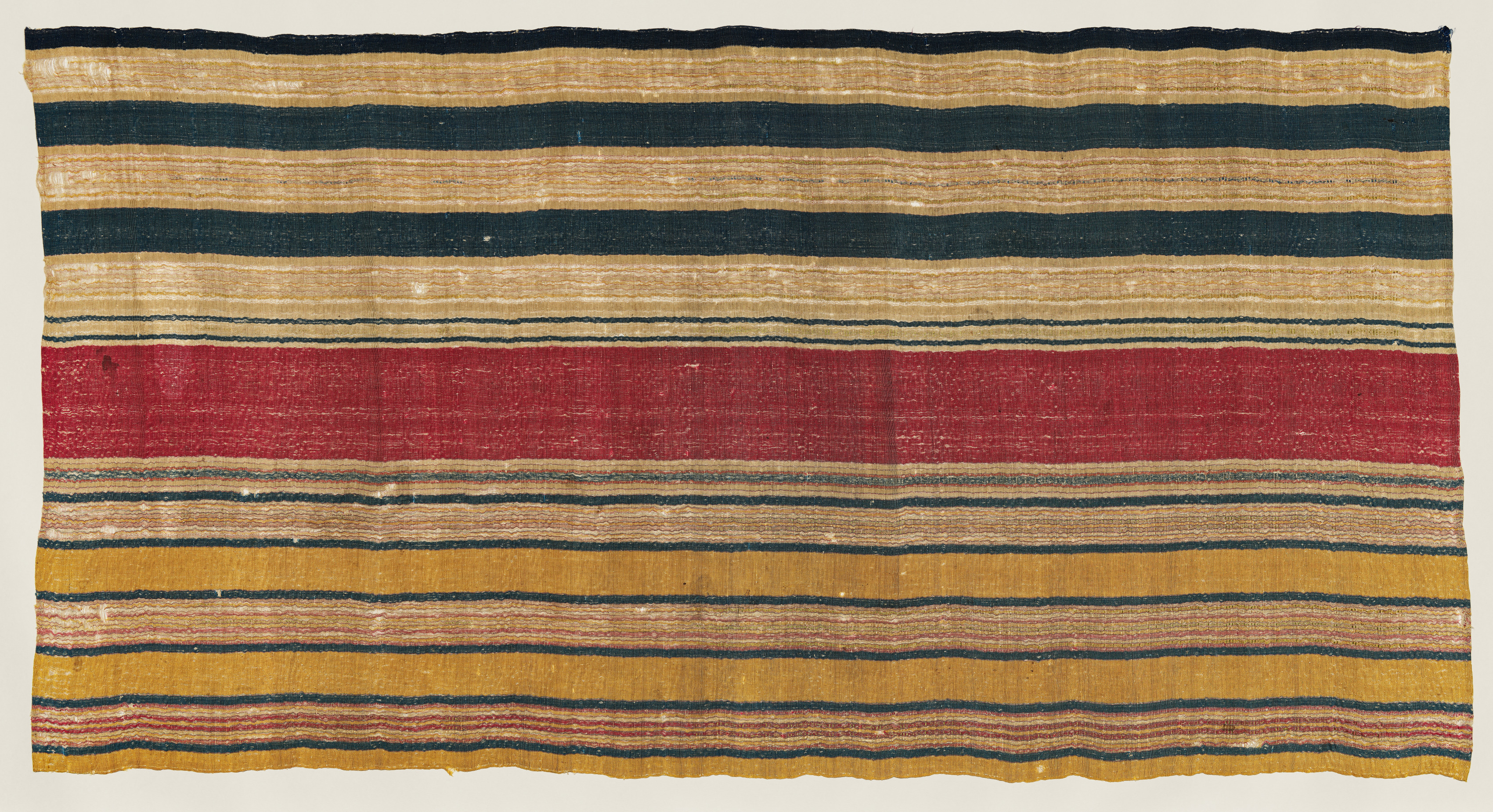
Deconstructing the Archive: The Avant-Garde Potential of Moroccan Furnishing Textiles
At Zoey Fashion Lab, our mission is to interrogate the material past to forge the aesthetic future. In this analysis, we turn our attention to a singular artifact: a Moroccan furnishing textile, woven from silk and imbued with the chromatic soul of North African dye traditions. This is not merely a relic of domestic craft; it is a repository of technical mastery and cultural dialogue. By applying our deconstructive lens, we uncover how this sixteenth-to-seventeenth-century textile—a silent witness to the "collision of cultures and the silent testimony of aesthetic fusion," as our Archive Resonance framework describes—can be reanimated as a radical, avant-garde design proposition for contemporary fashion.
Technical Provenance: The Silk and Dye Matrix
The foundation of this textile’s power lies in its materiality. Moroccan silk, often sourced from the famed tiraz workshops of Fez or Marrakech, represents a pinnacle of pre-industrial luxury. Unlike the mechanized threads of modernity, this silk carries the irregular, organic tension of hand-spun filaments. The warp and weft are not just structural; they are a record of the weaver’s rhythm, a kinetic signature. For Zoey Fashion Lab, this imperfection is not a flaw but a generative datum. We propose a digital mapping of these irregularities—a technique we call Warp-Error Capture—to algorithmically generate new, asymmetrical weave patterns that disrupt conventional garment construction.
The dye process is equally critical. Traditional Moroccan dyeing relied on natural chromophores: madder root for deep crimsons, indigo for celestial blues, saffron for solar yellows, and cochineal for purples. These were not stable, synthetic colors; they were living, reactive pigments that shifted with light, humidity, and age. The avant-garde potential lies in this chromatic volatility. We envision a collection where garments are treated with micro-encapsulated natural dyes that respond to the wearer’s body heat and environmental conditions, creating a dynamic, morphing surface—a living archive of interaction. This is not about replicating the past, but about weaponizing its instability as a design tool.
Archive Resonance: The Sixteenth-to-Seventeenth Century Context
Our Archive Resonance framework positions this textile within the crucible of global exchange. The sixteenth and seventeenth centuries were a period of intense cultural cross-pollination. Moroccan weavers were not isolated; they were nodes in a vast network. Silk threads from China and Persia, dye techniques from sub-Saharan Africa, and decorative motifs from Andalusia and the Ottoman Empire converged in the Maghreb. This textile is a palimpsest of influences: Islamic geometric rigor, Berber tribal symbolism, and European decorative flourishes, all woven into a single, coherent surface.
For the avant-garde designer, this hybridity is the ultimate provocation. We reject the notion of "purity" in craft. Instead, we embrace the friction of cultural synthesis. The Moroccan furnishing textile is not a static object; it is a record of negotiation, adaptation, and appropriation. Zoey Fashion Lab proposes to deconstruct this narrative by isolating specific motifs—the eight-pointed star, the hand of Fatima, the arabesque vine—and recontextualizing them through digital distortion and material displacement. Imagine a laser-cut leather bodice where the geometric star pattern is fractured and reassembled as a three-dimensional, sculptural exoskeleton. Or a silk organza gown where the arabesque is printed using conductive inks, turning the garment into a wearable circuit that lights up in response to touch.
Deconstructing the Furnishing Function
This textile was originally a furnishing—a wall hanging, a floor covering, or a ceremonial drape. Its function was to define space, to create a boundary between the interior and the exterior, the sacred and the profane. The avant-garde gesture is to subvert this function. By reimagining it as clothing, we transform the textile from a passive backdrop into an active, mobile architecture. The garment becomes a portable interior, a second skin that carries the weight of history and the promise of transformation.
We propose a series of garments that exploit this tension. Consider a cocoon coat constructed from multiple layers of the silk textile, each layer cut on a different bias to create a moiré effect that shifts with movement. The interior lining would be a digital print of the textile’s reverse side—the unseen, un-finished face—revealing the structural underpinnings that are normally hidden. This is a deconstructive reveal, a nod to the Japanese concept of wabi-sabi and the Western avant-garde tradition of exposing the seams. Alternatively, a modular cape could be assembled from fragments of the textile, held together by magnetic fasteners inspired by traditional Moroccan fibulae (brooches). The wearer could reconfigure the cape into a shawl, a skirt, or a wall hanging, blurring the line between garment and environment.
Avant-Garde Synthesis: A Proposed Collection
Drawing from this analysis, Zoey Fashion Lab proposes a capsule collection titled "Warp & Weft of the Maghreb." The collection will consist of five key pieces, each deconstructing a specific technical or symbolic element of the Moroccan furnishing textile.
1. The Chromatic Shift Gown: A floor-length gown made from silk treated with thermochromic natural dyes. The base color is a deep indigo, but as the wearer moves and generates heat, patterns of madder red and saffron yellow emerge, tracing the body’s kinetic energy. The dress is a living archive, responding to the present moment while referencing the past.
2. The Geometric Exoskeleton Jacket: A cropped jacket constructed from laser-cut leather and recycled metal, with the eight-pointed star motif digitally fractured and reassembled as a three-dimensional, wearable sculpture. The jacket is rigid on the outside but lined with the original silk textile, creating a tactile contrast between the industrial and the artisanal.
3. The Portable Interior Cape: A modular cape made from fragments of the silk textile, held together by magnetic fibulae. The cape can be reconfigured into a shawl, a skirt, or a wall hanging, challenging the boundary between fashion and interior design. Each fragment is sourced from a different Moroccan weaving tradition, creating a patchwork of regional identities.
4. The Conductive Arabesque Bodysuit: A second-skin bodysuit printed with the arabesque vine motif using conductive inks. The bodysuit is connected to a small battery pack that powers embedded LEDs, which illuminate the pattern in response to the wearer’s heartbeat. The garment becomes a biometric archive, recording and displaying the wearer’s physiological state.
5. The Unseen Reverse Trench: A trench coat constructed from multiple layers of the silk textile, with the interior lining printed with the textile’s reverse side. The coat is cut on the bias to create a moiré effect, and the seams are left exposed and reinforced with hand-stitched silk thread. The garment is a deconstructive manifesto, revealing the hidden labor and structure that underpins the finished surface.
Conclusion: The Textile as Provocation
The Moroccan furnishing textile is not a dead artifact; it is a living archive of technical mastery, cultural hybridity, and aesthetic dialogue. At Zoey Fashion Lab, we do not seek to preserve it in a museum case. Instead, we deconstruct it, fragment it, and reanimate it through avant-garde design. By embracing its material volatility, its cultural friction, and its functional subversion, we transform a piece of domestic history into a radical statement for the future of fashion. The warp and weft of the Maghreb become the threads of a new narrative—one that challenges the boundaries of garment, space, and identity. This is not nostalgia; this is resonance.