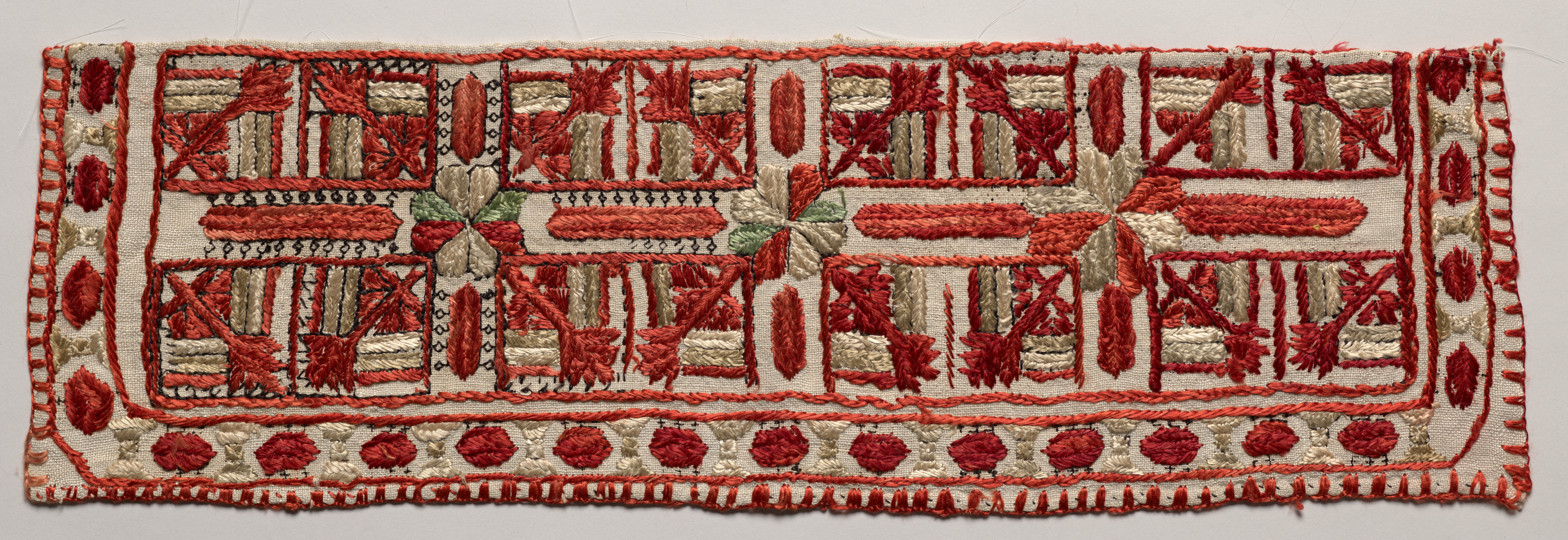
Archival Resonance: Deconstructing the Tambov Panel
At Zoey Fashion Lab, our mission is to excavate the latent narratives within historical textiles, transforming them into avant-garde design languages. The subject of this analysis—a panel originating from the Tambov province of Russia—presents a compelling case study in material dialectics. Comprising linen in a plain weave, silk, and intricate embroidery, this artifact is not merely a decorative fragment but a dense text of cultural memory, labor, and tactile intelligence. Under the lens of our Archive Resonance methodology, we deconstruct its technical composition to reveal a blueprint for radical, future-facing fashion.
1. Material Provenance: The Tambov Tension
The Tambov province, historically a region of agrarian intensity and folk artistry, provides the panel’s foundational context. Linen, derived from flax, was a ubiquitous material in Russian peasant life—valued for its durability, breathability, and the stark, unbleached neutrality that served as a canvas for symbolic expression. The plain weave structure here is deceptively simple. It is not a luxury textile but a utilitarian ground, a field of resistance against which the decorative elements assert themselves. This tension between the humble, functional base and the opulent, labor-intensive embellishment is the panel’s primary avant-garde gesture. It challenges the hierarchical division between ‘craft’ and ‘art,’ between the everyday and the ceremonial.
The introduction of silk into this linen matrix is a moment of deliberate transgression. Silk, a non-native luxury fiber in 18th-19th century rural Russia, suggests trade, wealth, or perhaps a wedding dowry’s prized possession. Its smooth, reflective surface creates a stark optical and tactile contrast with the matte, irregular linen. This is not a harmonious blend but a deliberate friction—a material dialogue that speaks to social stratification, cultural exchange, and the personal aspiration embedded within domestic objects. For Zoey Fashion Lab, this friction is a design principle: the avant-garde emerges not from seamless integration, but from the provocative juxtaposition of contradictory elements.
2. Technical Deconstruction: Weave, Stitch, and Surface
The Plain Weave Foundation: The linen’s plain weave—the simplest interlacing of warp and weft—establishes a rhythmic, grid-like structure. This grid is not a limitation but a generative framework. It provides a stable, predictable surface upon which the embroidery can act as a disruptive, organic force. In deconstructive fashion, this grid can be referenced as a structural skeleton—a base garment or textile that is then intentionally fragmented, slashed, or overlaid with contrasting materials. The plain weave’s inherent honesty (its warp and weft are equally visible) aligns with an avant-garde ethos of transparency, revealing the construction process itself as an aesthetic element.
Silk as a Disruptive Agent: The silk component, likely used for the embroidery threads or as small applied patches, introduces a new set of physical properties: high tensile strength, lustrous sheen, and a fluid drape. When stitched into the rigid linen ground, the silk creates a tensile conflict. The embroidery puckers the linen slightly, distorting its planar surface. This distortion is not a flaw; it is a record of the hand’s intervention. In our lab, we would amplify this effect. Imagine a garment where silk threads are pulled taut across a linen base, creating intentional, three-dimensional pleats or blisters. The silk becomes an active, sculptural force, reshaping the passive linen substrate.
Embroidery as Narrative Cartography: The embroidery on the Tambov panel is not merely decorative. It is a cartography of belief. Traditional Tambov motifs often feature geometric patterns (diamonds, crosses, zigzags) derived from Slavic pagan symbolism, later overlaid with Christian iconography. Each stitch is a deliberate act of inscription. The thread count, the direction of the stitch, the density of the coverage—all encode meaning. For the avant-garde designer, this is a call to treat embroidery as a form of critical writing. We can use stitch to deconstruct language itself, to create illegible texts, or to map abstract data onto a garment’s surface. The panel teaches us that embroidery is not a soft, feminine craft but a powerful, declarative act of marking territory—on cloth, on the body, on history.
3. Archive Resonance: From Historical Fragment to Avant-Garde Blueprint
The Archive Resonance reference—"器物与绘画不仅是时代技艺的结晶,更是文化碰撞与美学交融的无声见证" (objects and paintings are not only the crystallization of the era’s techniques, but also the silent witnesses of cultural collision and aesthetic fusion)—is the conceptual core of our analysis. The Tambov panel is precisely such a silent witness. It embodies the collision between peasant vernacular and aristocratic luxury, between pagan ritual and Orthodox devotion, between the functional and the symbolic. To resonate with this archive is not to replicate it, but to extract its core tensions and re-express them in contemporary materials and forms.
This leads to several avant-garde design strategies:
- Structural Transparency: The plain weave’s grid can be translated into a garment’s underlying architecture—perhaps a sheer organza base with exposed seams, referencing the loom’s logic.
- Material Juxtaposition: The linen-silk conflict can be recreated using modern equivalents: raw, unbleached cotton canvas combined with high-tech, iridescent polymers or recycled metallic threads. The goal is to preserve the tactile shock of the original.
- Stitch as Deconstruction: Embroidery can be used to deliberately distort the garment’s silhouette. Instead of reinforcing seams, stitches can pull fabric into unexpected gathers, creating asymmetrical volumes that mimic the puckering effect of the historical panel.
- Narrative Fragmentation: The panel’s motifs can be deconstructed into abstract, non-representational forms. A traditional diamond pattern might be reduced to a single, oversized stitch that travels across the garment, unraveling as it goes—a metaphor for the erosion of tradition under modernity.
4. Conclusion: The Avant-Garde as Archaeological Practice
The Tambov panel is not a relic to be preserved in a glass case. It is a working document—a set of instructions for material rebellion. At Zoey Fashion Lab, we see in its linen ground a call for structural honesty, in its silk a demand for luxurious disruption, and in its embroidery a model for narrative inscription. The panel’s true avant-garde potential lies not in its beauty, but in its contradictions. By deconstructing these contradictions—the tension between base and embellishment, between rigid grid and organic stitch, between local tradition and foreign material—we can generate garments that are not merely fashionable, but critical, historical, and tactilely radical. The archive does not speak; it resonates. Our task is to amplify that resonance into the future of fashion.