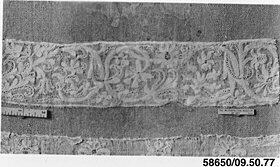
The Deconstruction of the Line: Strip as Architectural Imperative for SS26
The avant-garde gaze, ever restless, perpetually seeks to dismantle the familiar and reconstitute it into a lexicon of the new. For Zoey Fashion Laboratory’s SS26 collection, the subject of our definitive analysis is not a garment, but a fundamental unit of construction: the Strip. Originating from a global frontier of digital and artisanal cross-pollination, the Strip is no longer a mere remnant or a binding element. It is reimagined as a primary structural force, a narrative device of tension and release, executed through the ancient yet radically recontextualized technique of Drawnwork. This is not a study of minimalism; it is an exploration of maximalist precision, where absence defines presence and the void becomes a structural pillar.
The Drawnwork Matrix: From Negative Space to Positive Structure
Drawnwork, traditionally a form of embroidery where threads are removed to create openwork patterns, is here weaponized for a futuristic silhouette. In the SS26 context, the process is inverted: instead of removing threads from a woven ground, the Strip itself is the drawn thread, pulled taut across the body’s topography. The material—a hybrid of bio-engineered silk and recycled metallic microfilaments—is first treated with a thermosetting resin that allows it to hold a memory curve. The Strip is then not sewn, but drawn—pulled through precisely calibrated eyelets and tension nodes that are embedded into a sheer, second-skin base layer.
The result is a matrix of linear force. Each Strip becomes an active participant in the garment’s architecture, creating a dynamic interplay of compression and expansion. The negative space between the strips is not empty; it is a calculated void, a breath, a moment of potential energy. This technique allows for a silhouette that is simultaneously rigid and fluid, a paradox that defines the avant-garde spirit. The body is no longer draped or tailored; it is mapped by a network of drawn lines, each one a vector of intention.
Futuristic Silhouettes: The Exoskeleton of the Post-Human Form
The structural innovation of the Strip-Drawnwork hybrid manifests in three distinct silhouette archetypes for SS26, each a study in controlled chaos:
1. The Tension Cocoon: A jacket constructed from a single, continuous Strip that spirals from the left shoulder, across the back, and under the right arm, before returning to anchor at the nape. The drawnwork nodes are strategically placed to create a cocoon-like volume that is asymmetrical and weightless. The front remains open, revealing the bare skin beneath, while the back is a complex lattice of tension and release. The silhouette is not about covering; it is about defining a new contour—a second skeleton that moves with the wearer but is never fully attached.
2. The Radial Gown: A floor-length dress where the Strip originates from a single, central point at the solar plexus. From this epicenter, drawnwork channels radiate outward, pulling the fabric into a series of sharp, geometric folds. The strips themselves are of varying widths—from a millimeter-thin filament to a five-centimeter-wide ribbon—creating a gradient of opacity and transparency. The lower half of the gown is a cascade of these radial lines, creating a silhouette that is both architectural and ethereal, like a three-dimensional blueprint of a waterfall.
3. The Torsion Bodysuit: A second-skin garment that uses the Strip as a tool of bodily manipulation. Here, the drawnwork is applied to the torso in a spiral torsion pattern. The strips are pulled from the left hip, across the ribcage, and up to the right shoulder, creating a subtle, internal rotation. This is not visible to the eye, but is felt in the garment’s kinetic tension. The silhouette is deceptively simple—a sleek, monochromatic unitard—until the wearer moves, revealing the dynamic, twisting architecture beneath. It is a garment that exists in a state of perpetual torque.
The Global Frontier: Material as Message
The origin of this technique—the Global Frontier—is not a geographical location but a conceptual space where digital fabrication meets ancient handcraft. The strips are algorithmically designed to optimize tension distribution, then hand-stitched by artisans using a modified drawnwork needle. This synthesis of the binary and the manual imbues each piece with a unique fingerprint of imperfection. The metallic microfilaments, sourced from decommissioned satellite cables, catch light in unpredictable ways, creating a shimmer that is both organic and industrial.
The materiality of the Strip itself is a statement. It is neither fully fabric nor fully wire; it is a hybrid of textile and architecture. When the garment is not worn, it retains its shape, standing as a sculptural object. When worn, it yields to the body’s heat and movement, the drawnwork nodes releasing or tightening with each gesture. This responsiveness is the hallmark of the avant-garde: a garment that is not passive but interactive, a partner in the performance of identity.
Structural Innovation: The Reclamation of the Fragment
The Strip, in this analysis, is a fragment reclaimed from the waste of mass production. The drawnwork technique ensures that no material is wasted; every cut is deliberate, every void is a design choice. This is a radical departure from the couture tradition of draping and cutting from a whole cloth. Instead, the garment is assembled from its own absence. The structural integrity comes not from the fabric’s density but from the tension of the strips and the precision of the drawnwork nodes.
This innovation has profound implications for the future of silhouette. It allows for dynamic adjustability: a single garment can be reconfigured by the wearer, the strips loosened or tightened to change the volume and shape. The SS26 collection proposes a wardrobe that is not fixed but mutable, a system of modular lines that can be redrawn at will. The Strip, once a symbol of reduction, becomes a tool of infinite expansion.
Conclusion: The Line as Liberation
In the hands of Zoey Fashion Laboratory, the Strip is liberated from its utilitarian past. It is no longer a binding or a trimming; it is a primary language of structural innovation. The Drawnwork technique, reimagined for the post-digital age, allows the avant-garde to operate at the intersection of tension and grace, absence and presence. For SS26, the body is not dressed; it is inscribed with lines of force, each one a testament to the power of the fragment. The Strip, drawn from the global frontier, becomes the definitive architectural unit of a new, futuristic silhouette—one that is as much about the spaces between as the lines themselves.