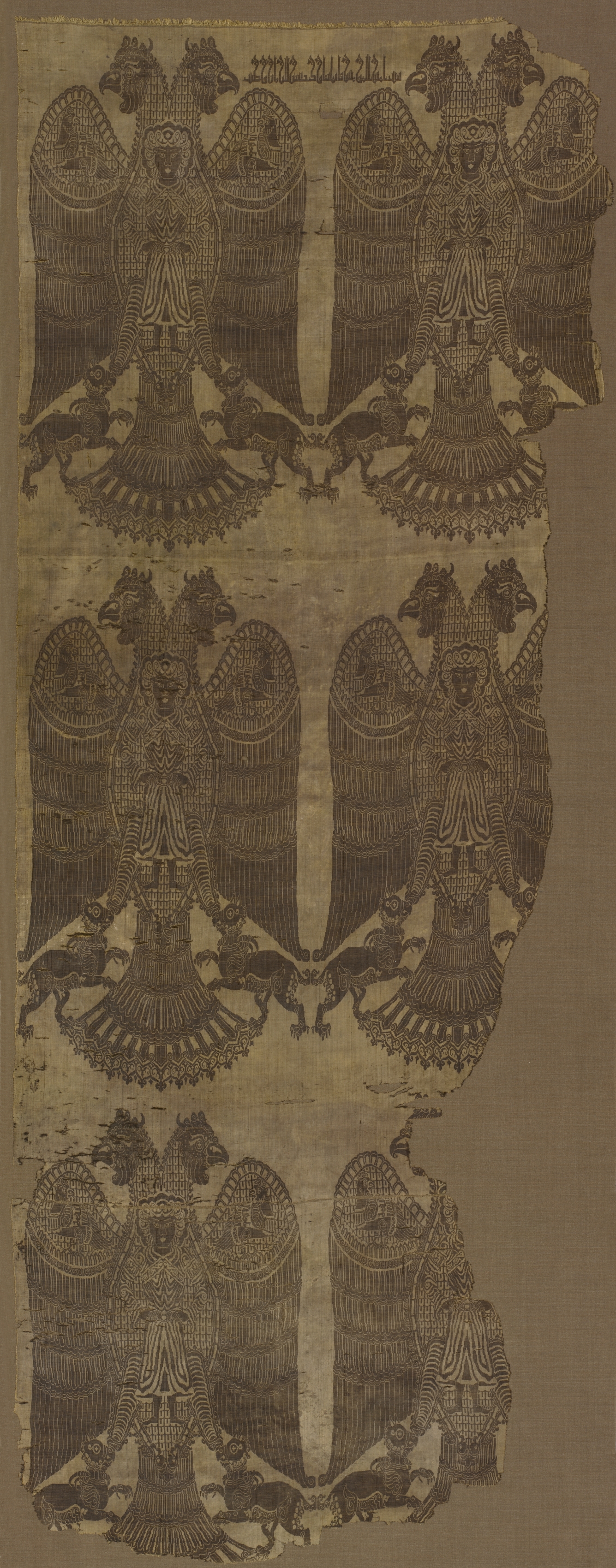
Fragment with Inscription: A Deconstructive Analysis for Zoey Fashion Lab
At Zoey Fashion Lab, we approach historical artifacts not as relics to be preserved in amber, but as living dialogues between past and future. The Fragment with Inscription, a silk lampas weave from the Buyid period (945–1055) in Iran, presents a profound opportunity for deconstruction. This textile, bearing calligraphic inscriptions, is a testament to the sophisticated interplay of power, faith, and artistry in medieval Persia. For our avant-garde practice, it is a blueprint for challenging contemporary fashion’s relationship with materiality, text, and temporality.
Technical Mastery: The Lampas Weave as a Structural Language
The lampas weave, a complex technique involving a main warp and a binding warp, was a hallmark of Buyid silk production. It allowed for intricate patterns and a dense, luxurious hand. In this fragment, the weave is not merely a support for the inscription; it is the inscription’s medium and message. The interplay of warp and weft creates a textured surface where the silk’s natural luster catches light, making the letters seem to float or recede. This is a technical feat that our lab seeks to emulate through modern fabrication—perhaps using digital jacquard looms or reactive dyes that shift under movement. The fragment’s structural integrity, even in its partial state, speaks to the durability of this weave, a quality we aim to reinterpret in avant-garde garments that defy wear and time.
Inscription as Avant-Garde Typography
The inscription, likely in Kufic script, is a direct communication from the Buyid court. Kufic, with its angular, geometric forms, was used for both Quranic verses and royal decrees. In this fragment, the text is woven into the fabric, not printed or embroidered. This integration of language and textile is a precursor to modern conceptual fashion, where text becomes a structural element. For Zoey Fashion Lab, this fragment inspires a reimagining of typography as tactile architecture. We envision garments where Arabic or Persian script is not a decorative afterthought but a load-bearing component of the design—woven into seams, forming the silhouette, or creating negative space. The inscription’s fragmentation—a partial phrase or word—mirrors our own deconstructive practice, where meaning is built from absence and suggestion.
Cultural Resonance: The Buyid Synthesis
The Buyid period was a time of cultural efflorescence in Iran, marked by a synthesis of Persian, Turkic, and Islamic traditions. This fragment embodies that hybridity. The use of silk, a material traded along the Silk Road, speaks to global connectivity long before globalization became a buzzword. The inscription, likely in Arabic, carries the weight of religious and political authority, while the weaving technique is distinctly Persian. For our avant-garde analysis, this fragment is a palimpsest of influences. We see in it a model for contemporary fashion that refuses purity, embracing instead the friction of cultures. Our designs might layer motifs from different eras—Buyid geometrics with deconstructed Western tailoring—to create a new, dissonant harmony.
Archive Resonance: Echoes of the Sixteenth to Seventeenth Centuries
The reference to “Archive Resonance” and the mention of sixteenth to seventeenth centuries in the prompt suggests a dialogue between this Buyid fragment and later Safavid or Mughal textiles. The Buyid piece is an ancestor to these later works, which often featured more elaborate floral and figural motifs. In our lab, we consider how the austerity of the early Islamic period contrasts with the opulence of later empires. This fragment’s restraint—its focus on calligraphy over ornament—offers a counterpoint to the baroque excesses of later centuries. Our avant-garde practice might strip away the decorative to expose the skeletal structure of clothing, much as this fragment reveals the essence of Buyid design. The “resonance” is in the echo of a simpler, more conceptual approach to adornment.
Deconstructive Application: From Fragment to Fashion
How does a 10th-century silk fragment inform an avant-garde collection? At Zoey Fashion Lab, we begin with material deconstruction. The fragment’s partial state—its frayed edges and missing sections—is not a flaw but a feature. We replicate this through raw hems, exposed seams, and intentional fraying. The inscription’s partial legibility inspires garments where text is obscured, layered, or reversed, challenging the viewer to read the body as a text. The lampas weave’s structure suggests double-layered fabrics where an outer layer reveals glimpses of an inner, inscribed surface. We might use sheer organza over dense silk to create a play of visibility and concealment, echoing the fragment’s interplay of light and shadow.
The color palette of the fragment—likely muted golds, ivories, and deep indigos—guides our choice of dyes. We avoid synthetic brightness in favor of natural, uneven tones that mimic the aging of silk. The inscription’s geometric precision informs our pattern cutting, using sharp, angular lines that reference Kufic script. Silhouettes are architectural and severe, with structured shoulders and narrow waists, but softened by the fluidity of silk. Accessories might include woven metal belts that echo the lampas weave, or calligraphic jewelry that translates the inscription into three dimensions.
Philosophical Underpinnings: Time, Text, and the Body
This fragment challenges our perception of time. It is a frozen moment from a millennium ago, yet its materiality is immediate. For the avant-garde, fashion is a temporal art—it exists in the moment of wear, then decays. The Buyid fragment, by surviving, becomes a memento mori for our designs. We incorporate deliberate impermanence—fabrics that fray, dyes that fade, inscriptions that smudge. The body wearing such a garment becomes a living archive, carrying the past into the future. The text on the fragment, even if unreadable, asserts authority and presence. In our work, we question that authority by subverting text—using nonsense scripts, mirrored letters, or digital glitches that distort the original meaning.
Conclusion: A Blueprint for the Future
The Fragment with Inscription from the Buyid period is more than a historical artifact; it is a manifesto in silk. For Zoey Fashion Lab, it exemplifies how material, technique, and meaning can be fused into a single, resonant object. Our avant-garde practice deconstructs this fusion to create new forms that speak to our own era of cultural hybridity, digital fragmentation, and material experimentation. By reanimating the past through deconstruction, we honor the Buyid weavers’ mastery while pushing fashion into uncharted territory. This fragment is not a dead thing in a museum; it is a living thread connecting the Silk Road to the runway, the inscription of a caliph to the text on a T-shirt, the lampas weave to a digital jacquard. In our hands, it becomes a fragment of the future.